The Success of Islam

6%

Review and Herald Publishing Association · Takoma Park Station, Washington, D. C. · Jul 20, 1916

FromReview and Herald, Vol. 93, No. 36.

Read the full edition

The Success of Islam

(Concluded)
F. H. LOASBY
FROM the multitude of voices already heard for improved conditions in India, we cannot but recognize the fact that something is earnestly expected, andmust be done. What does it all mean? It means the greatest step India has ever taken. It cannot mean less than the dawning of a new era for a great nation.
But what is it that concerns the missionary most? Surely the thought that all India may be given free and efficient education, is laden with marvelous possibilities. This will mean that the work of the missionary will be aided in a manner equal to that assistance which the invention of printing gave to the rapid dissemination of the Word of God. It means that every Indian will know more by far of the world, its people, and their movements than he knows now in a land where news travels quickly from mouth to mouth.
But perhaps it will mean more. It may mean the reawakening of old religions; the injecting of new fire into Hinduism and Mohammedanism as they become alarmed at the successes of Christianity. And while in one sense the task may be made easier, in another sense its difficulties may be increased. Obviously, now is the time to work. The close of the war must bring new opportunities and added responsibilities. India demands political rights; she must have the gospel privileges also. The former are not in the hands of the missionary to give; the latter it is our duty to give,—a duty enforced by the command of Christ.
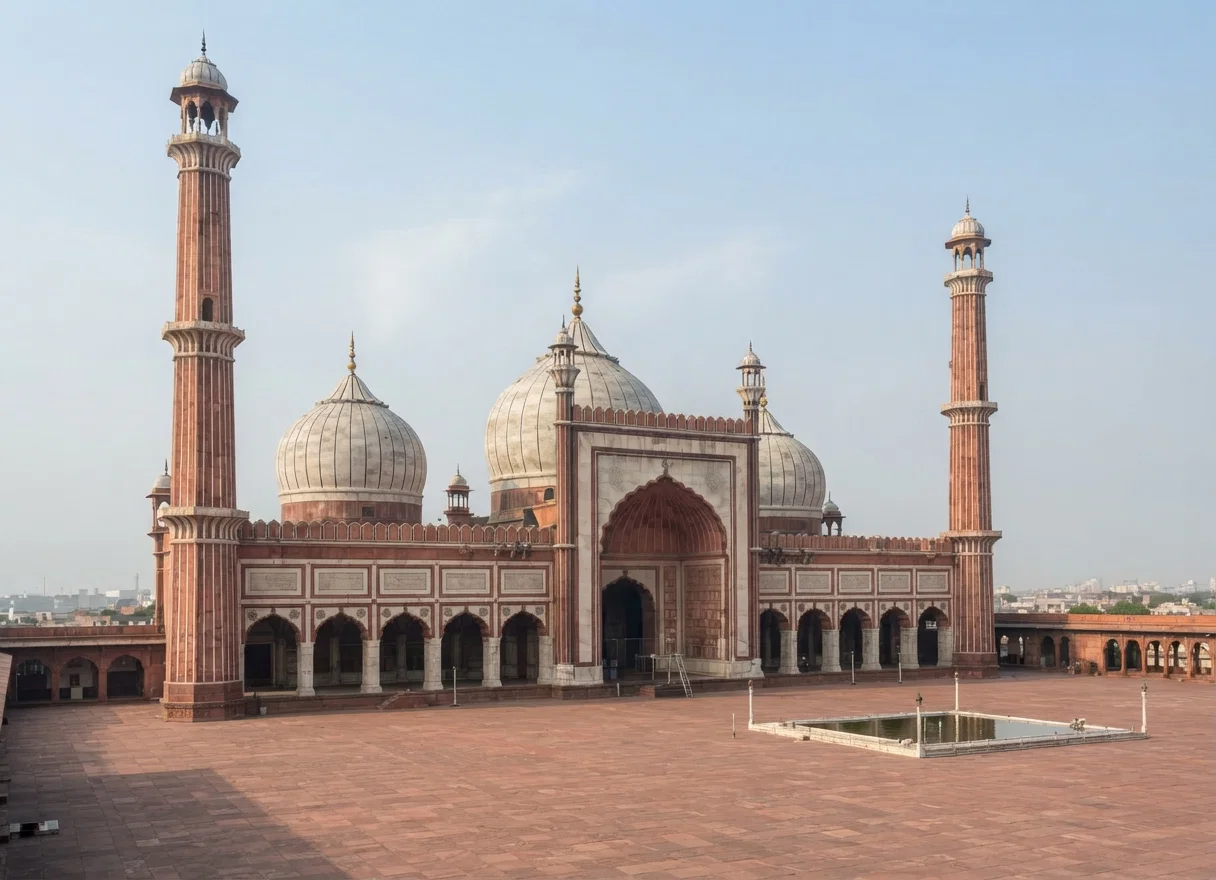
THE GREAT MOSQUE AT DELHI, INDIA
After the war, thousands of Indian soldiers will return to their homes in India. Many months of residence in the West, in contact with Western thought and religion, will make a difference to them in their attitude toward that thought and religion.
In passing, of course, we are bound to ask ourselves what will be the Indian's idea of a stricken and exhausted “Christian” Europe, mutilated and torn by her own “Christian” hands, so-called. Yet, in spite of this, cherished ideas and old prejudices will to some extent be swept away, leaving the minds of these people open to the reception of truth. The question is, How will they receive that truth, and at whose hand? It ought to be at the hand of the Christian missionary.
But here the thought introduces itself, Is it to be another contest between Christianity and Mohammedanism? The Crescent has supplanted the Cross in many places; is it to do so in India when the time of India's awakening comes? It is not for us to prophesy regarding this matter, but inasmuch as Turkey is losing the place which she once held in the minds of the Moslem masses, who is to say by what means that place will be filled? One can merely suggest that India is the greatest Mohammedan country, and boasts great Mohammedan leaders.
Hence it is obvious that before the Christian missionary are two duties: (1) To supply that desire for truth which must soon manifest itself, by giving the people Christianity, lest they accept Mohammedanism; (2) to win the Mohammedian himself to Christ. And in regard to this latter duty, perhaps missionary endeavor presents no more difficult task. But there is, and will be, fruit from among the Mohammedans.
A great and strong foundation has been laid for mission work among Mohammedans. The names of such men as Raymond Lull, Henry Martyn, Karl Pfander, Valpy French, Ion Keith Falconer, Peter Zwemer, and many living today, challenge us to accomplish even more than they accomplished; for our opportunities are greater, and the Spirit of Jesus is still ours. Here in India, where modern Mohammedan missions were born, there is much fruit to be seen. This is especially true of northern India, where accessions from Islam have been continuous during all the years since the death of Henry Martyn. Here and there converts from Mohammedanism have been added, until now, looking over the rolls of Christian membership, one is surprised to find so many converts from Islam. In the north, especially in the Punjab and the Northwest Frontier that Province, every congregation has a representation from the Moslem ranks. In some churches the majority of the members were gathered from among Moslems.
Men like Valpy French, who became the first missionary Bishop of Lahore, the center of the most important diocese in India then, died, worn out with labor in Moslem lands, at the age of sixty-six,—brilliant university men, “eating up Oriental languages like bread,” have opened up the way by initiating the great scheme of theological colleges for Mohammedans and others, such as the one in Lahore today. Books by these great men, such as “Mizan-ul-hagg,” “The Scales of Truth,” “Asmar-i-sherin,” and “First Sweet Fruits,” have accomplished much.
Before us as a people lies a splendid opportunity, upon us rests a grave responsibility. Men who come to India should be linguists. They should by the blessing of God be able to eat up “Oriental languages like bread.” No one else in India knows as much about India or its people as the missionary; no one else approaches so close to the people as the missionary—absolutely none. He enters into their life, their homes. He sits with them, eats with them, sorrows and rejoices with them. The missionary is practically the only man in India who takes nothing out of India, and puts his “everything” into it. We do not wish to derogate from the respective merits of others who come to India, yet they “take out” without putting anything in that has eternal value. But what of the missionary who does not get a thorough grasp of the language of the people, who does not grasp those idioms which let light into the very lives and thoughts of the people? He, like the trader or the officeholder, walks in another sphere, in which the Indian usually does not walk or think.
Just a word in closing. One has said, “Islam goes with every Moslem.” Yes, Islam goes with every Moslem. Hence the success of Islam. Every time I see a Mohammedan devoutly saying his prayers, whether in a crowded, stuffy third-class railway carriage or in the midst of a howling, yelling bazaar, I say, “God help me to know my duty.” Would to God Christianity went with every Christian!
Lahore.