Medical Missionary Department

3%

Review and Herald Publishing Association · Takoma Park Station, Washington, D. C. · Jul 20, 1916

FromReview and Herald, Vol. 93, No. 36.

Read the full edition

Medical Missionary Department

W. A. RUBLE, M. D. — General Secretary
L. A. HANSEN — Assistant Secretary
H. W. MILLER, M. D. — N. Am. Div. Secretary

Abbreviated Report of the Medical Department of the North American Division Conference
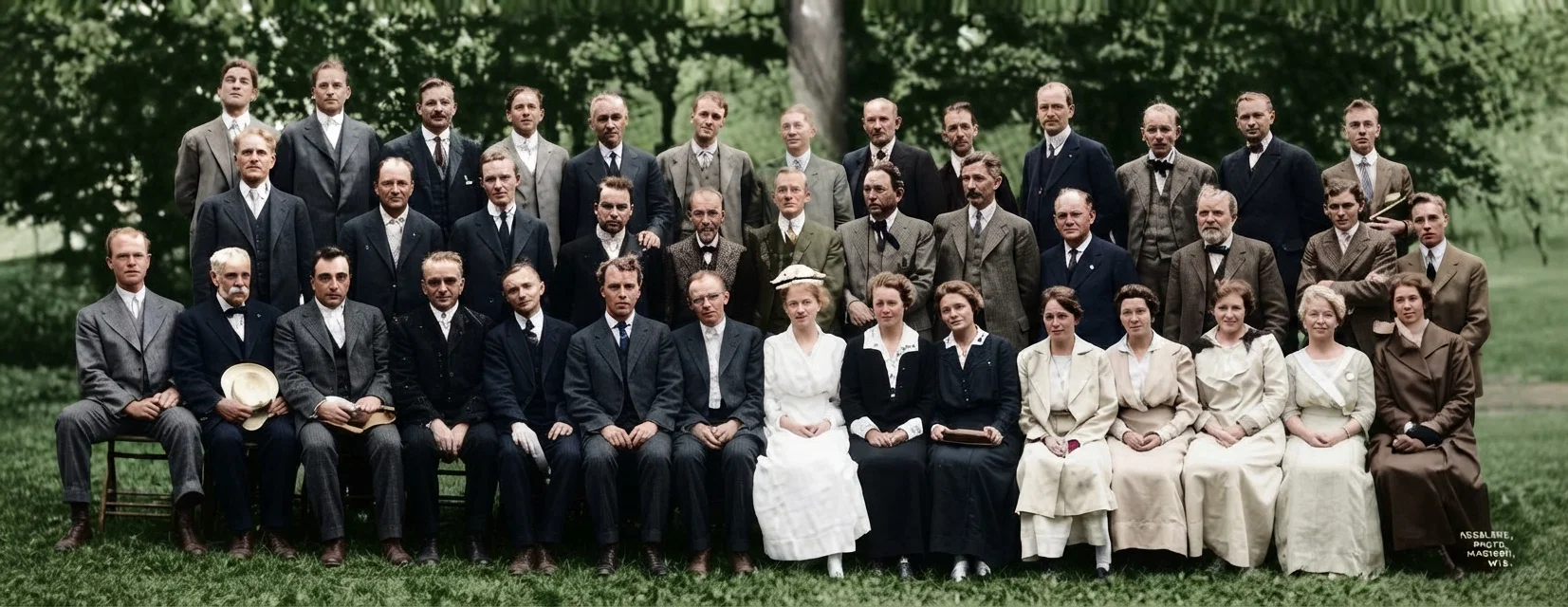
Read at the Medical Convention Held at Madison, Wis., June 5-10
It is with a great deal of pleasure that I submit a report of a work that has shown such growth and vigor during the past two years, especially when we recall the days of severe trial that characterized the beginning of our various sanitarium enterprises. Those days of oppression and depression are of so recent occurrence that I need not refresh your memories, but simply confine my remarks to conditions as we find them today, and touch upon the opportunities and possibilities that open before us.
MEDICAL COUNCIL AT MADISON, WIS.
When it is recalled that the object of our sanitarium work is chiefly twofold,—to care for the invalid sick, and to train an army of workers to minister in behalf of suffering humanity,—we today, as never before, realize that we are facing the closing work of this message. These words come to us now with special emphasis: “I wish to tell you that soon there will be no work done in ministerial lines but medical missionary work.” This evidently means that the closing work of this message will be done by and through a class of workers of whom you are the representatives here tonight.
Therefore as we approach the end, we should see a great revival in medical missionary work in this denomination; and by you, my brethren and sisters, at this convention, should be perfected the best-organized movement ever yet set on foot for doing a mighty world-wide medical missionary work, a work that will reach the souls of men and women, for, after all, soul-saving is the great object of this message to a perishing world. I must therefore believe that the great God who called this medical missionary work into existence, had as its object an effective means to reach the hearts and souls of sinful men, and it is represented as being the final resource in accomplishing this work.
In view of the importance of medical missionary effort at such a critical hour in the world's history, it need not seem strange that those most busy with the management of our sanitariums have been called together for such a convention as this, and great are the problems to which we must address ourselves with earnest and prayerful diligence during the few days of this meeting.
While there are many details to work out, much in method and system to study, may we never forget the great issue before us in all such considerations,—that we are planning for an effective way of honoring and glorifying God's name in the earth, and for the salvation of souls, and for a work which will be God's last effort to rescue stubborn and rebellious men; and let us not forget in our planning to apply those principles of denominational organization which have marked our progress in past years in its evangelistic efforts, since we learn that the continuance of these efforts is to be through medical missionary endeavor.
Surely nothing less in painstaking effort and self-sacrificing endeavor will be required of those who join in the closing
of this triumphant message, than characterized the pioneers of this blessed cause; and we may feel confident that such unselfish consecration to this work will be rewarded by a manifold increase as the result of the momentum gained by this movement through the intervening years.
Times have changed. Years ago men gained fortunes and a reputation by the slow accretion of generation after generation. Today there are possibilities of amassing tremendous fortunes in less than a decade. Think you that the great God cannot through his human agents give an equal and still greater demonstration in rapidity of growth in the building of a great superstructure upon the foundation already in preparation?
We must begin to show a strength in the medical work commensurate to our opportunities. Even yet we have no competitor in our chosen field. True, there are great hospitals in our land, and learned physicians and surgeons. True, there are great and heavily endowed institutes of medical research. Also, there are learned men whose skill we admire, at whose feet we ourselves have been studying technical science; but with us as a people still lies the creation of the greatest reform movement
yet seen, one that will attract men and women of all walks in life, that will hold them true to principle, and make of them faithful and correct representatives of Christ.
The world is giving us the facilities with which to do our work. We have recognized the great benefit of the printing press, the railway, the mail system, etc., at our disposal as auxiliaries in doing our God-appointed work; also the work of historians and anthropologists in furnishing us much valuable data. So may we not lay hold upon the researches of science and better acquaint ourselves with natural law through the studies of some of the noted men of today? The work of these men furnishes us with greater facilities than those possessed by any other people, and should lengthen our arms to do a greater work for God in a shorter time than ever before. It is ours to labor and work, under the encouragement of the Spirit, to save the sick. “Whosoever drinketh of the water that I shall give him shall never thirst; but the water that I shall give him shall be in him a well of water springing up into everlasting life.” How abundantly God has promised to increase our power
as we engage in a work of reform that is to prepare a people for translation!
We are now annually graduating more than two hundred trained nurses from our fifteen training schools. We believe that we owe a greater obligation to those whom we shall graduate in the future than we owed to those trained in the past. We have secured a good representation at this convention of those to whom we look most of all to train nurses,—the superintendents of our training schools,—and we trust they will put before us, with full emphasis, their needs in order to properly qualify nurses for work in connection with this message.
We believe that to perfect this work further and carry it out successfully, we should have a general secretary who shall devote her full time to the training of nurses, working with the various superintendents of nurses. This secretary should be one of our most experienced superintendents of training schools.
We ask, What has accounted for the prosperity that has come to our medical work in the recent past? It would seem but natural that every institution should at first require time to gain a patronage, but certainly some institutions have been better equipped, and have shown more careful, skilful, and painstakingeffort in diagnosis and treatment, than others. Satisfied patients and reformed patients are still our best advertisement. In certain instances the installation of the X ray has very noticeably established confidence and improved the patronage of an institution. Other improvements have had their part.
After two of our small sanitariums which were the poorest financially at the time, made the trial of an X ray and other new apparatus, others became interested, and today our institutions for the most part are doing good work in diagnosis, and are increasing their earning capacity. One sanitarium which recently installed an X-ray machine reports $100 receipts a week from that investment. Our amateur X-ray men are diagnosing surgical conditions, and their work is being highly commended.
We have agitated for greater care in the preservation of records, in history taking, and in laboratory work; for better service, and for greater uniformity in methods. We tried to get a uniform history blank adopted, and while we did not get a uniform blank, we succeeded in creating considerable interest in the proper recording of histories. We got out a uniform menu, and while not every sanitarium adopted and used the department menu, we had sanitarium menus sent us of much neater appearance than we had before seen.
Certainly great importance should be given to thorough and conscientious work, and we believe the secret of success lies largely in the whole-hearted devotion of the physician to the work in hand. The energy and intense zeal of professional men who are striving toward their goal of fame and wealth, should certainly be even more conspicuous in such a work as ours. It is reported of a prominent surgeon, that when he was informed of the hour of the marriage of his daughter, he looked at his clinic schedule, and to his good fortune it permitted of his attending, but he had to excuse himself from the banquet following, because of the importance of keeping his regular clinic hours at the hospital. Such love of one's work and devotion to it will, if applied to the interest of our sanitariums by their management, mean nothing but progress and an ever-increasing patronage.
I wish to bring before you the important question of giving careful study to the reorganization of our institutional work. To work out the details of our sanitarium organization, we must have well in mind what we are endeavoring to accomplish. There are certain things that cannot be sacrificed, others should be eliminated, and many things ought to be changed.
We find that the pattern on which our institutions for the most part were based, was a large institution with several hundred patients, several heads of departments, a system of hydrotherapy and massage as the chief lines of treatment, and the individual rooming of patients; and this extensive system we have endeavored to follow in our numerous small institutions. With from only a tenth to a twenty-fifth of that number of patients, we are trying to keep up the same departments.
Should we not introduce some occupation for our patients, as therapy lectures, entertainments, gymnastics, auto tours, carefully prescribed? Should we not provide wards, thus increasing our capacity for patients and decreasing the help required for them? Let us study what measures give results, and eliminate useless measures of treatment.

Educational Features

“The health reform movement is to fit and prepare a people for translation.” “To make natural law plain and urge its obedience is a work that accompanies the third angel's message.”
This calls for an educational program for the people. The people today are more awake to the importance and good derived from sanitariums than ever before, and many are hungering for knowledge of how to keep well. The opportunities of access to the people through literature and public lectures were never greater. We must measure up to our opportunities. The people want instruction, and they need it. Some very definite recommendations that can be put into effect must come from this convention in order that we may reach our people first, and through them the world.
We have no literature for circulation, save a monthly health magazine, the circulation of which should be greatly extended.
I am confident that a great opportunity is before us, and if we will but move forward, a great work awaits us; a still greater movement will yet be set on foot, and rich blessings and eternal reward await those who shall engage in it.
H. W. MILLER, M. D., Sec.