Some Steps Toward Its Accomplishment

5%

Review and Herald Publishing Association · Takoma Park Station, Washington, D. C. · Aug 24, 1916

FromReview and Herald, Vol. 93, No. 42.

Read the full edition

Some Steps Toward Its Accomplishment

The Atonement — No. 9

Some Steps Toward Its Accomplishment
J. O. CORLISS
The study of the atonement as carried on in the earthly sanctuary, has revealed that it had to do only with the blotting out of sins previously repented of and carried by personal sacrifice into the first apartment of the sanctuary. The service thus performed was therefore called the cleansing of the sanctuary. Lev. 16:19. This cleansing of the sanctuary from the sins carried into it was necessary in order that the design for which the tabernacle was erected might be realized, namely, that God might dwell among his people (Ex. 25:8); for he could not consistently dwell among them while they cherished sin.
The day of atonement was therefore virtually a day of judgment; for if, when the yearly cleansing from sin took place, any one of the people had wilfully chosen not to have his sins carried into the sanctuary beforehand through a sin offering, he must bear his own sin. Then since all sin was removed from the camp on that day, if any retained his sins, he must of course be expelled from among the people of Israel.
This work in the earthly sanctuary was a type of the work in the heavenly sanctuary, where Christ is the High Priest. Every sinner has opportunity to confess his sins, thus putting them on the Victim of the cross, through whose body they are borne to the heavenly sanctuary (1 Peter 2:24), there to be atoned for. But if any one does not choose to avail himself of this gracious privilege, he must bear his own sin, and suffer the consequence of it.
This service in the most holy place can be nothing less than the closing work for a sinful race. It is really an investigation of men's life records preparatory to awarding each his just due. This could not be done until all the good and evil resulting from each individual's life had been measured. A moment's thought will make it clear that full awards could not have been meted out at death to Voltaire, Paine, and others of their class, for the reason that their influence for wrong did not die with them. The same is true of such good men as Whitefield, the Wesleys, and the various missionaries who have spent their lives in an attempt to rescue men from the toils of sin. These men, like Abel, still speak, and not until the last generation closes, can their influence for good or evil be fully told.
The life record of every member of the human race must pass in review before the heavenly tribunal. But when? Will the time be announced suddenly, without due warning from the seat of authority? The assurance has been given that 'the Lord God will do nothing, but he revealeth his secret unto his servants the prophets.' Amos 3:7. Again, it was said in the apostolic days that the Lord had even then appointed the day in which he would judge the world in righteousness by the Lord Jesus. Acts 17:31. It must be, therefore, that some sign has been given by which men may know when that solemn period is at hand.
This very point was under discussion at one time by two heavenly beings, and this was what they said in the presence of a time-honored prophet: 'I heard one saint speaking, and another saint said unto that certain saint which spake, How long shall be the vision concerning the daily sacrifice, and the transgression of desolation, to give both the sanctuary and the host to be trodden underfoot? And he said unto me, Unto two thousand and three hundred days; then shall the sanctuary be cleansed.' Dan. 8:13, 14.
This cleansing could not possibly be applied to the earthly sanctuary; for that cleansing took place each year, while, taken literally, the period announced by the angel would cover more than six years. Again, the days mentioned could not have referred to literal time, since that would have brought the fulfilment of this prophecy within the days of Daniel's people. Besides, these days must be regarded as symbolic, for the prophet was distinctly informed that the vision would be fulfilled in 'the time of the end' (verse 17), and therefore not in the then near future.
The angel Gabriel was told to make the prophet fully understand the matter. We may well believe he did this; otherwise he would have been unfaithful to the trust committed to him. The prophet was obliged to wait for a time, and he 'set his face unto the Lord, to seek by prayer and supplication' the meaning of the strange revelation that had been given him.
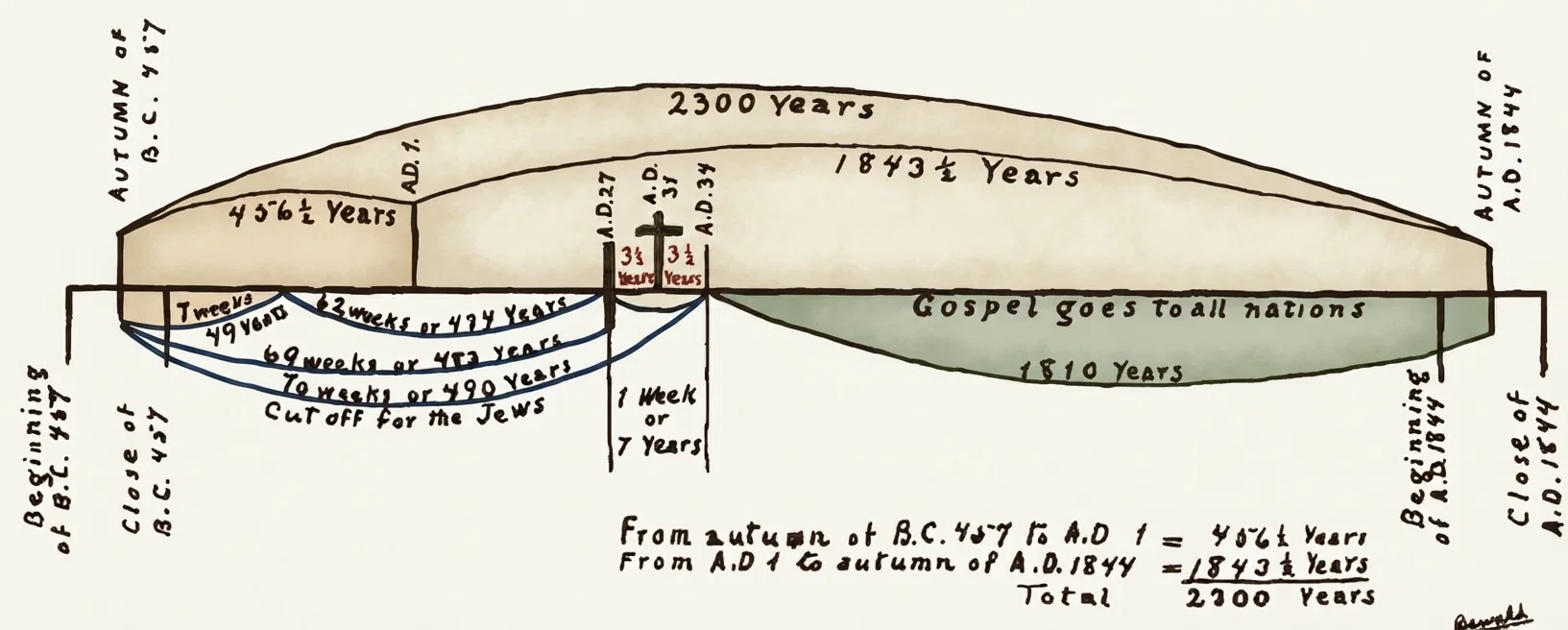
As the time for the ending of the Babylonian captivity drew near, the prophet began earnestly to pray for God to shine once more, as in days of old, on deserted and desolate Jerusalem. Dan. 9:3-19. During this supplication the angel Gabriel again addressed Daniel, saying that he had now come to give him the understanding he sought concerning the point of time in the vision. Verse 22. Thus he began: 'Seventy weeks are determined ['cut off,' as set forth in Gesenius's Hebrew lexicon] upon thy people and upon thy holy city.' Dan. 9:24. Seventy weeks, or 490 days, of the 2300 as set forth in the vision, were thus declared to apply to the career of the house of Israel. These days were to close the special privileges of Israel as the people of God, and their place and work were to be taken by others. Isa. 65:1-10.
Sixty-nine of these seventy weeks, or 483 days, were to extend to the appearing of the long-looked-for Messiah, and this time was to be reckoned from the date of the commandment to restore and build Jerusalem, following the seventy years of captivity. Dan. 9:25. The word 'Messiah' translated into English is rendered 'anointed.' (See margin of John 1:41.) Christ was anointed to his work by the Holy Spirit at his baptism. Compare Acts 10:37, 38, with Luke 3:21, 22. The chronological date in the margin opposite the last text, in Bibles with dates opposite verses, gives the date of this anointing as A. D. 27.
Looking back for the beginning of the 483 years to the time of the commandment to restore and build Jerusalem, we subtract the 27 years from the 483 years, and the result is 456 full years. But turning to the book of Ezra (chap. 7:6, 8), we find that Ezra actually arrived at Jerusalem in fulfilment of the command given him, as late as the fifth month of the year 457 B. C. From that time to the close of the last day of the year A. D. 26 would be 26½ full years after Christ, so that the time between these dates would actually amount to but 482½ years. But if the date of Christ's baptism be set forward to the autumn of A. D. 27, to correspond to the autumn of 457 B. C., as it actually did occur, then we have the complete 483 years fulfilled according to the prophetic announcement. This result is the working proof thatsymbolic days of Scripture refer to the same number of years as stated in the term of days used. A direct reference to this rule is found in Eze. 4:1-6, where the Lord said to the prophet, 'I have appointed thee each day for a year.'
Evidence of the correctness of the rule as applied in this case, and of the conclusion reached, is found in the fact that immediately following his baptism, the Saviour went forth and proclaimed, 'The time is fulfilled.' Mark 1:15. This could refer to no other definite time prophecy than that of the 2300 days, since the prediction pointing to the time of the anointing of the Messiah is found in no other prophecy than the one under consideration.
But there is yet the one remaining week of the 490 days to be considered. This was applied in the prophecy to the confirmation of the new covenant by the Messiah, and those associated with him in his earthly work. Dan. 9:27. Christ preached three and one-half years after his anointing, dying in the midst of the seventieth week, when the offerings of sacrifice and the oblations were to cease. This was attested to by the rending of the temple veil at the death cry of the divine Sacrifice. Matt. 27:50, 51.
Following the Saviour's death, his disciples preached to the Jews for another three and one-half years, or until the Jewish Sanhedrin, by open persecution of his followers, formally rejected the Saviour. Then God gave the commission to go to the Gentiles. Rom. 1:16; Acts 13:46. This would be in the autumn of A. D. 34.
And so ended the seventy weeks, or 490 days, cut off from the 2300 days to be devoted to the Jewish people. The remaining 1810 prophetic days, or years, added to the year A. D. 34, would reach to the year 1844 A. D. The significance of this date will be treated of in the next study.
Glendale, Cal.