Child: the Man of Sorrows

2%

Pacific Press Publishing Association · Mountain View, California · Aug 30, 1910

FromSigns of the Times, Vol. 37, No. 34.

Read the full edition

Child: the Man of Sorrows

By Mrs. L. D. Avery-Shuttle

Chapter XXVI.—Simon the Leper

LEPROSY—the very word turns the heart sick. It sounds the death knell of joy and hope forever, to him above whose luckless and despairing head it is pronounced. Leprosy; named the “scourge of God.”
The horrible disease is no respecter of persons. It knows no class distinction. It gives no consolations, and none are allowed it. It offers no comfort; it makes no promises; it gives no reprieve. Its awful breath breeds pestilence and decay. Its repulsive lip never seeks nor receives the kiss of love. Its bloated and ghastly form invites not the caress of affection. Its deformed and loathsome fingers are never grasped by the hand of hope.
Furthermore, it receives no bribe; nor may its gruesome approach be stayed by the gold of a Croesus or the gems of Golconda. When once its horrible finger is pointed at its victim, and its gurgling voice says “Come!” it admits of no parley.
It is a living death, and its victim an unburied corpse.
And this gruesome thing has dared approach the pretentious and luxurious home of Simon of Bethany. His life has been one of idleness and dissipation, with no thought or care but for the present, and with no ambition higher than that which promises present enjoyment. Liberal of purse, reckless in manner, fascinating in appearance, unscrupulous and thoroly selfish, Simon of Bethany had never allowed himself to be thwarted in any desire, or to be checked by any spasm of virtue. With him, to will, to desire, was to do, to possess.
He had received the first news of the continued insanity of Magdalene, whom he had so lightly ruined and cast aside like a broken toy, with a careless smile and a curl of the sensual lip. But already the mortal body of Simon of Bethany contained the germs of that awful thing which heeds not prayers or tears, and refuses to relax its horrid grip until it yields its prey to the rapacious maw of its twin brother, Death.
One morning, the young wife Prisca, bride of a few days only, noticed a slight but very peculiar roughness of the skin upon the broad, white brow of her young spouse.
Carelessly, lightly, with no thought of trouble, she called him to her side, and placed her small hand caressingly upon his cheek.
“What aileth thee, Simon? What hast thou upon thy brow? Of a truth I noticed this thing yesterday and the day before.”
“Surely there is naught upon my brow, my Prisca, save thy white hand,” replied the man, with a careless laugh—tho he raised his own hand to his forehead quickly, and the uneasy, shifting light in his eyes told plainer than words could do, that the faint shadow of a terrible fear was entering his heart.
But he must not allow the woman to notice the uneasiness which her words had caused him, and accordingly, with some light remark, he left her presence.
Truth to tell, he had himself noticed a small, white swelling a number of days before; but he had put the horrible thought, that would intrude itself, out of his mind. But now that Prisca had spoken, he determined to examine the lichen himself more carefully. To his horror he found that the scaly white eruption was perceptibly larger than when he had at first noticed it.
But impossible! He would think no more about it. He would treat it as a wild delusion unworthy a second thought. What! he, the care-free, the self-satisfied, the careless man of the world!
To any other man, such horrible visitation might come,—but not to him. He would not, could not abide the thought. The thing was a mere blotch—a scab—that would disappear entirely in a day or so. He would not think of it ever any more. Certainly he would never mention it to Prisca, unless she, indeed, should speak of it again,—which Heaven grant she might never do.
Thus did the uneasy and wretched man seek to hide from his trembling heart its own wild beatings.
One morning shortly thereafter, Simon walked the streets of Bethany. But he sought to avoid his fellow men. He was unnerved and preoccupied. Perhaps it would be better to rub a mollifying ointment upon the eruption, and cover the place with a cloth,—no, no! Why should he call attention to the thing that was robbing his soul of rest!
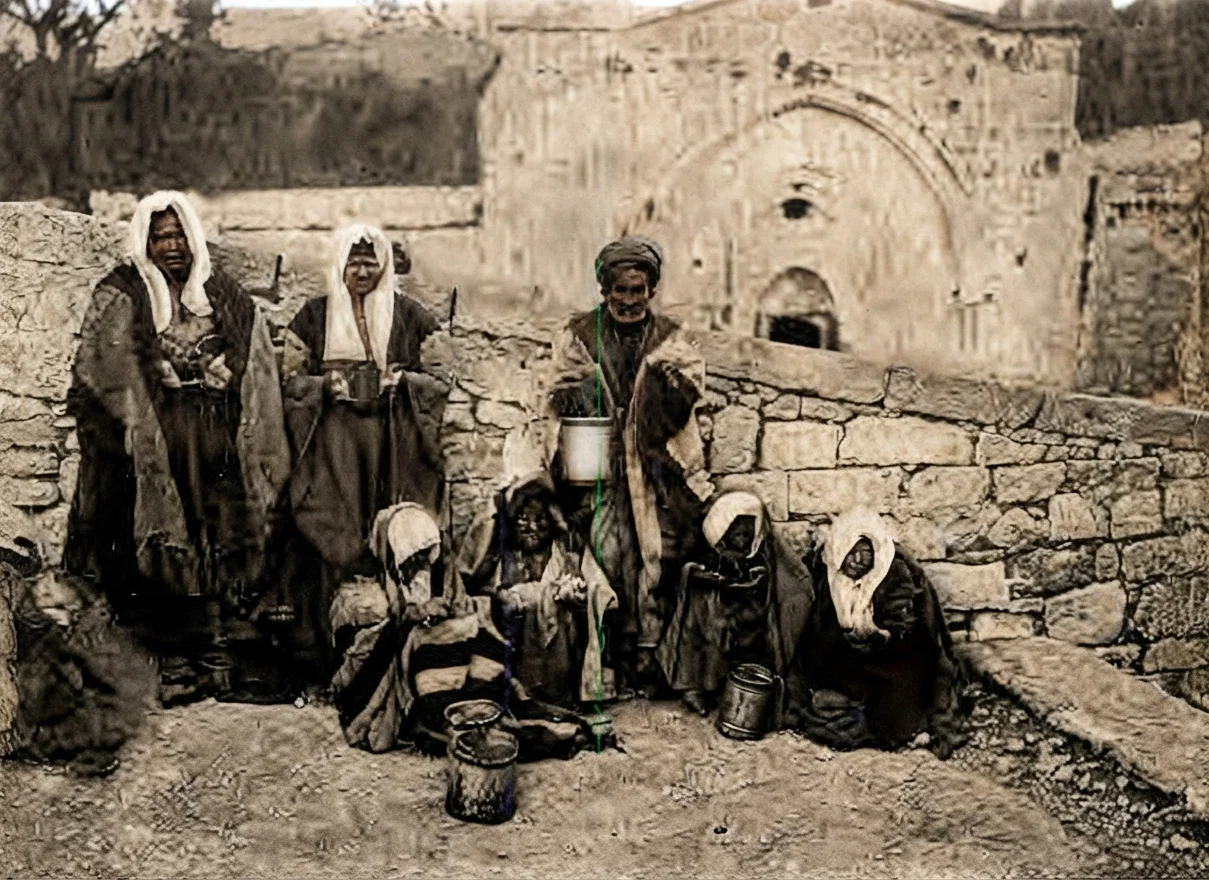
A Group of Lepers in Jerusalem
Once again Prisca had spoken; but he assured her that it was nothing but a slight eruption which would be healed in a few days, and he struggled pitifully to believe his own brave words,—the portions of his eyebrows were already turning white.
The errand which called him upon the street today, was a necessary one, else he would not have ventured to brave the keen eyes of the people.
“Ho, Simon, whither goest thou?”
It was the voice of his friend Machbor the ruler, from Jericho.
“How farest thou, Simon?”
“How art thou, Machbor?” Simon repeated bravely.
At first, Machbor gave him a careless glance; but his keen eyes at once detected the strange white spot upon his forehead—as if the ghastly finger of death had been laid upon it.
One more quick, searching glance from Machbor, which caused the hot blood to mount in a crimson wave to the temples, was enough. Simon turned his face away. He could not endure the look of mingled pity and horror which he read in the face of his friend, as Machbor stammered:
“As the Lord liveth, Simon, thou hast a—a mark upon thy brow—and the mark is white! Surely thou shouldst go at once up to Jerusalem and see the learned physicians; for why shouldst thou visit the priest until thou knowest somewhat for thyself? It may be it is nothing—”
A hunted, desperate look darkened the eyes of Simon as he impatiently interrupted him:
“Why speakest thou thus, O Machbor? for verily, man, thou believest that I am doomed!” and Simon grasped him by the shoulder almost fiercely. “But stay; thou mayest be right. I shall go up to Jerusalem at once, and, my friend,” he continued more calmly, “Go to my house, and speak thou to my wife Prisca, and say unto her that I am called to Jerusalem on a matter of business. Verily, Machbor, thou knowest somewhat of my past life, that it hath been unbecoming a true son of Israel, and I know that this which I now suffer is but the just punishment for my sins. But my heart is tender toward Prisca, my wife. It is best that she know not of this thing that hath befallen me,—tho indeed I saw her weeping but yesterday, and she hath already twice spoken of this thing,” continued Simon, speaking desperately and rapidly, and occasionally raising his hand nervously to his brow.
“I will go now, Machbor. Tell thou Prisca I shall be home to-morrow if naught detain me.”
Machbor bowed sadly; and Simon passed on.
One short month has passed away. In a place appointed for the purpose, in the city of Jerusalem, two men are closeted together. It is a large room devoid of ornamentation, or aught save the most necessary and meager furniture. We know by the dress of one of them, that he is a priest. The face of the other man is so distorted and drawn with anguish, and his fine, broad shoulders are so stooped and bent, that we would scarcely recognize him as the careless, light-hearted Simon of Bethany.
“Do I understand thee, Issachar?” he questions, addressing the priest. “Do I understand thee? Is there now no hope?”
“There is none, O Simon,” replies the priest indifferently; for Issachar has already in his lifetime pronounced the death sentence upon so many wretched creatures, that he has become quite inured to human suffering.
“There is none!” he repeats slowly, again casting his practised eye critically over the disfigured face. “Thou hast already appeared before me twice, and the physicians of the city agree with me that there is no hope. Thou art unclean; and unless the Almighty save thee even as He saved Naaman the Syrian, thou shalt die in thine uncleanness, for the scourge of God hath indeed overtaken and smitten thee. And now, if thou art minded to write unto thy wife, behold, I will copy thy writing and send it unto her at Bethany. For verily thou shalt return thither no more.”
It is an old man, bowed and bent, that sits to write a long, last farewell to his beloved wife and home; for the words of the priest have entered his despairing soul, and have written lines of anguish upon his brow, such as the hand of time alone can never trace, and bowed his broad shoulders with a burden more cruel than that of the passing years. The fingers of a fierce despair clutch at his heart as he writes:
“Prisca, My Beloved Wife:
“Thou knowest by now that the physicians have declared my case hopeless; and now, Issachar, the priest, has but this day added to my utter despair, by confirming the words of the physicians.
“Prisca, until I knew that I should never see thee more, I understood not how I loved thee. Better death than this awful thing which the Almighty hath sent upon me as punishment for my sins,—for even thus saith the priest. There is one, my Prisca, whom thou knowest not,—Magdalene, of Bethany. In the days of my folly, I did her a great wrong. But now am I punished by the stroke of Jehovah.
“I have entreated; I have prayed; I have raved like a man bereft of reason; I have offered my entire fortune to the physicians,—it is vain. Thy tender heart will break,—is breaking now, and thou wilt go to thy grave mourning. But even so they will not that I should look upon thy sweet face.
“But, my Prisca, be comforted. It will not be for long. I have been from thee but a few weeks, and even now thou wouldst scarcely know me.
“I shall dwell among the doomed wretches outside this city; it will be some small comfort to me to know that I am near thee.
“I shall always wear the crimson abba thou gavest me, my wife; and sometimes, when thou comest up to Jerusalem, thou wilt, it may be, take thy way toward the doleful habitation of the lepers, and if thou wilt stand afar off among the hills, and hold in thine hand thy crimson mantle, my gift to thee, then shall I see thee and know thee, for of a truth I shall always wait for thee,—and thou shalt know me also, by mine abba; tho I would not that thou shouldst see my face. Better far that thou rememberest me as upon the happy day when thou gavest it me. But approach not too near, my beloved, for the mournful cry ‘Unclean, unclean,’ will cause thee bitter grief.
“Speak not of me to mine acquaintance. Their words of pity would but cut thee to the heart. But allow Machbor, the ruler from Jericho, to befriend thee, as also Elkanah, thy father. I have none other to whom I may commend thee but unto the God of Israel,—and Him, alas, I know not.
“Thou knowest that I may now no longer be called a Pharisee; but if the doctrine of the Pharisee be true, and if there be forgiveness with Jehovah, we may meet at the resurrection of the dead. If not, I bid thee now an eternal farewell.
“Thou knowest that many men say that the Messiah hath appeared. Even so thinketh my friend Machbor. Even so declared the Baptizer, whom Antipas hath committed to prison. I know not. But I do believe that a great prophet hath arisen, and that if indeed He be the Messiah, He will go up to Jerusalem and reign gloriously; and the bands of the Roman shall be broken. But alas! who shall break the bands of thy wretched spouse,
“SIMON THE LEPER!”
(To be continued)