Man’s Sin and Saviour

3%

Pacific Press Publishing Association · Mountain View, California · Aug 30, 1910

FromSigns of the Times, Vol. 37, No. 34.

Read the full edition

Man’s Sin and Saviour

By E. J. Hibbard

VIII. Meaning of the Sanctuary

The ancient sanctuary service, as commanded by the Lord through Moses, contained a graphic description of the Gospel in all its parts. In the various parts of this service, by types and shadows, not only was the remedy for sin made plain, but in case of stubborn and persistent sin, an extreme penalty was inflicted. It is therefore easy to see, by a thoughtful reading of the various commands in reference to the sanctuary, that the future of both repentant and unrepentant sinners was revealed.
That the whole temple service centered in Christ is plain from the Saviour’s words in John 2:19, “Destroy this temple, and in three days I will raise it up.” The literal temple was under discussion when Jesus uttered these words. He had just cleansed it from the defilement caused by the traffic of buying and selling within its sacred precincts, and the Jews had asked, “What sign showest Thou unto us, seeing that Thou doest these things?” Jesus in reply uttered the words above quoted. “Then said the Jews, Forty and six years was this temple in building, and wilt Thou rear it up in three days? But He spake of the temple of His body.”
From this we believe it fair to conclude that the temple under consideration, and all the services pertaining thereto, were but a type of His body, His sacrifice and priesthood. With this in view every part of the ancient sanctuary service becomes illuminated, and the Christian can well take a lively interest in studying its various offerings and services.
Tho not all the offerings were called sin-offerings, yet each one had special reference to sin, and without sin would never have been required; “for every high priest taken from among men is ordained for men in things pertaining to God, that he may offer both gifts and sacrifices for sins.” Heb. 5:1. But “whosoever committeth sin transgresseth also the law: for sin is the transgression of the law” (1 John 3:4), and “where no law is, there is no transgression,” for “sin is not imputed when there is no law.” Rom. 4:15; and 5:13.
Since, therefore, the entire work of the Levitical priesthood was made necessary because
of sin, and since sin is the transgression of the law, it follows that the sanctuary service and all that pertained to it centered in that part of the sanctuary where the law rested; namely, the most holy place, in the ark of the testimony. Here Moses, according to God’s command, had deposited the two tables of stone upon which were written the ten words of God.
The book of Leviticus contains a complete outline of the various services of the tabernacle. Among the offerings might be noted burnt offerings, meat-offerings, peace-offerings, sin-offerings, and trespass-offerings. But, contrary to the supposition of many, these were no yoke of bondage forced upon the people, for thus it is written: “He shall offer it of his own voluntary will at the door of the tabernacle of the congregation before the Lord.” Now whatever is done at the dictation of our own voluntary will is far from a yoke of bondage. And this is true also of the anti-type Jesus Christ. The Gospel and the power of God give salvation to every one that believeth, “that whosoever believeth in Him should not perish, but have everlasting life;” and “whosoever will, let him take the water of life freely.” From first to last the Gospel of eternal salvation is only to him who accepts it of his own voluntary will.
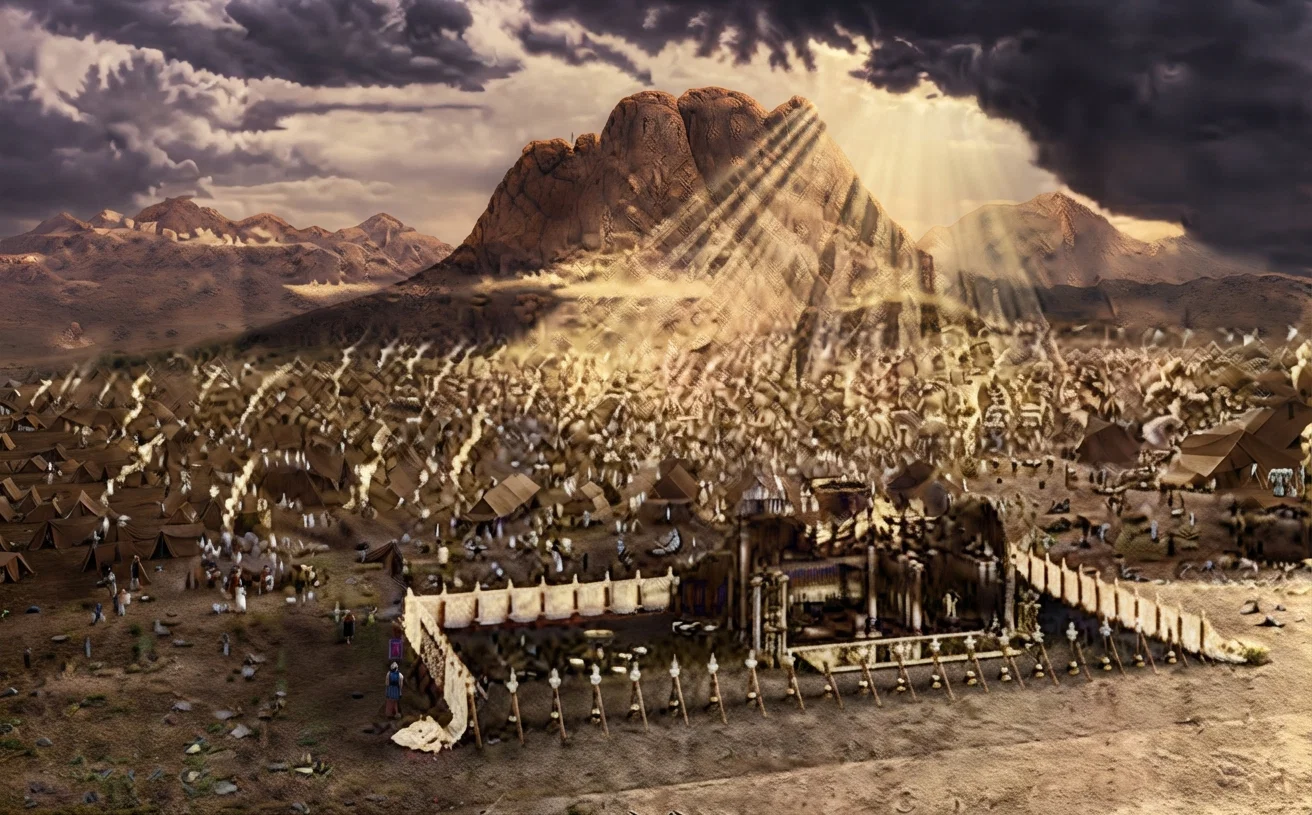
The Sanctuary, Court, Camp of Israel, and Mount Sinai
(From Kelchner's Model)
The Sanctuary, Court, Camp of Israel, and Mount Sinai (From Kelchner's Model)

The Sin-Offering

God’s directions in reference to this are given in the following words: “If any one of the common people sin through ignorance, while he doeth somewhat against any of the commandments of the Lord concerning things which ought not to be done, and be guilty; or if his sin, which he hath sinned, come to his knowledge: then he shall bring his offering, a kid of the goats, a female without blemish, for his sin which he hath sinned. And he shall lay his hand upon the head of the sin-offering, and slay the sin-offering in the place of the burnt offering. And the priest shall take of the blood thereof with his finger, and put it upon the horns of the altar of burnt offering, and shall pour out all the blood thereof at the bottom of the altar. And he shall take away all the fat thereof, . . . and the priest shall burn it upon the altar for a sweet savor unto the Lord; and the priest shall make an atonement for him, and it shall be forgiven him.” Lev. 4:27-31.
From this we gather, first, that whoever commits a sin “doeth somewhat against the commandments of the Lord;” second, when his sin comes to his knowledge he brings an offering; third, in laying his hands upon the offering and confessing his sin he shows that a substitution has been made—an innocent one has to suffer the penalty belonging to the guilty; fourth, the sinner himself was commanded to slay the offering, thus showing that each transgressor is guilty of the blood of Christ, and also that Christ would have come to earth and died for the salvation of one sinner; fifth, the priest, by sprinkling the blood of the victim in the places commanded of God, showed that satisfaction had been made for the transgression of God’s holy law; and sixth, the burning of the fat of the victim represents the cleansing from unrighteousness when sins are forgiven. Thus the psalmist viewed it when he said, “The wicked shall perish, and the enemies of the Lord shall be as the fat of lambs: they shall consume; into smoke shall they consume away.”
Tho the remedy for sin here described was to be accepted only at the voluntary will of the transgressor, yet every part of the service was minutely regulated by law; for after describing all these offerings and God’s directions concerning them, it stands written thus: “This is the law of the burnt offering, of the meat-offering, and of the sin-offering, and of the trespass-offering, and of the consecrations, and of the sacrifice of the peace-offerings; which the Lord commanded Moses in Mount Sinai, in the day that He commanded the children of Israel to offer their oblations unto the Lord, in the wilderness of Sinai.” Lev. 7:37, 38.
We find, then, that in sinning some law was always transgressed; and in making the atonement for sin, directions were followedwhich were minutely described by another law. One law, therefore, in the Word of God, points out sin, while another law directs us to the remedy for sin.
Peculiar among the offerings was one not intended to represent expiation of sin, but was rather the discoverer of sin; and this is called the meal offering. Let us remember that among the Israelites social purity was most rigidly enforced, and that for a wilful violation of the seventh commandment the penalty was death. If there were witnesses to the fact, that was the end of the matter; but in case the husband was suspicious of his wife, tho he had no direct evidence of her infidelity, she was brought to the priest, and with her an offering consisting of a tenth part of an ephah of barley meal. No oil or frankincense was to be mingled with this offering, for it was an offering of jealousy, an offering of memorial bringing iniquity to remembrance. In connection with this offering the priest was to administer bitter water, which, after drinking, if the party in question were innocent, would produce no evil results, but if guilty, would cause a condition which would lead to a speedy and dreadful death. In this way God would rid Israel of the very suspicion of impurity.
We also gather from the type that sin is not confined to the overt act, but rather that open transgression is but the fruit of an inward condition of the heart and character. Hence, “if we confess our sins, He is faithful and just to forgive us our sins, and to cleanse us from all unrighteousness.” 1 John 1:9.
Of this cleansing power I now wish to speak. In the antitype Christ declares, “The bread of God is He which cometh down from heaven, and giveth life unto the world.” “I am that bread of life.” “This is the bread which cometh down from heaven, that a man may eat thereof, and not die.” “Whoso eateth My flesh, and drinketh My blood, hath eternal life; and I will raise him up at the last day.” John 6:33, 48, 50, 54.

God Wills to Abide in Us

In the type, on a table expressly prepared for the same, were twelve loaves of showbread, a loaf for each tribe, and this was placed on the table fresh every Sabbath morning. Now “showbread” means “bread of the presence”—the bread which brings God’s presence to men. Notwithstanding the fact that only the priests could lawfully eat the showbread, the one loaf standing for each tribe indicated that God’s presence was intended to abide in the inner life of each person in every tribe. It is the presence of God in the soul which cleanses from all unrighteousness.
In the antitype, Christ is the light of the world. “In Him was life; and the life was the light of men.” John 1:4. “God, who commanded the light to shine out of darkness, hath shined in our hearts, to give the light of the knowledge of the glory of God in the face of Jesus Christ.” In the type illustrating that which is to illumine the hearts of men who accept the Gospel, we have the candlestick with seven branches and burning perpetually before the Lord. The light of life never grows dim and never ceases burning. Last in consideration at this time, let us look at the altar of incense.
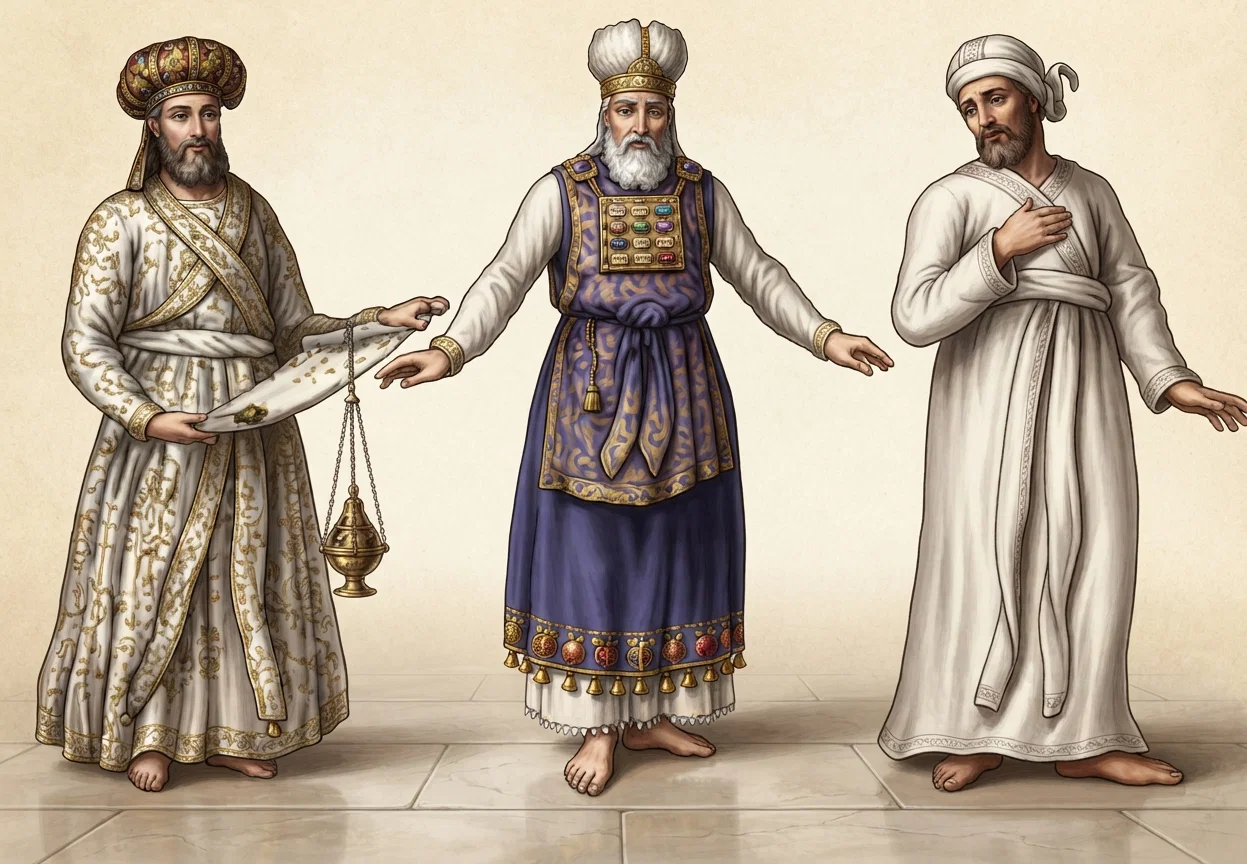
Priest  High Priest  Levite
Another has said, “The incense ascending with the prayers of Israel represents the intercession of Christ, His perfect righteousness, which, through faith, is imputed to His people, and which can alone make the worship of sinful beings acceptable to God.”
That prayer and incense were offered together is clearly seen in the case of Zacharias, the father of John the Baptist, at the time the angel announced to him John’s birth. “According to the custom of the priest’s office, his lot was to burn incense when he went into the temple of the Lord. And the whole multitude of the people were praying without at the time of incense.”
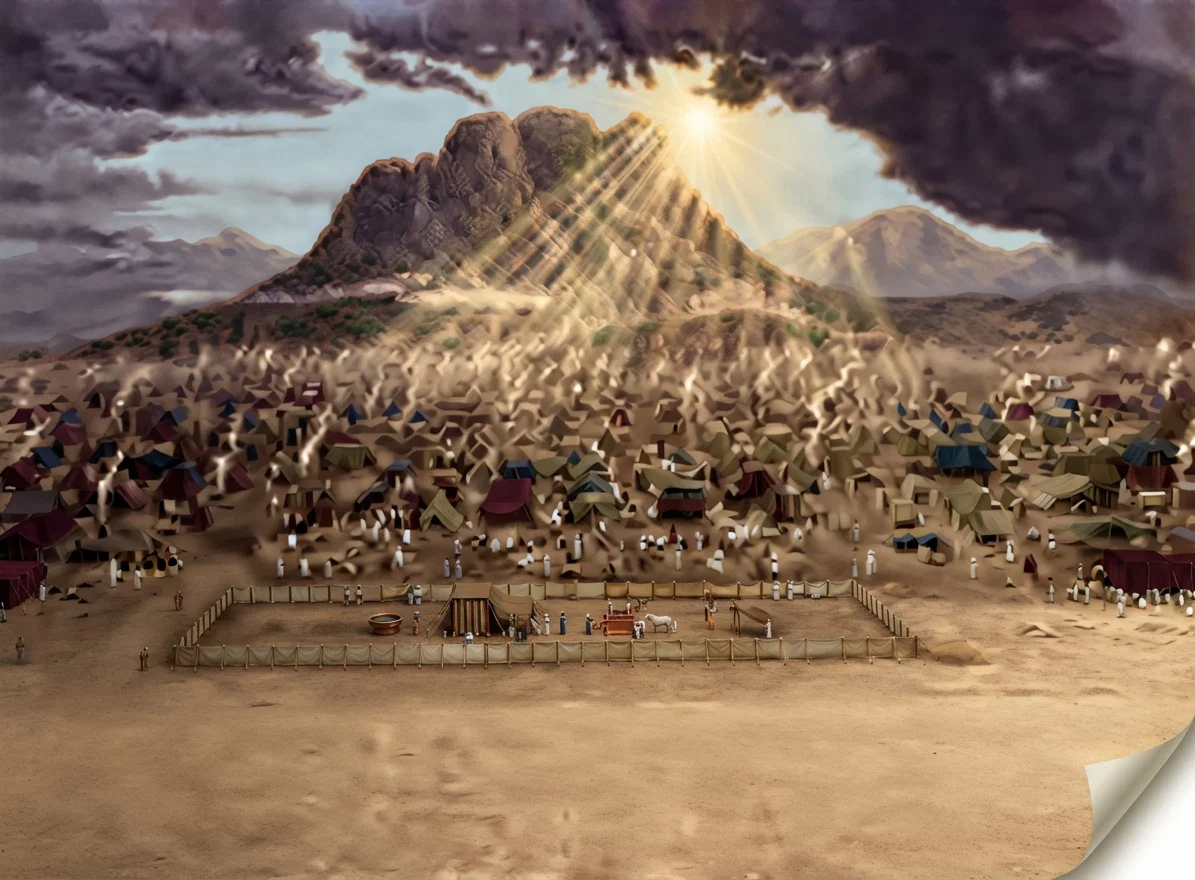
The ground prepared for the sanctuary
Thus, in the type, we find as a remedy for sin, first, the innocent victim slain for the transgressor. Second, the sinner conferring his guilt upon the head of the innocent animal before it was slain, thus in type representing the transfer of guilt from man to Christ, through the atonement made by the death of the victim. “For without the shedding of blood there is no remission.” Third, the forgiveness of sin thus confessed and atoned for. Fourth, the cleansing from the effects of sin indicated by the showbread and the light of the candlestick. And fifth, the acceptability of our prayers in the courts above, being mingled with the incense of Christ’s perfect righteousness and intercession.
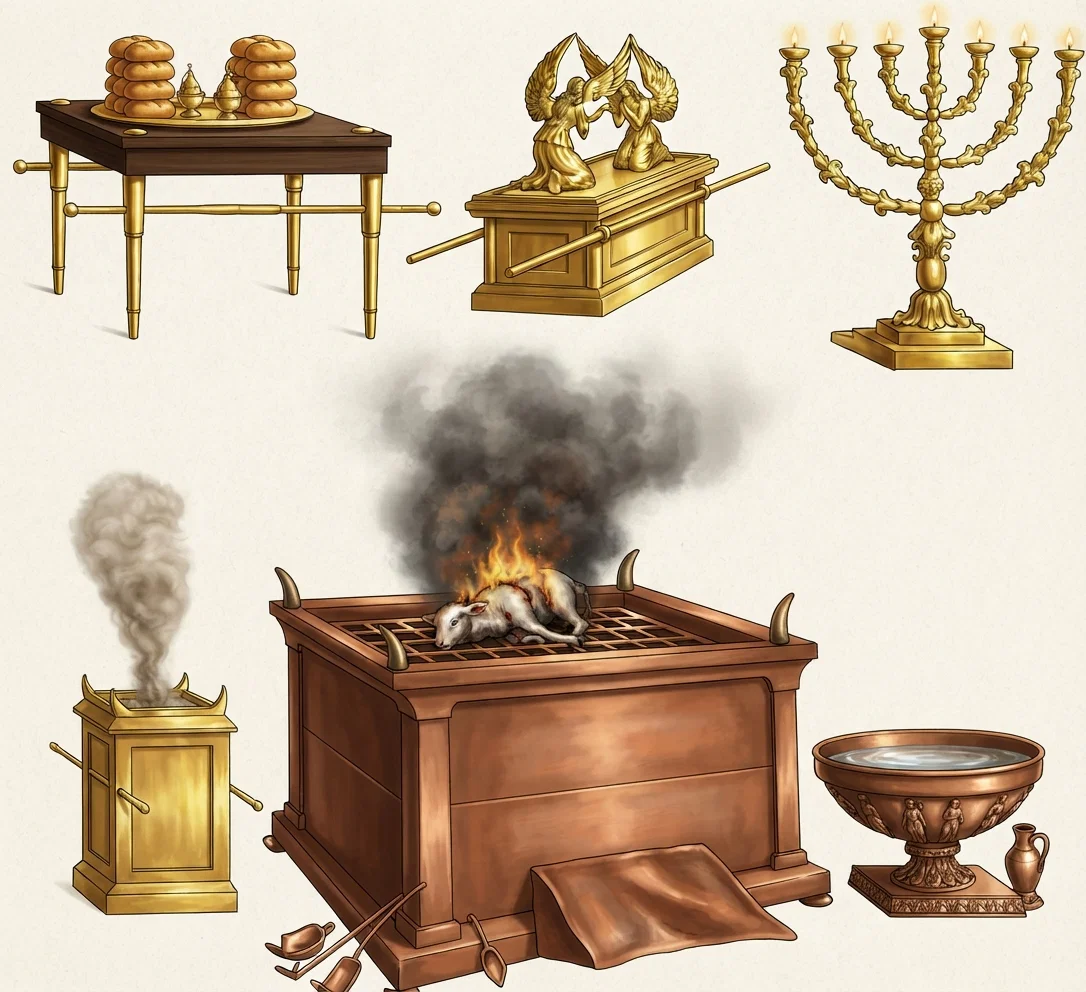
Furniture of the sanctuary. Reading from left to right on top row, table of showbread, ark of the covenant, golden candlestick; bottom row, altar of incense, altar of burnt offering, laver.
“Let us therefore come boldly unto the throne of grace, that we may obtain mercy, and find grace to help in time of need.” Heb. 4:16.