We study two of the typical churches in this number, Smyrna and Pergamum. It might be well to consider briefly the types, the actual churches and towns of Asia Minor. Ephesus, of our last lesson, is no more. The magnificent ruins of the great temple of Diana and the famous theater of the mighty throbbing, pleasure-loving city are about all that there is of her former power and grandeur. Both city and church are no more.
Smyrna was a celebrated commercial city of ancient times. It was less than fifty miles north of Ephesus, on the Smyrnian Gulf, an arm of the Ægean Sea, at the mouth of the little river Meles. Its origin runs far back into antiquity. It was finally destroyed by the Lydians, after which it lay waste for four centuries to the time of Alexander the Great, who began its rebuilding a little distance from the old site. This work was continued under Antigonus, and it soon grew to a flourishing city. The city was destroyed by an earthquake in A.D. 177, but was rebuilt with more than its former splendor by the Emperor Aurelius. While it declined from its former glory, it is today no inconsiderable city with a population of 130,000, and a great central trade emporium. The Turks call it Imzir, even Infidel Imzir, because of its large population of non-Moslems. Most of the Christians are the formal members of the Greek and Armenian churches. The early church, used as a type, has not its antitype in Smyrna.
Pergamos, or better, Pergamum, lies about sixty miles north of Smyrna, in a wonderfully fertile valley in the province of Mysia, of which it was the capital. Through it ran the River Ciacus. Two centuries before the Christian era it was a noted seat of literature and the fine arts, and the residence of the celebrated Attalian kings. Under King Eumenes the library was increased to 200,000 volumes. The art of preparing skins for manuscripts reached here its perfection, and from the place came the term parchment. Mark Antony transported the library to Egypt as a present to Cleopatra. Under Rome its preeminence was maintained. Remains of noted buildings are still in evidence. In this city Æsculapius was worshiped in the form of a living serpent, the god of Pergamos. As the serpent is a type of Satan, so it could be said that Satan had a seat or throne in Pergamos, a type of later manifestations. The town now is poor and mean; there are a few Christians, and remains of a church of a few centuries ago. The early Christians did not have the trials in Pergamos which they had in Smyrna.
The Answer of the Text
[The answers to the questions are from the American Revised Version. Omitting questions, and disregarding sometimes the capitals at the beginning and the period at the close of an answer, the text may be read continuously. In notes and comments both versions are used without designation.]
1. How does the Master address Himself to Smyrna?
“And to the angel of the church of Smyrna write: These things saith the First and the Last, who was dead, and lived again.”¹
2. What had He recognized in Smyrna?
“I know thy tribulation, and thy poverty (but thou art rich), and the blasphemy of them that say they are Jews, and they are not, but are a synagogue of Satan.”²
3. What exhortation does the Master offer in view of suffering to come?
“Fear not the things which thou art about to suffer: behold, the devil is about to cast some of you into prison, that ye may be tried; and ye shall have tribulation ten days.”³
4. What assurance is given the faithful?
“Be thou faithful unto death, and I will give thee the crown of life.”⁴
5. What earnest call is made to every anxious soul?
“He that hath an ear, let HIM hear what the Spirit saith to the churches.”
6. What is the promise to the overcomer?
“He that overcometh shall not be hurt of the second death.”
The Letter to Pergamum
7. How does our Lord represent Himself to Pergamum?
“These things saith He that hath the sharp two-edged sword.”⁵
8. What did He recognize?
“I know where thou dwellest, even where Satan’s throne is.”⁶
9. For what did He commend them?
“And thou holdest fast My name, and didst not deny My faith, even in the days of Antipas My witness, My faithful one, who was killed among you, where Satan dwelleth.”⁷
10. What reproof does the Master give?
“But I have a few things against thee, because thou hast there some that hold the teaching of Balaam, who taught Balak to cast a stumbling-block before the children of Israel, to eat things sacrificed to idols, and to commit fornication. So hast thou also some that hold the teaching of the Nicolaitans in like manner.”⁸
11. What charge and warning are given?
“Repent therefore; or else I come to thee quickly, and I will make war against them with the sword of My mouth.”⁹
12. What earnest admonition is repeated to all?
“He that hath an ear, let HIM HEAR what the SPIRIT saith to the churches.”
13. What is the promise to the overcomer?
“To him that overcometh, to him will I give of the hidden manna, and I will give him a white stone, and upon the stone a new name written, which no one knoweth but he that receiveth it.”¹⁰
Notes of Explanation
1. “Smyrna.”—From myrrh, more odorous by being crushed, typical of that condition of the church during the pagan persecutions about 100 to 300. “The First and the Last.”—The One who creates, who places the feet of the cleansed sinner in the heavenly way, the One able to save to the uttermost, to carry to eternal victory all who trust Him. Again is emphasized the awful fact of chapter 1:18, He “was dead,”—Christ the Son of God. But He lives again, and because He lives we shall live also. How fitting that He should reveal Himself as death’s Victor to that church of Smyrna which should pass through such fierce persecution even unto death.
2. “I know.”—The Master knows it all, knows the tribulation, the thrashing, the pressing, the crushing, knows the grinding poverty caused by7persecution, banishment, confiscation of goods; but more precious than earthly treasure are the riches of faith. “Harken, my beloved brethren; did not God choose them that are poor as to the world to be rich in faith, and heirs of the kingdom which He promised to them that love Him?”James 2:5. “Blessed are ye poor: for yours is the kingdom of God.”Luke 6:20. What are all the baubles of earth compared with one hour of God’s eternal riches! “Jews.”—Jews who were not Jews. They had the human blood, and bore the name, but were not Jews in God’s measure of the meaning. “They are not all Israel, that are of Israel.”Rom. 9:6. “He is not a Jew who is one outwardly; . . . but he is a Jew who is one inwardly.”Rom. 2:28, 29. “Jew” is from “Judah,” the center of which tribe is Shiloh, the Saviour, who declares that “salvation is of the Jews.”Gen. 49:10; John 4:22. “Synagog.”—A meeting-place. “Church” is never used of those apostate. “Satan” means adversary. All those who oppose Christ or His cause belong to the company of the adversary, the synagog of Satan.
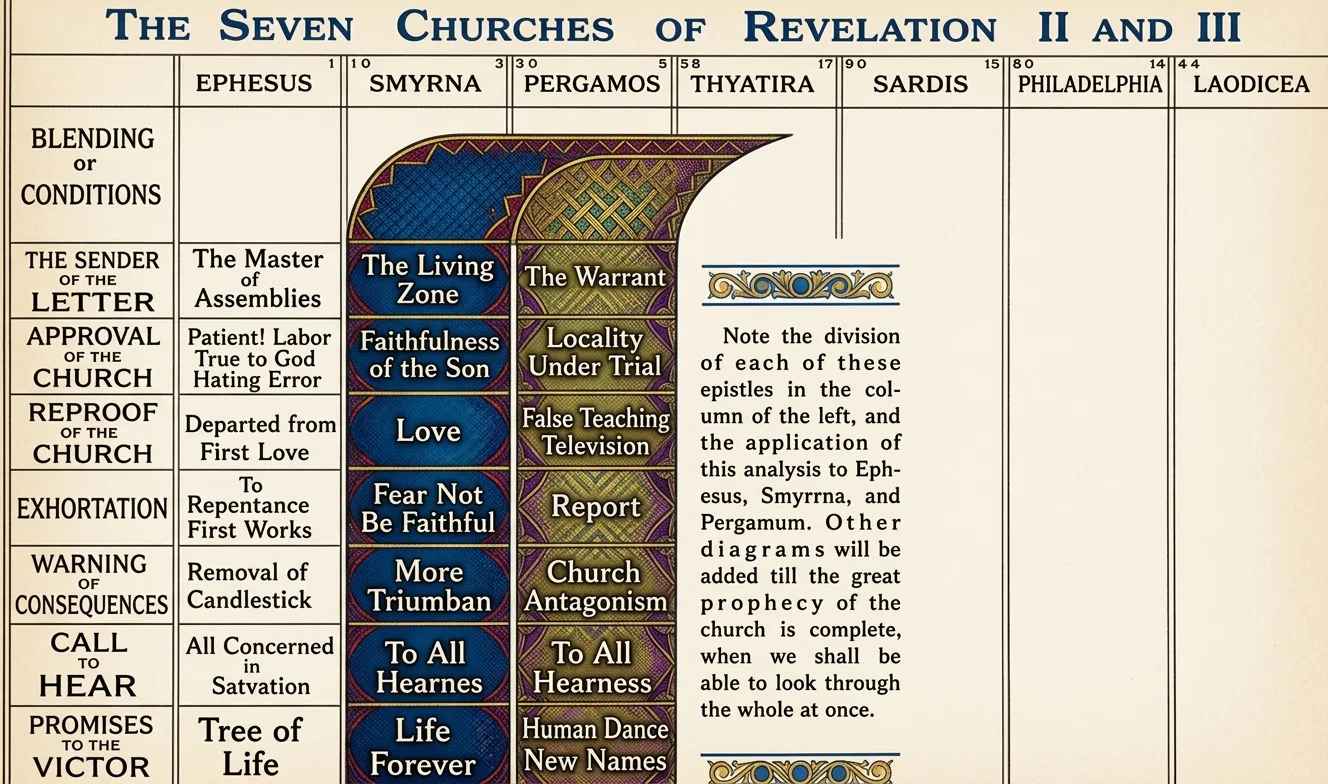
THE SEVEN CHURCHES OF REVELATION II AND III
3. “About to suffer.”—The Revelation was written about A.D. 95 or 96. Pagan persecution had already begun. John was on Patmos for his faith. That persecution would become more wide-spread. God’s people would suffer more than in apostolic times. That time was upon them, they were entering upon it; let them. The devil was planning their destruction. If he could not beguile them away, he would force them, coerce them, put them to death. All the persecution of all ages has had for its instigator the devil. It came the worst to this early church under the “ten days,” symbolical of ten years’ persecution under the Emperor Diocletian, 302 to 312, when thousands upon thousands were put to death, often with cruelties indescribable.
4. “Crown of life.”—The crown implies victory now; not the kingly crown, or diadem, but the victor’s garland, the stephanos, placed upon the brow of him who strives lawfully. 2 Tim. 2:5. It is the “crown of righteousness,” imparted in the faith of Christ (2 Tim. 4:8); it is “the crown of life,” life everlasting, which the approved of God will receive (James 1:12), the unfading, incorruptible “crown of glory” (1 Peter 5:4). Let the devil and death do their worst, He who has tunneled the grave in victory holds for the resurrection morning the crown of life for every overcomer. Those who sought to purchase ease by yielding to the devil, will, tho they rise from the dead, go down to eternal death; but the overcomer in Christ shall not be hurt of the second death. Rev. 20:14.
5. Pergamum.—The name is said to mean height, elevation, which well fitted that splendid city, and also the symbolized condition of the church from the council of Nice to near the middle of the sixth century. The “sharp two-edged sword,” the Word of God, not simply the Word in general, but the Word in judgment, that cuts out sin or the sinner who identifies himself with the sin. In the age of the Pergamum condition the church of God was departing from the Word of God to human doctrines, human philosophy, human tradition. Christ would emphasize as the one standard the Word.
6. “Satan’s throne.”—As the local church in Pergamum dwelt in a city where the worship of a living serpent, the emblem of the devil (Rev. 12:9) was in vogue, so the church living in that period of time when Rome, the seat of world empire and corruption, became the head of the rapidly apostatizing church. It was during this period that the foundation of the Papacy was laid in the growing assumption of the Roman bishop, mightily helped by the civil power under such rulers as Constantine, Clovis, and Justinian. However sincere those were who were working to that end, the devil was at the bottom of all the perversions.
7. “Antipas” was perhaps an unknown martyr, or represented a class opposed to the growing assumptions of the Papacy,—“anti,” against, “pas,” father or pope.
8. “Against thee.”—It was “one thing” against the Ephesus condition; it is a “few things” against the Pergamum. The doctrines of the Nicolaitans which were hated by Ephesus were tolerated by Pergamum, as were also those who taught as did Balaam, fornication, union with the world, union with the state, consummated in this period, an eternal curse to both church and state. Yet the best of God’s children now tolerate it.
9. “Repent,” turn, or the Master has become the adversary, as He of old withstood Balaam. One’s case is indeed hopeless when he makes Infinite Power his enemy.
10. “Hidden Manna.”—The manna, “corn of heaven,” given by miraculous power, typified Christ Jesus, the Bread of Life. John 6:33, 48-51. Not hidden in the sense of purpose to put from the grasp of men, but hidden to unbelief. The mystery of God is disclosed to the child of faith. 1 Tim. 3:16; Col. 1:26, 27. “If our Gospel be hid, it is hid to them that are lost; in whom the god of this world hath blinded the minds of them which believe not.” The hidden mystery is the hidden manna, the Bread of Life, Christ Jesus. The overcomer shall partake of Him to the full. A white stone represents God’s choice for us. It is the pebble used in voting, black if against, white if favorable. Christ casts His vote for us by the white stone or pebble upon which is engraved a new name, representative of character. A man of old gained the victory, and his name was changed from Jacob the supplanter to Israel the prevailer. Gen. 32:28. Our new name will be the sum of all our experience, the name we are spelling out day by day, by the hardest of labor at times, under severest trial, often making great blunders, yet under the Master making progress. We do not know it now, but God sees it. Like the tapestry weavers, we see the wrong side, it seems rough and ugly; God sees the finished name. He knows it, of course, for He bestows it, and has spelled it all out with us; but no one else knows it, because no one else can have our experience. It is an eternally open secret (but partially read by others) to all eternity, between each soul and its Lord. Pergamum represents an age of charms, amulets, hoodoos, mascots, relics, superstitions of things and relics once touched by some good soul; how fitting it was to present the true in the same form of mystery, yet eternally effective. God grant that the reader may eat of the hidden manna, and spell out by His grace the perfect and eternal new name.