In the light of Holy Scripture and the plans and purposes of God regarding the world, it is plainly evident that the wonderful development of swift modes of intercommunication has a direct relation to the divine scheme of world evangelization.
Here is one picture that Inspiration gave long ago of the closing of the Gospel work in the earth: “And I saw another angel fly in the midst of heaven, having the everlasting Gospel to preach unto them that dwell on the earth, and to every nation, and kindred, and tongue, and people.” Sometime the generation was to come in which not only would the world and all its peoples be brought to the knowledge of Christendom by exploration and development, but facilities must come to that generation by which a quick work could be done. So swiftly was the evangel to be carried that the prophet could represent it only as by an angel flying through the midst of heaven.
Does it not seem strange to us now that just a few years before the opening of this present generation there had been scarcely a new idea as to swift travel and intercommunication since the days of Moses? Men were traveling up and down the world and over the seas just as they did in the days of Phenicia and Babylon.
But mark you: the last generation was at hand. In that generation a Gospel message was to be carried to every nation and people. And suddenly, as tho at one motion of the hand of Providence, there was set stirring a train of new ideas in transportation which have changed the whole six thousand years of human history.
In his “Short History of Our Own Times,” Mr. Justin McCarthy, writing about 1880, nicely puts this sudden development as follows:
“The history of the past forty or fifty years is almost absolutely distinct from that of any preceding period. In all that part of our social life which is affected by industrial and mechanical appliances we see a complete revolution. A man of the present day suddenly thrust back fifty years in life would find himself as awkwardly unsuited to the ways of that time as if he were sent back to the age when the Romans occupied Britain. He would find himself harassed at every step he took. He could do hardly anything as he does it to-day. Sir Robert Peel traveled from Rome to London to assume office as prime minister, exactly as Constantine traveled from York to Rome to become emperor. Each traveler had all that sails and horses could do for him, and no more. A few years later Peel might have reached London from Rome in some forty-eight hours.”
The heart is filled with awe as we contemplate the wonderful changes of our own generation, and realize that they have come about according to the purpose of God, that in our time the whole world shall be evangelized.
Here is the world's system of international postal communication. What a place that has in the evangelical effort, in spreading the printed messengers of truth, and keeping the forces in the world-wide campaign in touch with one another! Every week in our Mission Board office we thank God for this facility which brings the communications so swiftly from across the seven seas. It is so much a very part of our life to-day that we scarcely give a thought to the fact that it is really a very modern thing; for Rowland Hill, the originator of the cheap system of postage, died only in the ’70’s. Miss Harriet Martineau tells the following story of the manner in which Mr. Hill was led to give attention to the improvement of the postal system:
“Coleridge, when a young man, was walking through the lake district, when he one day saw the postman deliver a letter to a woman at a cottage door. The woman turned it over and examined it, and then returned it, saying she could not pay the postage, which was a shilling. Hearing that the letter was from her brother, Coleridge paid the postage in spite of the manifest unwillingness of the woman. As soon as the postman was out of sight she showed Coleridge how his money had been wasted, as far as she was concerned. The sheet was blank. There was an agreement between her brother and herself that as long as all went well with him he should send a blank sheet in this way once a quarter; and she thus had tidings of him without expense of postage. Most persons would have remembered this incident as a curious story to tell; but there was one mind which wakened up at once to a sense of the significance of the fact. It struck Mr. Rowland Hill that there must be something wrong in a system which drove a brother and sister to cheating in order to gratify their desire to hear of one another’s welfare.”
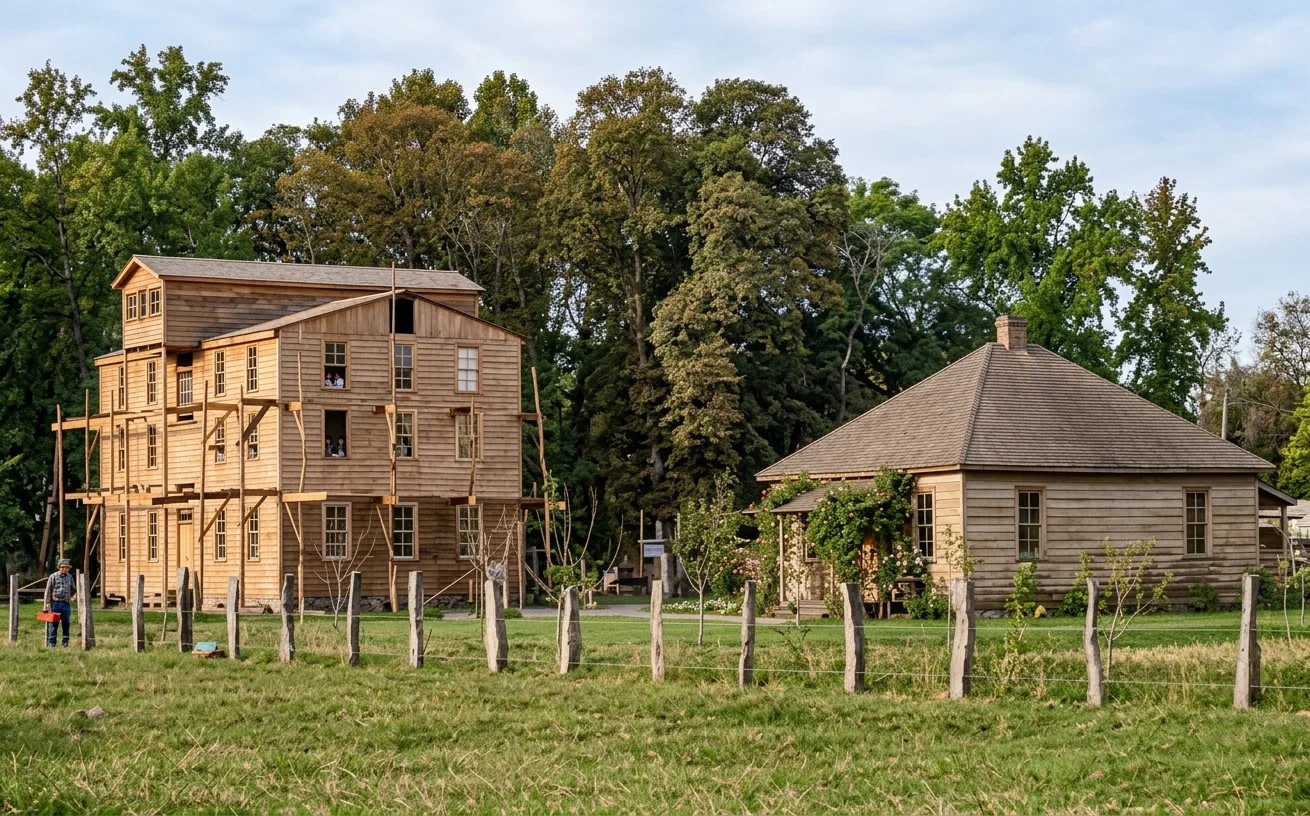
Rua School, Santiago, Chile
In 1839 the British government took up Mr. Hill’s scheme of postal reform; and from that day to this, improvements have been bringing widely separated parts of the world into closer and swifter and cheaper communication. Hardly a place is off the postal circuit summer or winter. Not long since a Canadian paper gave a picturesque description of the departure of the Christmas mail on sledges from the old Hudson Bay frontier post of Edmonton to the regions of the Great Slave Lake and the MacKenzie River, by the Arctic Sea.
Those were beautiful sailing ships pictured in the early missionary literature as bearing the missionary to strange places over the sea. Even yet one of the prettiest sights in mid-ocean is a full-rigged ship under sail. But it was too slow and uncertain a method for the carrying within one generation of a message to every land. So while Mills and Judson and their associates were praying in 1806 at Williamstown, Massachusetts, for God to rouse the churches to the needs of the heathen—which led to the first American foreign missionary organization—Fulton, by the Hudson, was working away on his steamboat, the Clermont, which three years later was to revolutionize ocean travel.
As Julia Ward Howe wrote for the recent Fulton centenary,—
“And not alone for Hudson’s stream
Avails the magic power of steam.
Blessings of unimagined worth
Its speed shall carry ’round the earth;
Knowledge shall on its pinions fly,
Nor land nor race in darkness lie;
Commerce her hoards shall freely bring
To many an urgent summoning,
And Want and Wealth, in sundered lands,
Shall closely clasp redeeming hands.”
By the means placed in our hands, the whole world is reduced to practical compass for such a movement as is called for in the closing years of this generation. Across Asia by rail is realized, and already it is meaning much in the development of the work of our Seventh-day Adventist Mission Board in Siberia and Turkestan. Railways pierce Africa at various points, and the great trunk system of the Cape-to-Cairo route makes swift progress in the far interior.
Thank God, the time has come when as15the church of Christ rouses to its solemn obligations, the truths of His Holy Word and the message of the coming of the Lord may be carried swiftly to every nation, kindred, tongue, and people, even as by an angel flying in the midst of heaven. That is the heavenly vision to which we must never be disobedient. To our generation these wonderful facilities for a quick work have been given. In our time, then, must be fulfilled the promise and prophecy of the Saviour: “This Gospel of the kingdom shall be preached in all the world for a witness unto all nations; and then shall the end come.”