European Letter

2%

Pacific Press Publishing Association · Mountain View, Cal. · Dec 20, 1910

FromSigns of the Times, Vol. 37, No. 50.

Read the full edition

European Letter

By Our Own Correspondent
Three revolutions in one month is a big number for Europe in these days of “armed peace.” And yet the statement is true of the past month, in which we have seen the beginning and end of a Berlin terror, a Portuguese revolution, and a French demonstration of anarchy. It almost made one think of 1848, when all European thrones were tottering.

Troubles in Germany

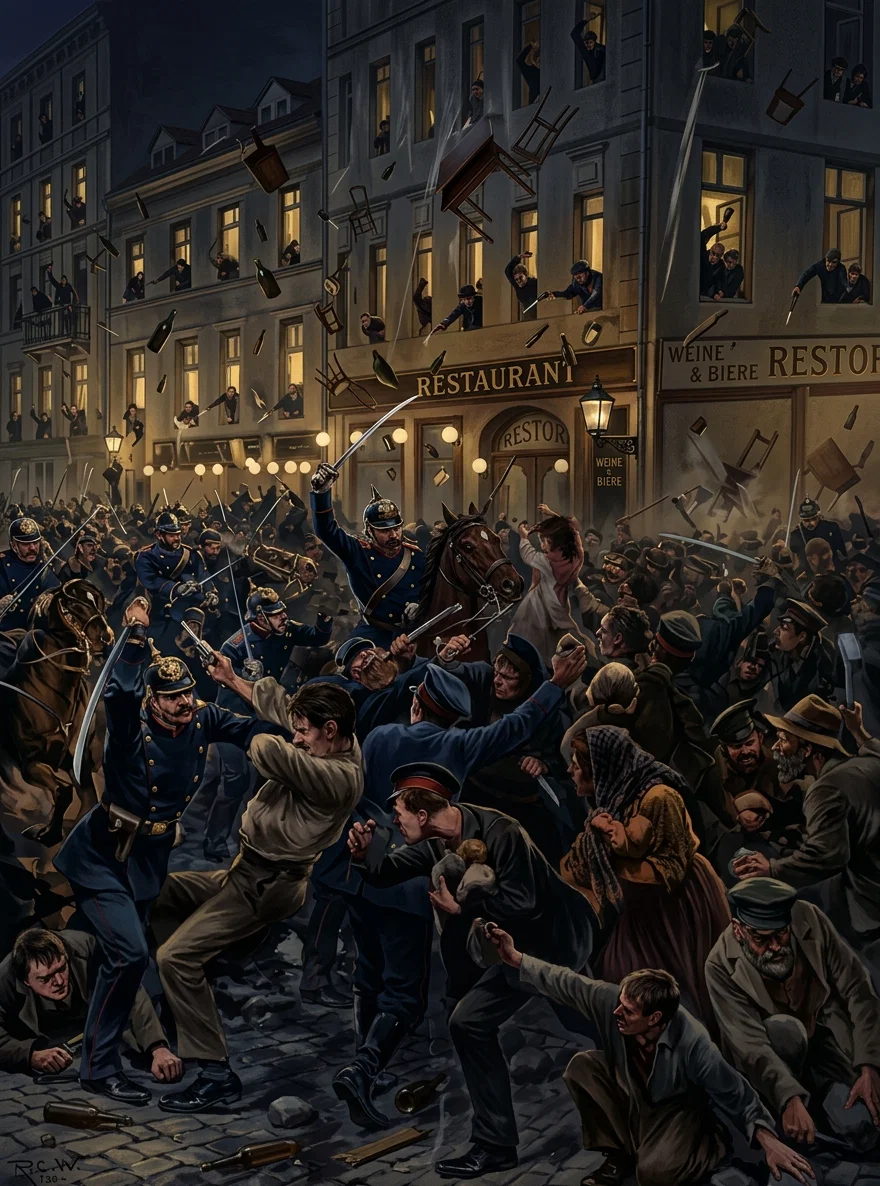
The troubles which have filled, during five successive nights, the working district Moabit in Berlin with bloodshed and devastation, is said by leading papers to have been the gravest event of this kind since the bloody week in Barcelona.
They began by hostile acts exercised toward laboring men who had remained at work, on
the part of strikers, or, as they are called, by “fox’s hunt.” The police intervened. Then something strange was witnessed: all the street-lamps and all lights in houses went out; and when darkness was complete, the unseen forces of disorder began to bombard the police with stones and even with revolvers’ bullets. Stores were plundered, and kerosene fires were lighted in the streets.
Who could have believed, exclaims the “Post,” a conservative paper, that in Prussia, in the capital of the German empire, the masses could exert the same nefarious influence, have the same possibilities of domination, as in Paris or in Barcelona? A mob committing the worst outrages, firing on the police, ruining the prestige and authority of the state—there are sad prospects for a case of war, when such things are possible when the barracks are full of soldiers.
Only the great energy and the well-known severity of the German police saved the Moabit quarter from a prolonged revolution. Of course, the Socialists, who are sure to be on the side of disorder, did not appreciate the success of the Berlin police. They call it intolerable brutality, while they look complacently at the savagery of the mob. At a recent Socialist congress
in Magdeburg, the plans suggested to the government by General von Bissing in a case of street revolution, were bitterly criticized. According to Socialists, a revolutionary party has a right, in their meetings and by means of their innumerable associations, to foment openly armed rebellion; but the threatened society has no right to protect itself,—an assumption which, as some one said, is either childish or hypocritical.

Revolution in Portugal

Hardly was the Berlin rebellion quelled when a West European monarchy eight centuries and a half old suddenly came to an end. And yet Portugal had seen the time when its banners, thanks to the wonderful success of its navigators, wafted over one coast of India,
over Brazil, Egypt, Arabia, Malacca, and the Molucca Islands. At that time, Spain occupied only the West Indies. All this grandeur passed, and now the monarchy itself has just disappeared before popular discontent at the uselessness of the reigning family.
Conspicuously and sadly was the Catholic clergy made equally responsible for the evils of the nation by the triumphant popular party. In their wrath, the people rushed madly against those men who were wont to speak to them about God and the church.
Abbot Lourenço de Mattos, director of the Catholic and royalist paper “Portugal,” was one of the first victims of this spirit. His office was broken into by a mob, his printing-office pillaged, himself struck down and killed outright, and his corpse carried along the principal streets amid vociferous crowds.
Little or no harm was done to the secular clergy; but the regular clergy, or monks and nuns, especially the Jesuits, who were literally “hunted,” were made to feel that their services
were not appreciated by the common people. One of the first acts of the government was to expel from five to six thousand members of the different religious orders—that is, those belonging to foreign nations—and to send home those native of Portugal.
The Portuguese are not irreligious, but rather superstitious, their principal object of worship being Saint Anthony. What they especially want in religious lines, is to be baptized and buried by a priest, and the privilege of having a few masses said when they feel like it. Besides that, they have little respect for their priests. A royalist, who is also a devout Catholic, recently said to a foreign journalist:
“The Portuguese clergy is a very strange one, in fact the last one on the scale. Here the rule is that a priest is married. In Spain a priest hides from his pews the sight of his wife, and does not own his children. Our Portuguese clergymen do not feel this bashfulness. They nearly live with their family, and honestly so. They do not abandon their female partner, and look out for their children as far as they can, using to this end all the privileges granted by the law.”
How lamentable the situation of the Portuguese priest! How sad, in order to live according to God and nature
to pass for hypocrite, an impure man, and a perjurer before those to whom he is bound to teach truth and holiness! This is what Rome does for nations and individuals.

Trouble in France

Third revolution: Hardly had Portuguese events ceased from calling the attention of the world, when came the turn of France to pass through a few most critical days. Little did the railroad strike lack of being a regular revolution, and worse even. It has been asserted by responsible political men that a plot had been made between the Socialists and the royalist party, and that this strike was only a handle by which to overthrow the republic. However this may be, the German general Litzmann, commenting upon this event in the Berlin “Taegliche Rundschau,” remarks that between the 11th and the 15th of October, France was at the mercy of a foreign aggression, from the fact of its railroads’ being paralyzed. The next war, he says, if the war comes, will break out suddenly, and begin with blows given with the rapidity of lightning, which may be decisive, and in which the two adversaries will vie with each other in swiftness.
Knowing this, the French authorities must have felt some sense of the danger in which the country lay. In their plight, they resorted to a measure of which there is no case on record, and which succeeded in bringing the strike to an end as by magic. This consisted in declaring all the railroad men under military duty for a period of twenty-one days, and obliging them as such to wear a badge. This decree applied to upwards of 100,000 railroad men. But, as was remarked by a deputy at the Chamber, this will probably avail only once, and may not be used a second time.
The Paris correspondent of the “Journal de Geneve” writes to this journal under date of October 30:
Berlin police in conflict with strikers and their supporters in the Moabit quarter of the city. The police have deemed it necessary to use both swords and revolvers. The strikers and their sympathizers used everything which could be used to hurl at the police — sticks, stones, bottles, chairs. In some cases the strikers extinguished the street lights.
“Never, since one can remember, has the Chamber seen a meeting interrupted by so many and such violent incidents. In leaving the hall, some said that this was a meeting of the Convention (of 1792). And indeed, one could not help thinking of the Convention. . . . The scene reminded one of the worst times of the Revolution.”
The conservative paper “Le Temps” remarked:
“Meetings such as Saturday’s (October 29) must inspire us with the gravest reflections. If the Chamber shall express a vote in favor of revolutionary violence, . . . the president of the republic must remember that he has a right to dissolve Parliament, . . . rather than to allow a Chamber enslaved by anarchy to jeopardize France and the republic.”
M. Raymond Poincaré, senator, member of the French Academy, speaking at Poitiers, referred to the same events as follows:
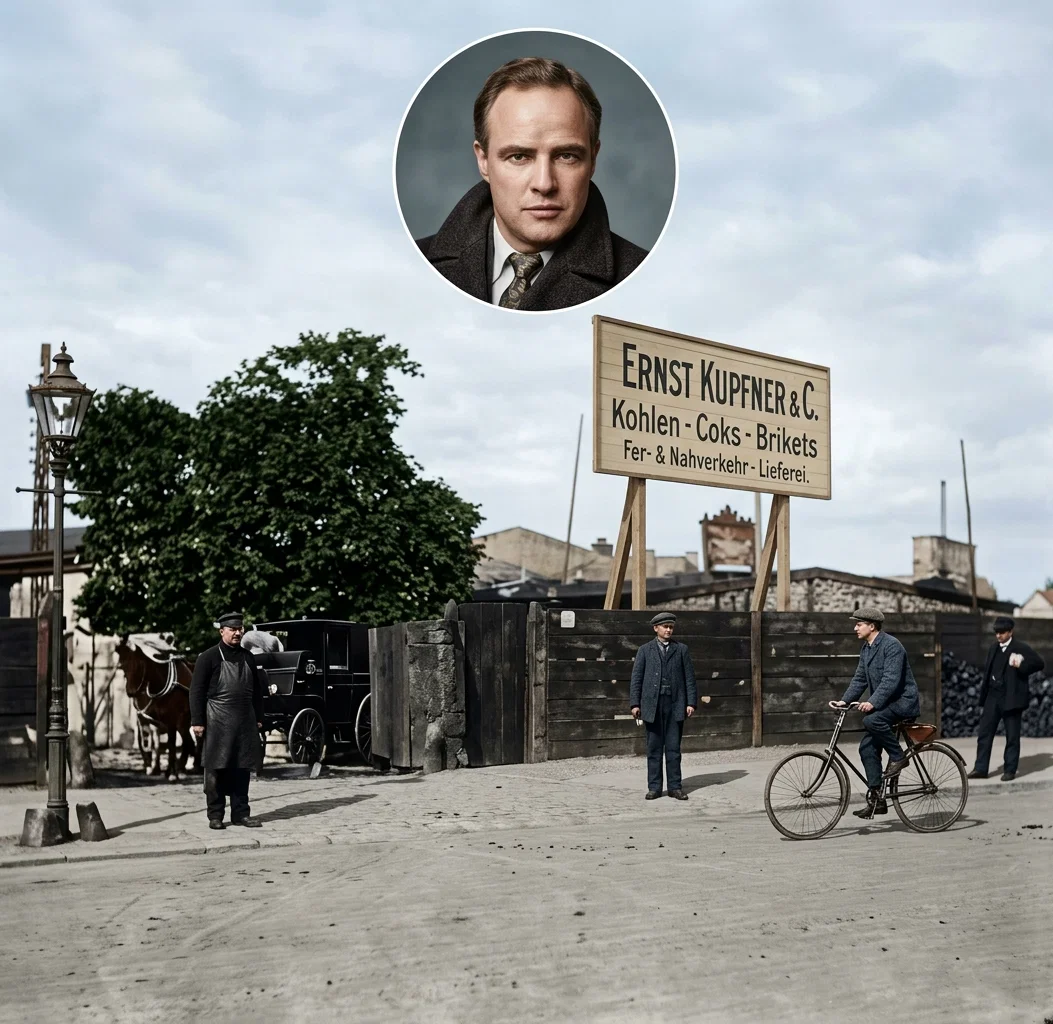
The coal yards of Kuppner & Co., where the Berlin riots originated. The portrait is that of Mr. Nile of the London “Daily Mail,” who with three other journalists was severely injured by the police.
“To be or not to be is the question which is facing France to-day. . . . Yea, not France only, but the whole world is worked by ferments unknown up to this day, and not well-defined as yet.”
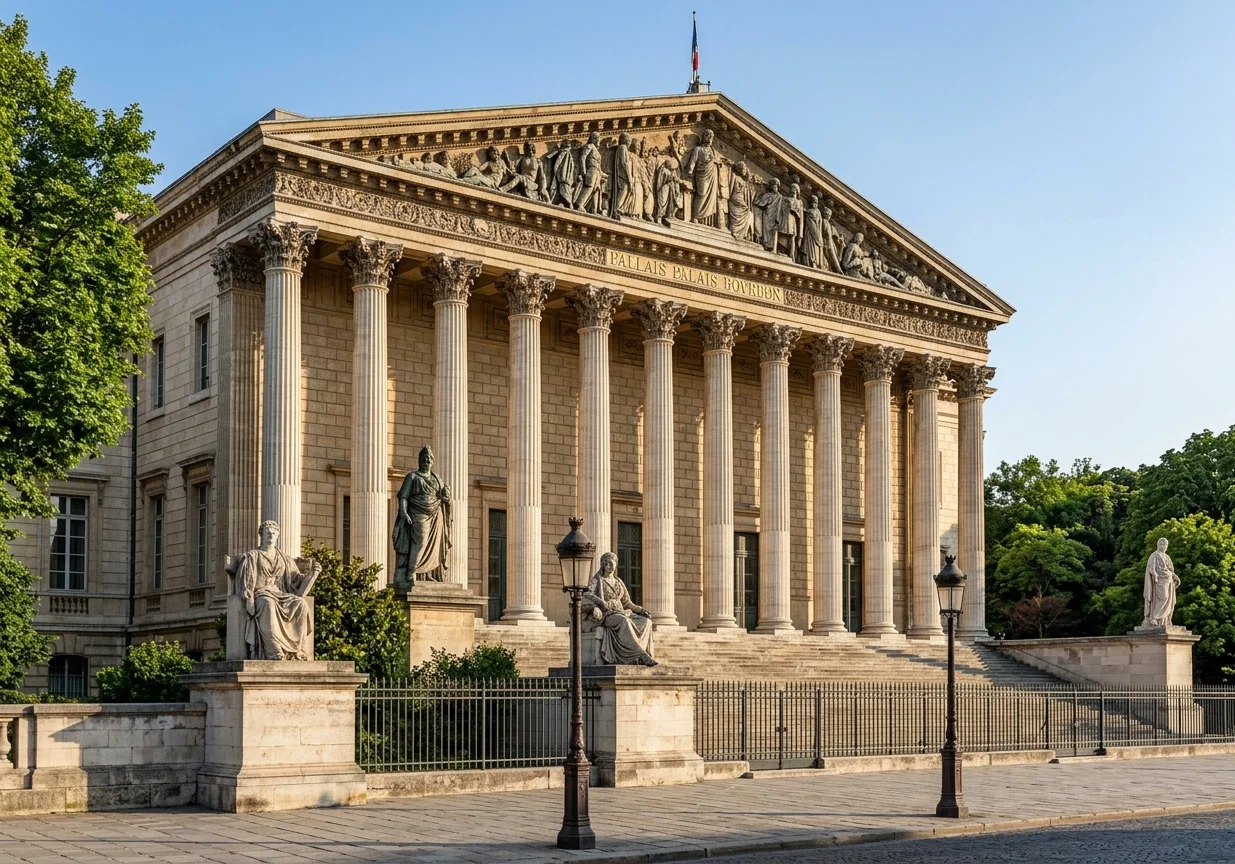
Having happily ceased on the railroads, the trouble was carried into the Palais Bourbon. M. Briand’s government was furiously attacked by the Socialist and revolutionist deputies for the manner in which it had brought about peace in the land. For several days, the Chamber looked and sounded more like a gigantic cage of wild beasts than like an assembly of legislators. A spectator thought that he could see the hideous face of the Jacquerie of revolutionary days.
M. Briand courageously and eloquently defended the action of his government. He unveiled the fact that the strikers’ movement was “an enterprise of ruin and death against the country, and of which the strikers themselves were the blind instruments.” Among other things, he read the following circular:
Mr. Briand, Premier of France
“Comrade. The comrades who are sending you this paper know you if you don’t know them. They ask you in the night from June 1 to 2 [the post-office strike] to cut all the telegraphic wires within your reach and to follow up the job as far as you can.”
In the frightful parliamentary encounter which has just taken place in France, it must be said that the government and M. Briand were in a rather delicate position, and that self-justification was a rather hard task for them. A few years ago, one of the members of the government declared that a strike on the part of the laboring men in one of the public services was perfectly legitimate. M. Briand himself, formerly a Socialist leader, is known to have advocated the general strike with great ardor. His opposers did not hesitate in recalling this fact. While M. Briand was vigorously condemning the strikers, a deputy shouted, “Don’t be too hard on them, they are your scholars!” Another one said to him, “You are the very one who converted me to Socialism!” Yet another: “This odious and repugnant role of provoking agent, Mr. President, you have played it yourself, by having us cowardly arrested after preaching the general strike yourself.”
And when, answering from the floor, in the midst of exasperating clamors, M. Briand spoke against the “fox’s hunt,” Citizen Colly was seen leaving his bench and leaping forward, shouting: “ARISTIDE! ARISTIDE! TOI AUSSI, TU L’AS FAITE, LA CHASSE AUX RENARDS!” (Aristide! Aristide! you took part in it yourself, the chase of foxes!) Going still further, the party of anarchy penetrated into the premier’s private life and abused him in the most abominable manner.
As one witnesses such scenes, he is forced to ask himself how long any kind of free government can last in a nation where the spirit of order and decency has sunk so low. Can it be that France is again ready for anarchy? Has she entirely forgotten the lessons of 1793?
Chamber of Deputies, Paris
And is she preparing to renew the experiences of an atheist and Jacobin revolution at a time when all nations are talking of progress?
JEAN VUILLEUMIER.
Gland, Switzerland.
— ★ ★ —