South China

5%

Review and Herald Publishing Association · Washington, D. C. · Jul 2, 1914

FromReview and Herald, Vol. 91, No. 27.

Read the full edition

South China

E. H. WILBUR
[What proves to be Brother Wilbur’s last report follows. Very fittingly a personal letter from Brother Nagel accompanies this good, cheering report of dear Brother Wilbur, giving items concerning his death. Both will be read with unusual interest.]
It has been some time since I have written a report for the REVIEW. We greatly enjoy the reports from other fields, and know that our brethren are also interested to hear from China. Although this country has for the past two years been more or less unsettled by revolution and robbers, yet our work has moved steadily forward, increasing in numbers and strength. Thousands of copies of the Chinese Signs of the Times have found their way into the remotest parts of the field, and are sure to bear fruit to the glory of God. Our evangelists for several years were greatly handicapped for lack of Chinese literature giving instruction in Bible doctrines, but now we have a book of Bible readings, also a verse-by-verse commentary on the book of Revelation. Besides these, a book on Daniel is just coming from the press. These, with our Sabbath School Lesson Quarterlies, the Signs of the Times, “Christ Our Saviour,” and other literature, are proving a great help to our Chinese workers.
It has been a source of rejoicing to the writer to see the work in China develop from a small beginning to its present proportions. When we first arrived in this field, Brother A. LaRue, Elder J. N. Anderson and family, and Miss Ida Thompson in Hongkong were the only workers in the employ of the Seventh-day Adventist Mission in China, and there was only one Chinese member in China, so far as we know. Now all this is changed. We have in China over sixty European workers (including wives), three Chinese ordained ministers, besides a good company of loyal Chinese evangelists and colporteurs. The report of our Sabbath schools for the quarter ending Dec. 31, 1913, for the three mission fields in China, shows a membership of 1,954. Last year there were more baptisms in China than in any other year in the history of our work. Although Canton was for several months last year in the throes of a second revolution, yet our work went forward, and at the Cantonese general meeting in November, twenty-two were baptized. On March 28, 1914, at the time of our South China Committee meeting, ten were baptized at Canton.
Last autumn it was voted that I and my family move from Fatshan to Pakhoi. We arrived in the latter place Feb. 3, 1914. Pakhoi is about five hundred miles by water from Canton. Last week we went by wheelbarrow to visit one of our outstations, Limchow, which is about twenty-seven miles inland. We left Pakhoi at 6 A. M. and arrived at Limchow at 1 P. M. It was a tiresome journey, but we were favored with good weather both going and coming. During the two days that we were there, we held three meetings daily. Between the meetings Mrs. Wilbur and the Bible woman went to visit the women in their homes, while I spent the time with the evangelist there, giving him personal instruction about the canvassing work, methods of labor, etc. On Thursday, April 16, 1914, two persons were baptized at Limchow, one a young man of twenty-two years, and the other a woman of sixty-nine, neither of whom was ever a member of any other church.
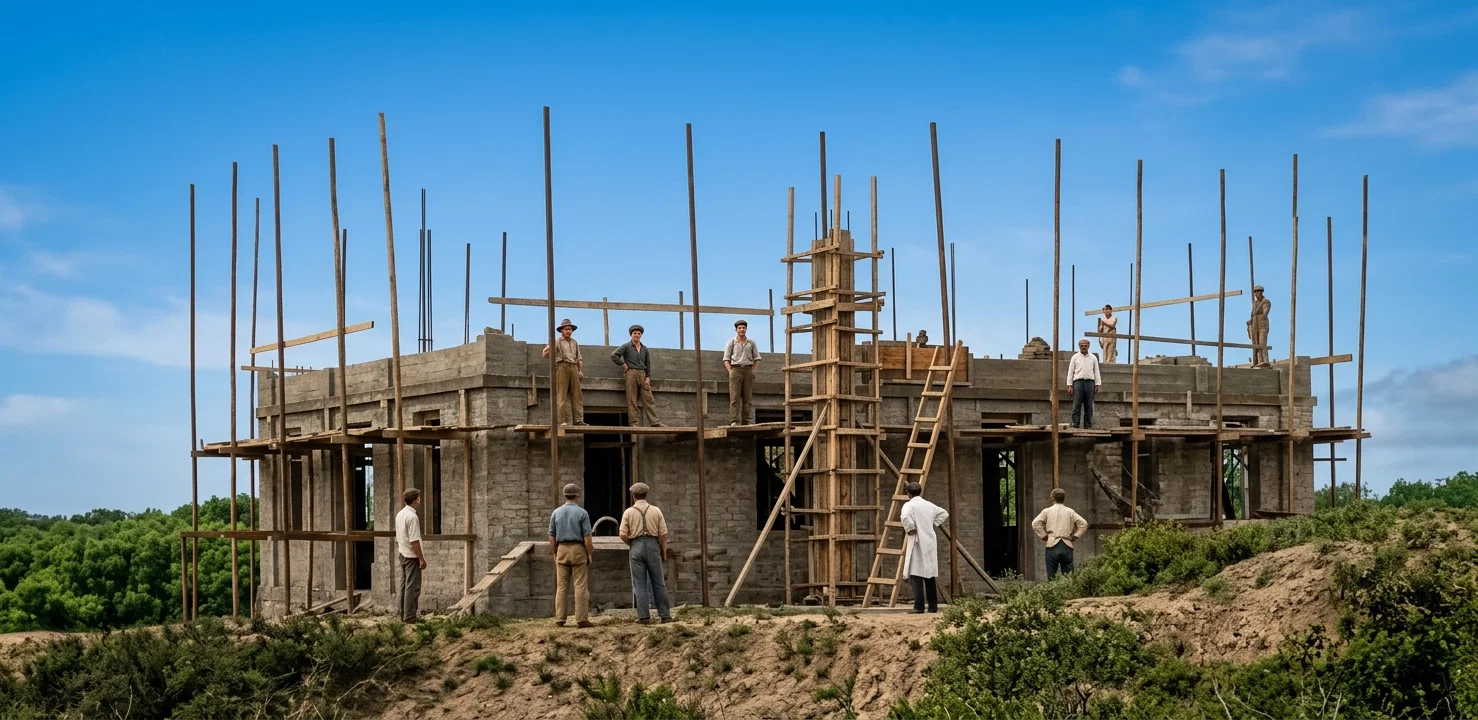
THE NEW DORMITORY AT DIAMANTE, ARGENTINA, BEING BUILT FROM MONEY PROVIDED BY THIRTEENTH SABBATH OFFERINGS GIVEN DEC. 27, 1913
Pakhoi and its vicinity have for several years suffered greatly from plague, but we are glad that thus far this year there has been very little if any of that disease here. However, at present there are in some sections a few cases of smallpox and dysentery. Our evangelist at Limchow lost his mother by dysentery about three weeks ago.
Two new provinces in China have been entered this year. In January, Elder Law Keem and family moved into Kwang-si, and already he has two companies of believers. In March, Brethren Allum and Warren went to open work in Szechuan, the largest province in China.
We are of good courage in the work, and desire the prayers of our brethren and sisters that the everlasting gospel may quickly go to the people of this land, and that we may be kept by the power of God, and be found ready to meet the Master when he comes a little while from this.
Pakhoi, South China.
[Brother Nagel’s letter follows, written from Wai Chow, May 9.]
LIKE thunder out of a clear sky, comes the sad news of Brother Wilbur’s death at Pakhoi, South China, May 1, 1914. Others will no doubt write of it, yet I desire to add a few words.
Personally, I feel the loss to our work here most keenly. Within the past few weeks three workers have left the South China Mission—nearly half of the remaining number, seven. Brother Bach left the work at Pakhoi, and Brother Wilbur went to take his place. Brother Hills found it necessary to return to the States, and Brother Anderson, from the Hakka field, went to take his place. This leaves me alone with the Hakka work. And now dear Brother Wilbur is called to lay down his burdens. Who can be sent to take his place is more than I know.
Our few workers are now so scattered that only one worker is in a place. Brother Wilbur died away off to the south, five hundred miles distant, he and his family all alone, with no one to help them. And as boats are not regular, though Brother George Harlow left as soon as he received the telegram, possibly two weeks will go by before he can reach that place.
This ought not to be. There should be at least two families in each division. One house stands empty in our compound, and it looks as if it would continue to be so until—I don’t know when.
South China is not like many other fields. We have many dialects, and therefore workers cannot be shifted very well from one place to another. At present Brother B. L. Anderson is at Amoy, Brother J. P. Anderson is in Swatow, Dr. Law Keem is in Kwang-si Province, Brother Ham is in Hongkong, Brother Meeker is at Canton, and we are at Wai Chow.
Brother Harlow, our superintendent, is not well. He was here at Wai Chow until the latter part of April. Returning home, he was sick and unable to be up for several days. He had just got up again when the telegram came saying Brother Wilbur was dead. He left at once at duty’s call for Pakhoi. This is a very hard trip, and unless God especially cares for him during this trying experience, he will return in a very critical condition.
Have you plenty more men to fill these broken ranks? The enemy of our souls is working fearfully hard in this field. If there are any workers who need the united prayers of God’s people, it is his missionaries to this people.
Brother Wilbur was a man greatly loved by the Chinese. When I told our workers of his death, at prayer meeting last evening, the tears flowed freely down their cheeks. He did faithful work, and I am sure he sleeps awaiting the trumpet call on the resurrection morning. The following lines fittingly apply to him:— > “Earnest, unselfish, consecrated, true, > With nothing but the noblest end in view; Choosing to toil in distant fields unknown, > Contented to be poor and little known. > Faithful to death! O man of God, well done! > Thy fight is ended, and thy crown is won.”