AFTER spending four months in Argentina and Uruguay, and attending the camp meeting and the session of the South American Union Conference, we sailed March 1, 1914, for our permanent field of labor.
En route we passed the Falkland Islands, a part of our field. These islands are situated about four hundred and fifty miles east of the Magellan Strait. The group is a British possession, containing twelve inhabited islands, and thirty or more uninhabited ones. Their surfaces are hilly, with many rocky points. No trees are found on them, but they have an abundance of grass, which furnishes pasture for thousands of sheep.
The entire population of the group is 2,400. Most of these are English-speaking people engaged in sheep raising.
Few vegetables are grown on the Falklands. All fruit and other provisions are imported. The climate is cold and windy, with considerable snow during long winters.
Stanley, the largest town and chief seaport, having a population of about nine hundred, is situated on the East Falkland. It has three schools, a Catholic, a Baptist, and a government school; three churches, Catholic, Baptist, and Episcopalian; two large stores, and five saloons.
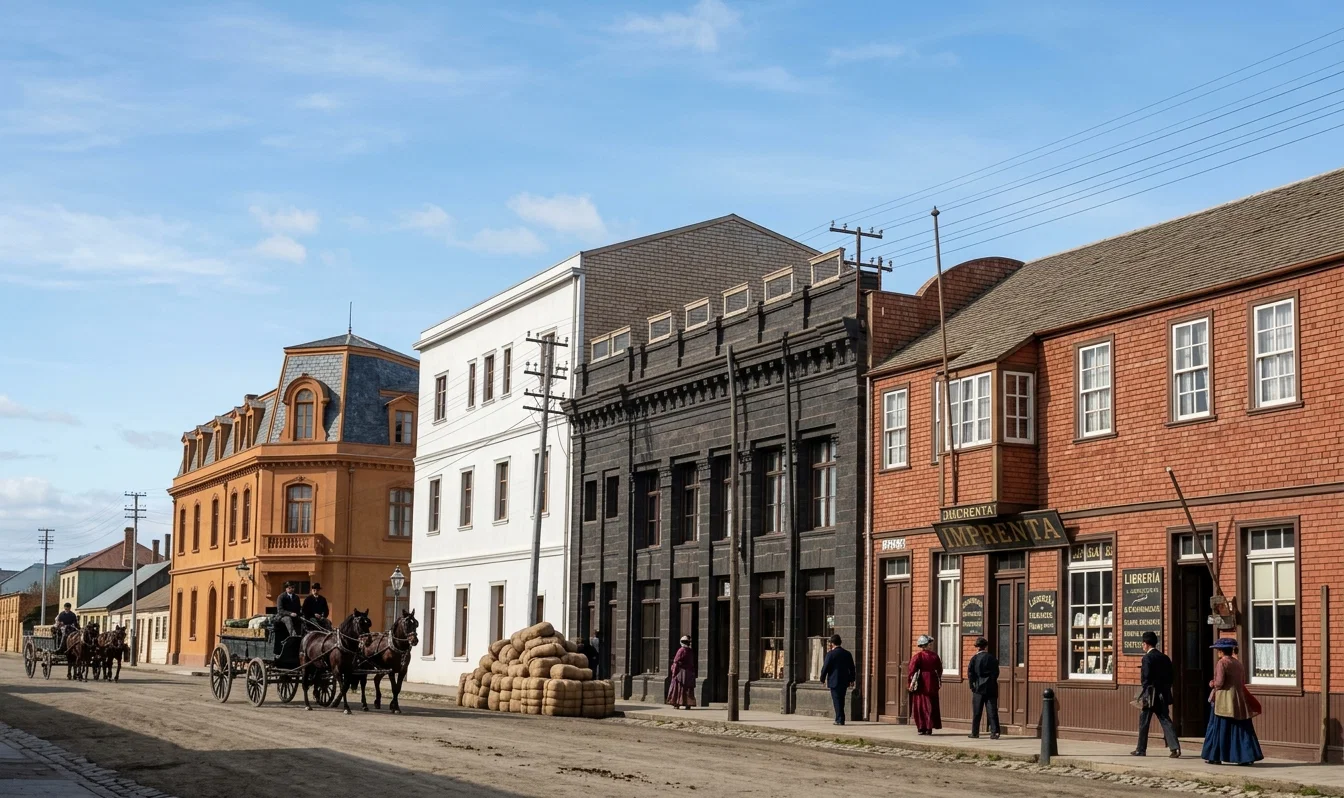
STREET IN PUNTA ARENAS, SOUTHERNMOST CITY IN SOUTH AMERICA
The Royal mail steamer stops at Stanley twice a month, bringing the mail and supplies for the islands.
These islands, with the territories of Santa Cruz and Chubut of Argentina, Magallanes of Chile, and the islands of Tierra del Fuego, constitute the southern mission field of South America.
There has never been a worker located here permanently. Several years ago a few books were sold on the Falklands and in Punta Arenas.
We reached Punta Arenas, our destination, on March 6, 1914. This is a thriving city of 17,000 inhabitants. It is made up of a cosmopolitan population. It is an important wool-shipping and coaling station. Being the distributing point in the south, nearly all vessels stop here on their way through the strait. It is a city only about fifteen years old, and is quite modern in many respects.
As we are giving this closing message to these people of the frozen regions of the south, we hope our brethren will remember us in their petitions at the throne of grace.