The 2300 Days of Daniel 8

1%

Review and Herald Publishing Association · Takoma Park Station, Washington, D. C. · Oct 11, 1915

FromReview and Herald, Vol. 92, No. 50.

Read the full edition

The 2300 Days of Daniel 8

A Bible Study

1. IMMEDIATELY after the vision of Daniel 8, what did Daniel learn from his study of the prophecy of Jeremiah?
“In the first year of Darius . . . I Daniel understood by books the number of the years, whereof the word of the Lord came to Jeremiah the prophet, that he would accomplish seventy years in the desolations of Jerusalem.” Dan. 9: 1, 2.
NOTE.— The first deportation to Babylon, when Daniel and his companions were carried captive, was in 606 B. C., and the 70 years of Jeremiah’s prophecy would therefore expire in 536 B. C. The first year of Darius was 538 B. C., and the restoration period was therefore only two years distant from that time.

Daniel’s Prayer for Light

2. What did the nearness of the time of restoration from captivity lead Daniel to do?
“And I set my face unto the Lord God, to seek by prayer and supplications, with fasting, and sackcloth, and ashes.” Verse 3.
3. What urgent petition of the prophet connects this prayer with the vision of the taking away of the continual mediation and the desolation of the sanctuary recorded in Daniel 8?
“Now therefore, O our God, hear the prayer of thy servant, and his supplications, and cause thy face to shine upon thy sanctuary that is desolate, for the Lord’s sake.” Dan. 9: 17.

Gabriel Sent to Explain the Vision

4. At the conclusion of Daniel’s prayer, what assurance did Gabriel give him?
“And he informed me, and talked with me, and said, O Daniel, I am now come forth to give thee skill to understand.” Verse 22.
5. What previous instruction connected with the vision of Daniel 8 was thus being more fully carried out?
“And I heard a man’s voice between the banks of Ulai, which called, and said, Gabriel, make this man to understand the vision.” Dan. 8: 16.
6. Why was further instruction concerning this vision necessary?
“And I Daniel fainted, and was sick certain days; afterward I rose up, and did the king’s business; and I was astonished at the vision, but none understood it.” Verse 27.
7. To what did Gabriel now direct Daniel’s attention?
“At the beginning of thy supplications the commandment came forth, and I am come to show thee; for thou art greatly beloved: therefore understand the matter, and consider the vision.” Dan. 9: 23.
NOTE.— There is abundant evidence that the instruction in the ninth chapter of Daniel supplements and interprets the vision of the eighth chapter. Note the following facts:—
a. Daniel did not understand the vision concerning the treading down of his people and the sanctuary, and therefore searched the prophecies anew concerning the period of captivity;
b. He evidently made a connection between the period of 70 years mentioned by Jeremiah and the 2300 days of the vision, and he at once began to pray earnestly for the restoration of the city and the sanctuary.
c. The angel Gabriel, who appeared to him at the first and interpreted all the vision with the exception of the 2300 days, now appears, and again directs his attention to the vision.
d. The events of the vision begin with the kingdom of the Medes and Persians, the era of the restoration of the Jews to their own land.
In the absence of any instruction to the contrary, this would be the natural time in which to locate the beginning of the period of 2300 days; and this is the very time given for the beginning of the 70 weeks, which are clearly a part of the 2300 days, and thus determine the time of their commencement.
e. The 70 weeks, or 490 years, extended from the restoration of literal Jerusalem and the literal temple to the preaching of the gospel to all the world. See Acts 15: 14-17. This special preaching of the gospel was completed in one generation, and was followed by the destruction of Jerusalem.
f. The 2300 prophetic days, or 2300 literal years, begin at the same time as the 490 years, or 70 weeks, or in 457 B. C., when the commandment to restore and to build Jerusalem went forth; and extend from the restoration of literal Jerusalem and the typical temple service after the captivity in ancient Babylon, in the time of the Medes and Persians, to A. D. 1844, the time for the restoration of spiritual Jerusalem and of the knowledge of the mediation of Christ in the heavenly sanctuary, taken away by the little horn, after the captivity in modern Babylon. This work of restoration is to be accomplished in one generation by preaching the gospel to all the world (Rev. 14: 6-12), and this will be followed by the destruction of the world, or the fall of all nations, of which the destruction of Jerusalem was a type.

The Seventy Weeks

8. What portion of the 2300 days (years) mentioned in the vision, was allotted to the Jews?
“Seventy weeks are determined upon thy people and upon thy holy city.” Verse 24, first clause.
NOTE.— “As both the 2300 years of chapter 8 and the ‘seventy weeks’ of chapter 9 start from the Persian period of Jewish history, in other words, as they both date from the restoration era which followed the Babylonian captivity, their starting points must be either identical or closely related chronologically.”—“A Light for the Last Days,” by H. Grattan Guinness, London, Hodder & Stoughton, 1893, page 183.
“There is plainly a close correspondence between the two visions of Daniel 8 and 9. The 70 weeks are said to be cut off for certain distinct objects; and this implies a longer period from which they are separated, either the course of time in general or some period distinctly revealed. Now the previous date [the 2300 days] includes two events,—the restoration of the sacrifice, and the desolation. The first of these is identical in character with the 70 weeks, which are a period of the restored polity of Jerusalem; and hence the most natural of the cutting off is that which refers to the whole period of the former vision.”—“First Elements of Sacred Prophecy,” by T. R. Birks, London, 1843, pages 359, 360.
9. What was to be accomplished at the close of the 70 weeks?
“To finish the transgression, and to make an end of sins, and to make reconciliation for iniquity, and to bring in everlasting righteousness, and to seal up the vision and prophecy, and to anoint the Most Holy.” Verse 24, latter part.
NOTE.— For “the Most Holy,” the Douay Version reads, “the Saint of saints.”
10. What portion of this period was to reach to Christ, the Messiah, or Anointed One?
“Know therefore and understand, that from the going forth of the commandment to restore and to build Jerusalem unto the Messiah the Prince shall be seven weeks, and threescore and two weeks.” Verse 25, first part.
NOTE.— The word Messiah means anointed, and Jesus was anointed with the Holy Spirit (Acts 10: 38) at his baptism, in A. D. 27. Matt. 3: 16.
11. At the end of this time, what was to be done to Messiah?
“And after threescore and two weeks shall Messiah be cut off.” Verse 26, first part.
12. How was the destruction of Jerusalem and the sanctuary by the Romans then foretold?
“And the people of the prince that shall come shall destroy the city and the sanctuary; and the end thereof shall be with a flood, and unto the end of the war desolations are determined.” Verse 26, last part.

The One Week

13. What was Messiah to do during the seventieth week?
“And he shall confirm the covenant with many for one week.” Verse 27, first clause. See Matt. 26: 26-28.
14. What was he to take away in the midst of this week?
“And in the midst of the week he shall cause the sacrifice and the oblation to cease.” Verse 27, next clause.
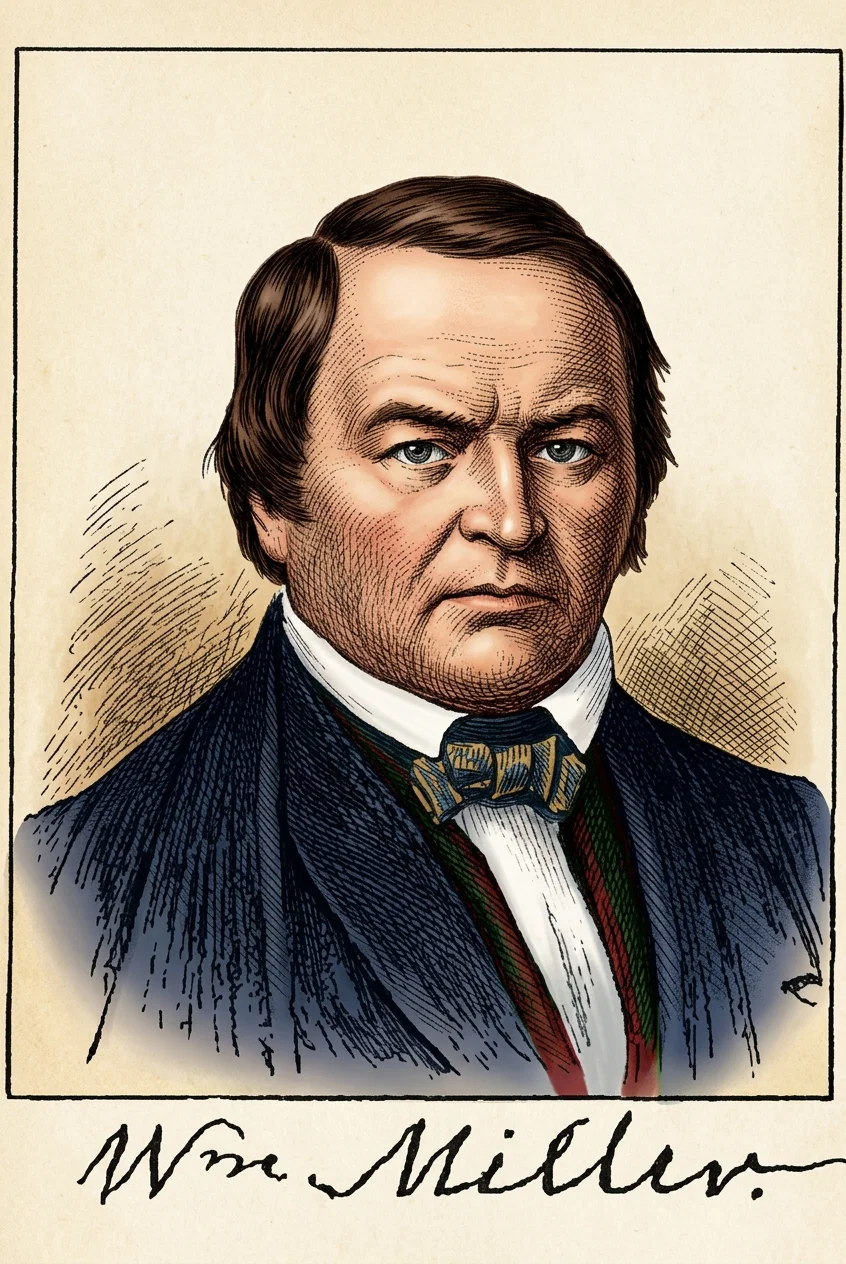
Wm. Miller.
Wm. Miller.
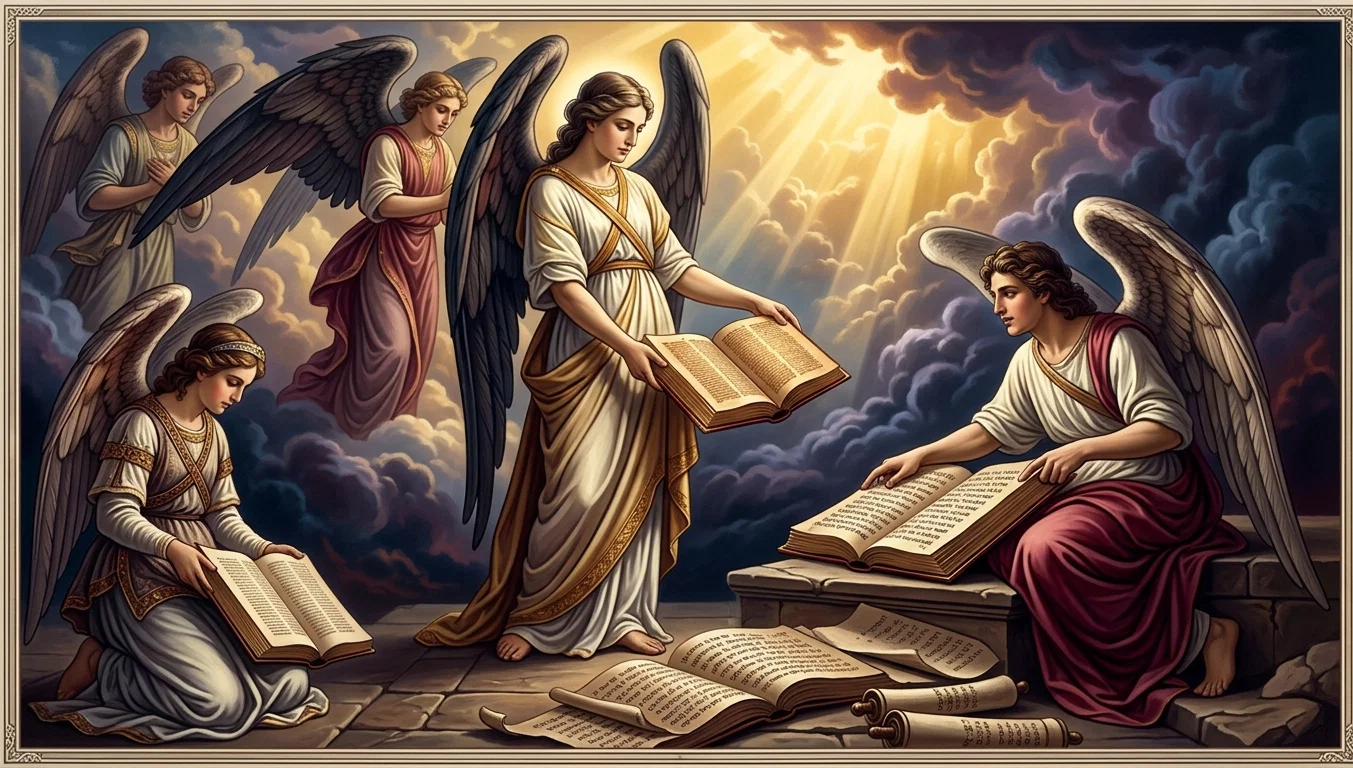
THE JUDGMENT WAS SET, AND THE BOOKS WERE OPENED. DAN. 7:10
NOTE.— Ancient Babylon took away the typical service by the destruction of the temple at the capture of Jerusalem. This service was restored at the rebuilding of Jerusalem, but was perverted into mere formalism by the Jews, and was taken away by Christ at the first advent, when he blotted out the handwriting of ordinances, and “took it out of the way, nailing it to his cross.” Col. 2: 14. He then became “a minister of the sanctuary, and of the true tabernacle, which the Lord pitched, and not man.” Heb. 8: 2. Thus he established the service in the heavenly sanctuary. The little horn, the Papacy, as far as was within its power, took away from the people the mediation of Christ in the heavenly sanctuary, and substituted for it the Roman priesthood, with the Pope as Pontifex Maximus, or high priest. Power over this truth of the gospel and over the people of God was allowed to the Papacy because of transgression (Dan. 8: 12, R. V.), just as the people of Jerusalem were given into the hands of the king of ancient Babylon for the same reason. 1 Chron. 9: 1. Thus has the Papacy “cast down the truth to the ground,” and has trodden underfoot the sanctuary and the people of God.
15. How are the judgments upon Jerusalem again foretold?
“And for the overspreading of abominations he shall make it desolate, even until the consummation, and that determined shall be poured upon the desolate.” Remainder of verse 27.
NOTE.— Seventy weeks would be 490 days; and as a day in prophecy represents a year (Num. 14: 34; Eze. 4: 6), this period would be 490 years. The commandment to restore and build Jerusalem was brought to its completion by Artaxerxes Longimanus in the seventh year of his reign (Ezra 6: 14; 7: 7, 8), which, as already noted, was 457 B. C. From this date the 69 weeks, or 483 years, would extend to the baptism of Christ, in A. D. 27, and the whole period to A. D. 34, when the martyrdom of Stephen occurred, and the gospel began to be preached to the Gentiles. Before the end of that generation, Jerusalem was destroyed by the Romans, A. D. 70. The 2300 years would extend from 457 B. C. to A. D. 1844, when began the great second advent movement, which calls upon all to come out of modern Babylon, and to prepare for the next great event, the coming of Christ and the destruction of the world by fire. “Nevertheless we, according to his promise, look for new heavens and a new earth.”

The Full Period of 2300 Days

16. What question was asked in the vision of Daniel 8?
“Then I heard a holy one speaking; and another holy one said unto that certain one which spake, How long shall be the vision concerning the continual burnt offering, and the transgression that maketh desolate, to give both the sanctuary and the host to be trodden underfoot?” Dan. 8: 13.
NOTE.— Literal Jerusalem was given into the hands of ancient Babylon, and the typical service in the earthly sanctuary was thus taken away. Dan. 1: 1, 2. This was prophetic of the experience of spiritual Jerusalem in modern Babylon, foretold in the prophecies of Daniel and John, and of the taking away of the mediation of Christ in the heavenly sanctuary. Dan. 7: 25; 8: 13. These two visions expose the work of modern Babylon, the Papacy, and determine the limit of its permitted power over the people of God, and of its perversion of the gospel of Christ in substituting another ecclesiastical system for the work of Christ in the heavenly sanctuary.
The general theme upon which the book of Daniel treats is Babylon, both ancient and modern. Chapters 1-6, inclusive, present certain historical facts leading up to the fall of ancient Babylon, and an attempt to destroy the prophet Daniel himself, and the final attempt to destroy the people of God,—a brief historical outline, which is in itself a prophecy of modern Babylon. Chapters 7-9, inclusive, contain prophecies relating especially to modern Babylon, which supplement the historical prophecy of the previous chapters, and enable us to draw a very exact and striking parallel between ancient and modern Babylon. A brief outline of this parallel may be stated thus:—
a. In the religion of ancient Babylon, image worship found a prominent place. The same is true of modern Babylon.
b. Ancient Babylon affirmed that the gods (or God) dwelt not in the flesh. By the dogma of the Immaculate Conception of the Virgin Mary (that is, that she herself was born without the taint of original sin), modern Babylon teaches that God, in the person of his Son, did not take the same flesh with us; that is, sinful flesh.
c. Ancient Babylon persecuted those who refused to accept her dogmas and worship according to her laws. Modern Babylon has done the same.
d. The king of ancient Babylon set himself above God, and attempted to make his kingdom an everlasting kingdom. So does modern Babylon.
e. Ancient Babylon rejected the true gospel as taught to Nebuchadnezzar, and the fall of Babylon came in consequence. Modern Babylon has done the same in her rejection of the true gospel as brought to her in the Reformation, and her fall is inevitable and impending.
f. The fall of ancient Babylon came just at the time when it was giving expression to its contempt of all its enemies, and its confidence in its own permanence. This experience will be repeated in the history of modern Babylon.
17. What prophetic period, therefore, extends to the deliverance of God’s people from captivity in modern Babylon, and the restoration to them of the mediation of Christ?
“And he said unto me, Unto two thousand and three hundred days; then shall the sanctuary be cleansed.” Verse 14.
NOTE.— The earthly sanctuary was a type of the heavenly sanctuary (Heb. 9: 23, 24; Lev. 16: 29, 30, 33); the cleansing of the earthly sanctuary was typical of the cleansing in the heavenly sanctuary; and this cleansing of the sanctuary accomplished on the great day of atonement is the closing work of Christ in his mediation for sin. And the commencement of the cleansing of the heavenly sanctuary marks the beginning of a new era in the experience of the people of God on earth; namely, the deliverance from the power of modern Babylon, the restoration to them of the knowledge of the mediation of Christ for them in the heavenly sanctuary, and a cleansing from sin in preparation for the second advent of Christ. The cleansing of the heavenly sanctuary involves the investigative judgment, which will be followed by the plagues and by Christ’s coming. This period, therefore, determines the time of restoration and of judgment.