Conditions in Peru

8%

Review and Herald Publishing Association · Takoma Park Station, Washington, D. C. · Feb 10, 1916

FromReview and Herald, Vol. 93, No. 8.

Read the full edition

Conditions in Peru

A. L. WESTPHAL
“THEY bear him upon the shoulder, they carry him, and set him in his place, and he standeth; from his place shall he not remove: yea, one shall cry unto him, yet can he not answer, nor save him out of his trouble.”
These words of Isaiah were forcibly impressed on my mind this morning as I stood on the principal square of Lima and watched the surging masses gathered to do homage to the “Lord of Miracles.” Since early morning the Plaza de Armas and the street leading to the church of Santo Domingo, half a block from our office, have been filled with the lay religious fraternity, in purple frocks, who have charge of the ceremony. The procession left the church a block distant, but the people are crowding in to get a better view of the ceremony.
First come banners of the Holy Heart and other such emblems, followed by crowds of the faithful with burning tapers, intermingled with gray-haired men and smooth-faced youth wearing the purple gown of their fraternity. The principal feature of the procession is still half a block away, but every head is bare awaiting its arrival. The “Lord of Miracles” is still a hundred yards away when there pass three lamps on staffs, made after the fashion of the old kerosene street lamps of days gone by, those on the outside being surmounted by angels and the middle one by the cross and other emblems. Frankincense fills the air, while the chant of singers resounds through the narrow street.
Now there come enormous candles of two and three inches in diameter, and one just in front of the carriers is at least four inches through and a yard and a half long. This time it is not an image, but an oil painting of the crucified Saviour that is being venerated. On a platform with handles there stands a painting of the Saviour on the cross, and back of this, facing the opposite direction, is one of the Holy Virgin with the Babe, and Joseph kneeling in reverence near. Surrounding these pictures on the platform are many flowers and also lighted candles of all sizes.
Carrying this “Lord of Miracles” are about twenty-four men, who sway back and forth to the music of a military band. Next comes the officiating priest, who, in the robes and miter of his office, and escorted by six youth carrying a scarlet canopy over his head, mumbles prayers out of his prayer book almost faster than he can make his mouth go. On either side fifteen to twenty policemen in parade dress,—white gloves, plumes, etc.,—accompany the procession, to do homage to the idol. As it passes, officers and soldiers who are watching stand at attention, while a few devout women fall on their knees. The crowd still fills the street, although the procession has gone on half a block.
As we see these poor, deluded people bowing down to wood and stone, silver and gold, our hearts go out in pity for them, and we feel as never before the need of giving them this last saving message.
These religious feasts are the curse of the land, as they lead to feasting and carousing. A few weeks ago I was in the interior where they had been feasting already four days, celebrating the patron saint of the village. At midnight we still heard the music and dancing, and were awakened at four in the morning by the strains of the band, while feasting, drinking, immorality, and strife were rife. No wonder that intelligent and progressive people express themselves as did a representative in congress a few weeks ago when the election of a bishop for Puno was being discussed. He said that the clergy and bishops with their religious feasts were brutalizing, exploiting, and alcoholizing the people. He was sure that if Christ would come to earth, he would not become their leader.
Slowly there is coming a change over the people, and I am told that each year the processions are losing some of their splendor and pomp of years ago. I know of two places in the interior where the communities have decided not to have any more feasts, and in one place it was decided to open a school with the money and educate their children.
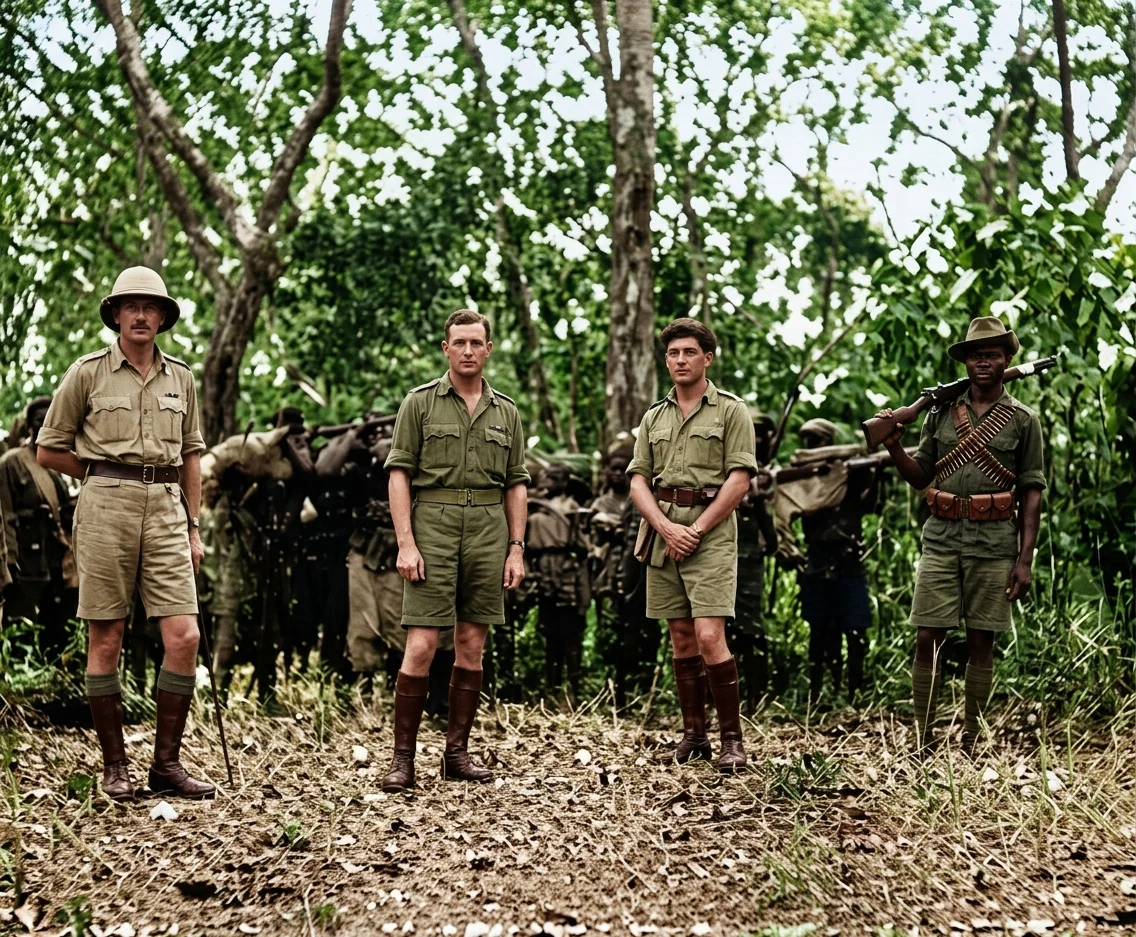
BRITISH OFFICERS NEAR KONGO BORDER
From different places there come to us calls for teachers to teach the gospel, but for lack of workers we are unable to respond. Shall we allow those who wish to know the light to stay in darkness? Shall we rest comfortably in the knowledge of God's love without taking it to those who do not know it? Our earnest prayer is that God may send workers now into his great white harvest field.
Lima.