The Catholic Mirror, the official organ of Cardinal Gibbons, in its issue of June 12, 1897, reports a discourse by Father O'Keefe, delivered the Sunday before, in which some very grave charges are made from the Roman Catholic standpoint against Protestants in general. Mr. O'Keefe gives a concluding summary of a series of discourses he has been delivering in answer to some sermons of a Protestant pastor in Baltimore. The pastor maintained the Protestant doctrine that “the Bible is the word of God, his mouthpiece to us—our guide and our treasure.”
Mr. O'Keefe, on the contrary, held, in accordance with the established Catholic view, that the Bible is not a sufficient rule of Christian faith, but that it must be supplemented and supported by the traditions, interpretations, and authority of the Catholic Church.
True Protestants believe, as stated by Chillingworth, that “the Bible only is the religion of Protestants.” And when this fundamental principle is assailed in such strong terms as those employed by Mr. O'Keefe, it is important that every Protestant shall closely examine the foundations of his faith and practice, and be assured of the ground on which he is standing.
The following quotations are extracted from the report of Father O'Keefe's discourse, omitting such portions as are so personal and local in character as to be wanting in interest to the general reader. Mr. O'Keefe says:—
“[Reverend —] affects to believe it [the Bible] to be the embodiment of God's will toward man addressed to him under that form, as expressed within its pages and covers. He pretends to cherish it beyond every earthly treasure; he proposes to look to it for counsel and instruction in all that appertains to the present and future life. In a word, he almost imagines he hears the voice of God speaking through its pages. He is himself against all gainsayers who would disparage or seek to detract from its divine origin. And yet this [Reverend —], with the intense, and almost idolatrous worship of his Bible, if we take his word for it, has, I boldly assert, proved himself a base traitor to his own avowed principles, and abandoning that highly cherished boon and spiritual gift and treasure, has, with a treachery unparalleled in the annals of human sophistry, delivered himself and his following over to the Catholic Church, as surely as Judas sold his Master for thirty pieces of silver—a church that he never ceases to stigmatize and revile.
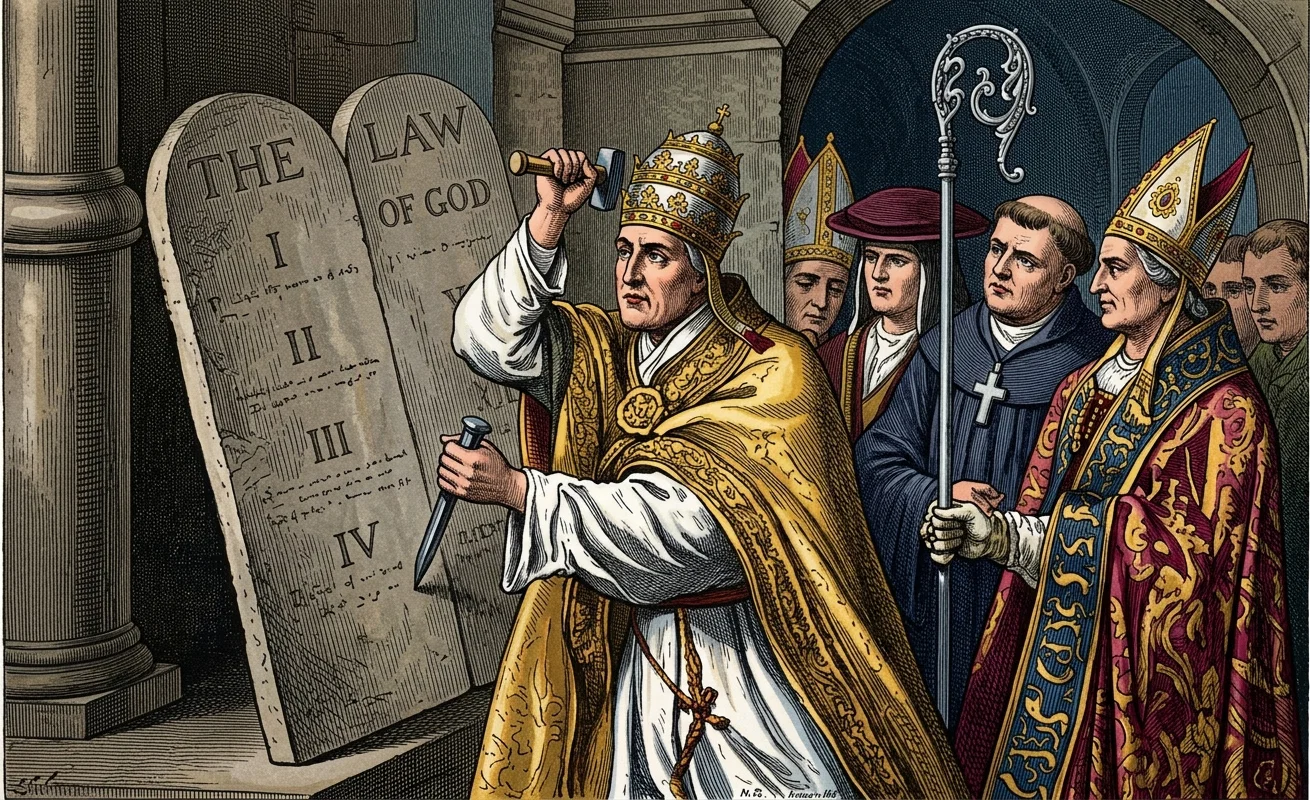
HE SHALL THINK TO CHANGE TIMES AND LAWS
“With the piercing appeal made with so much agonizing pathos, ‘Have we no Bible that logic and priests cannot destroy?’ before our minds, let us seek a correct appreciation of its sincerity.
“Before, however, doing this, let us investigate the true inwardness of this frantic appeal.
“‘The Bible is the word of God, his mouthpiece to us—our guide and our treasure. We clasp it to our heart of hearts daily, as did once—and ever after—the great Luther, when he discovered for the first time the chained copy in the library. It is the direct expression of “the way, the truth, and the life,” to us and all evangelical Christians. Without it and its soothing influences we should be lost both here and hereafter, etc.’”
“But this consoling picture happens to have a reverse side also; and as Dr. — has put it so aptly, ‘The great purpose of Protestant ministers must be to uphold the inspiration of the Scriptures,’ let us calmly inquire as to the record of the same Protestant ministers for more than ten generations, touching their respect for, and adherence to, the teachings of their inspired guide. Let me ask what teaching of Protestantism is more impressively inculcated by the ministers, in season and out of season, than the sanctification of the Sabbath? There is no lesson better conned in the Sunday school; none from the pulpit more energetically impressed than this, grounded in indelible characters on every page of our Bible. And yet a greater mockery, delusion, and snare was never before sought to be palmed off on the unsuspecting masses of Protestantism.
“Open the Bible with the book of Genesis,—when God rested from creation on the seventh day, called thereafter Sabbath, because God rested on that day,—and peruse every page of the Old Testament, and the New to the last page of the Revelation, and point me to a single passage or word in the Bible that deviates in the slightest point from the day of rest taken by the Creator, in the divine injunction, not only authorized but actually kept by the Master and his apostles.
“The Hebrew people have undeviatingly handed down this day of rest by keeping it every week since the command, ‘Remember the Sabbath day, to keep it holy,’ was promulgated, until last Saturday. They have the divine injunction for this obligation in their Bible, which they hold to be God’s Word; and it is equally certain that for over sixty years from the origin of Christianity, of which the Gospels and the Acts of the Apostles are, in the estimation of Protestants, their own witnesses, no word or act from the Master or the apostles has ever furnished any indication of a change of day.
“And here we are reminded furthermore of the perennial cry of the Reverend Doctor, ‘Have we no Bible that logic and priests cannot destroy?’ I answer emphatically, ‘You have a Bible, whether a divine or human work you cannot say, which you have been persistently antagonizing every week of your life. That guide and teacher of yours, which you hypocritically profess to regard as the word of God, orders you, under severe penalties, to keep the Sabbath day; that day first kept by the Redeemer every week while on earth; the same day kept to this hour by the Hebrew people, who in this particular are consistent followers of their and your Bible. Let me here ask this redoubtable champion of Protestantism whether he and his blinded followers have once obeyed during their whole lives this highly treasured teacher. I can answer for him and them most emphatically, No! What excuse or subterfuge can be offered by them in palliation of this lifelong infraction of a commandment which God himself calls a perpetual covenant?—None whatsoever. And does he not declare that the penalty of its infraction is death?—All this is undeniable. But have they no excuse to offer for their treachery to their inspired teacher?—None whatsoever.’”
All Protestantism stands this day before the world convicted of the grossest treachery toward their teacher, the Bible, without the shadow of excuse for their treason. And what is far worse, they have abandoned their divine guide, the Bible, and accepted the practice of the Catholic Church, which they stigmatize as a corrupt organization, steeped in error, while their own action in this particular brands them as the most illogical, self-convicted organization on earth.
“Before concluding this discourse, I will take occasion to address my remarks to Dr. — personally.
“You cannot help feeling, now that you have entered on the recent controversy, altogether unequipped with the qualifications necessary, whether natural or acquired. And I would suggest that, as an honest man who has the courage of his convictions, you have no resource left other than to apprise the good people who look to you for guidance, of the fact that a change has come over the spirit of your dream, which I will take the liberty to outline for you. You may use the following words or their equivalent in your own language:—
“‘Brethren, you are well aware of my recent encounter with a Catholic priest touching the origin of our dearly cherished teacher, the Bible. . . . Did you ever suspect that you had never once kept the Sabbath of the Lord? When I recall the earnest appeals made by me from this and other pulpits to my people to sanctify the Sabbath, and my manifold and severe remonstrances against its desecration, I feel mortified beyond expression that all my eloquence has been misspent and misapplied. Our Bible teaches absolutely that the Lord’s Sabbath is Saturday, not Sunday, and we have never kept it. Thus we are stranded high and dry by our apostasy in abandoning our teacher, the Bible, and borrowing Rome’s day. But what are we to do in the future? We may as well view the situation squarely.’”
“‘We can go on as ever, living down public sentiment and sound logical principles, but where is the truth—where the honesty involved in such a proceeding? This would be rank hypocrisy. On the other hand, if we adhere to its teaching, it is necessary as an honest man to brave all opposition, and decide on obeying God’s command to keep with the Jews the Bible Sabbath, and meet hereafter each Saturday, instead of Sunday. Honesty and truth demand this course.’”
“‘But there is still another alternative left. We are indebted to Rome for the Sunday arrangement. . . . Let us give her a hearing. If her claim can be maintained, we are no longer without a divine teacher, and that teacher ensures us the possession of Sunday. “All’s well that ends well.”’”
Such a challenge as the foregoing, thrown into the face of the Protestant world by a representative of the Catholic Church, should receive the candid consideration that the importance of the subject demands. We should investigate this matter, and on finding that the papal claim is true, should return to the Word of God, and reverently observe the seventh day, the Lord’s Sabbath, instead of the first day of the week as substituted by the Church of Rome.