Special Mention

8%

Review and Herald Publishing Association · Tacoma Park Station, Washington, D. C. · Mar 16, 1916

FromReview and Herald, Vol. 93, No. 14.

Read the full edition

Special Mention

The Burning of the College View — Branch of the Pacific Press Publishing Association
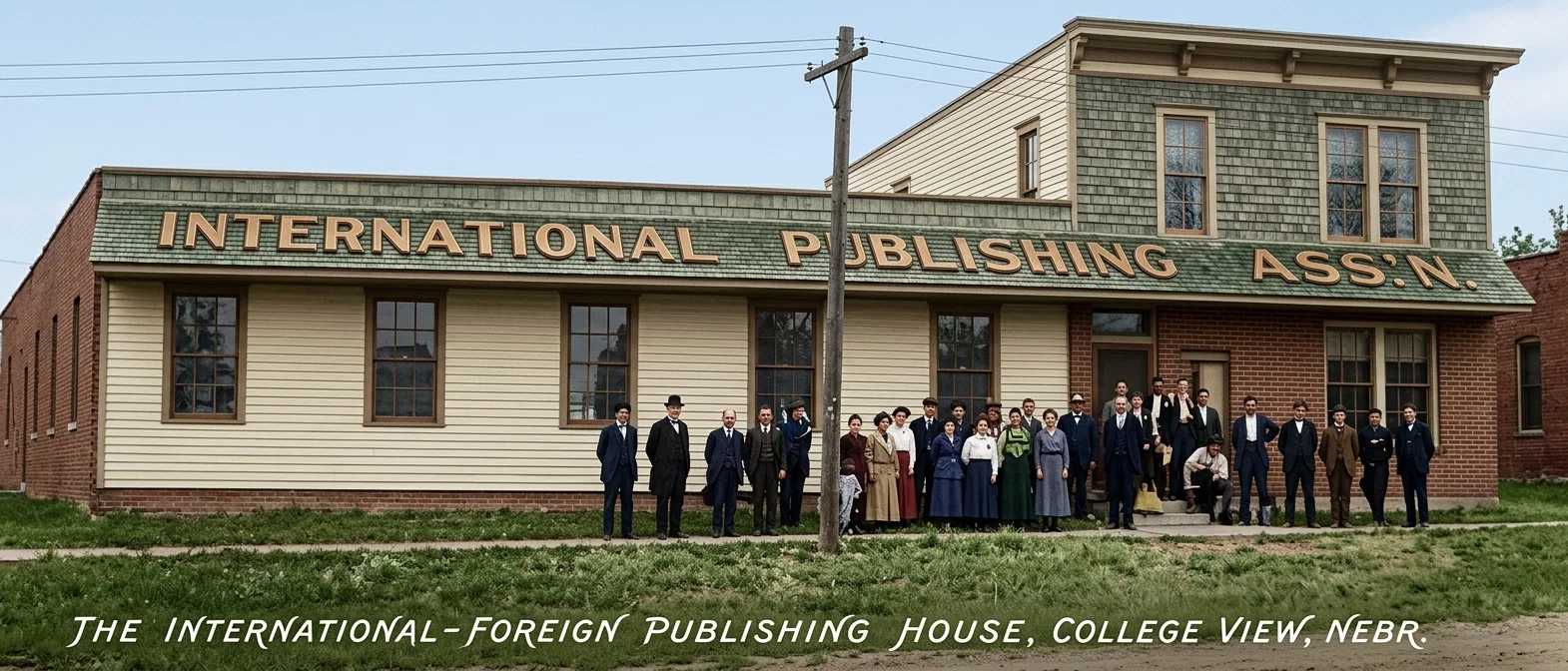
SUNDAY morning, February 27, just as we were finishing our usual worship, Brother F. F. Byington detected the odor of fire. He opened the stock room door adjoining our business office, and a blinding cloud of smoke poured in upon our assembled workers. The fire had evidently started in the basement, where the heating plant was located, and had already burned through the floor.
The alarm was given. The local fire company responded quickly, as did also one company from Lincoln, who made the five-mile run in eight minutes. But the fire had already gained such headway that in spite of the very best efforts of both companies, it enveloped the entire building almost immediately. It was with great difficulty that the adjoining buildings were saved. The smoke was so dense that, when a person was once out, it was dangerous to reenter the building; therefore but little could be done to save its contents. Only the adding machine, four typewriters, and an office chair were carried out. Several of the employees lost their coats and hats.
COLLEGE VIEW BRANCH OF THE PACIFIC PRESS PUBLISHING ASSOCIATION
Fortunately, all the mailing lists for our periodicals were saved, as were also valuable records contained in the safe. Our plates in a vault separate from the building are, of course, intact. A portion of our signatures are kept in a separate building on the rear of the lot, and these were also saved. Everything else—our entire stock of books, tracts, and Bibles, inventoried at about $8,000; our machinery plant; paper stock, including a $2,000 carload of paper just received; editorial libraries; and all in the way of office equipment—was lost. The total loss will be in the vicinity of $30,000. Our insurance is a little over $20,000. The adjuster has not arrived, so we are not able to state the net loss.

Our Present Plans

We immediately telephoned to Kansas City, knowing that both H. H. Hall and S. N. Curtiss were there. They came on the first train, and are still with us, assisting in making temporary plans for our work. This week's papers will be printed in Lincoln, and as our lists are intact, will go forward with only a few days' delay. These are the Deutscher Arbeiter, the German church paper; the Evangelisches Sendebuch, the Danish-Norwegian missionary paper; and the Tidens Tecken, the Swedish weekly Signs of the Times. The Christlicher Hausfreund will be mailed on time.
The cashier of the Bank of College View, Mr. S. J. Quantock, invited us to make our temporary headquarters over the bank, which adjoins our ruins. Pres. H. A. Morrison of Union College has given our editors a large, pleasant room in the main building of the college, where they are hard at work preparing new copy. Their manuscript, translations, and copy of every description were destroyed. Under these trying conditions we feel that these men ought to be especially remembered in our prayers.
Brother Curtiss brought with him copies of the inventories of the books, tracts, and pamphlets in all foreign languages which are on hand at our various depositories throughout the United States. We have also similar lists from some tract societies. All these stocks are being listed so that orders can be promptly forwarded to offices having stock. This enables us to act as a clearing house for foreign literature, just as we have done heretofore. Therefore let no one withhold orders, as we believe the stock available will tide us over until we can reprint. Our latest German, Danish-Norwegian, and Swedish catalogues and tract announcements had just been put into the hands of our tract societies, and may be relied upon as giving up-to-date lists of our publications in these languages.

The Help Needed

The work which has called this institution into being—the preparation and circulation of literature in foreign languages in this country—will go forward. We have faith to believe that this very calamity will awaken the interest of our foreign-speaking brethren and sisters to renewed missionary activity. Letters and telegrams already received indicate that this is the case. We are appealing to them to help us by sending in good lists of subscriptions to our missionary papers, and by supplying themselves more liberally than ever before with the tracts, pamphlets, and books in their various languages.
Will not our English brethren and sisters everywhere respond to a similar appeal? In nearly every community there live foreigners to whom the message should be carried in their own language. Instead of becoming disheartened because of the loss which has been sustained, will not our people everywhere take a new interest in the circulation of our foreign literature? This is what will bring out of this loss a great blessing to our work among the foreigners in this country. May we not, therefore, expect this help from you? J. R. FERREN.