The General Conference

2%

Review and Herald Publishing Association · Takoma Park Station, Washington, D. C. · Jun 19, 1913

FromReview and Herald, Vol. 90, No. 25.

Read the full edition

The General Conference

Thirty-Eighth Session, May 15 to June 8, 1913

Thirtieth Meeting

June 4, 10 A. M.
L. R. CONRADI in the chair.
J. F. Huenergardt offered prayer.
L. R. Conradi: The first matter this morning will be found on page 263 of the Bulletin [page 567 of last week's REVIEW], unfinished business, the partial report from the committee on plans.
Resolution 23 was read, requesting the publishing houses to prepare a series of tracts for sale by colporteurs.
Mrs. S. N. Haskell: There are possibilities in the tract work that we do not realize. Tracts can be arranged in packages and sold so that individuals can earn a good living while selling the tracts, and our tracts meet a larger percentage of people than any other class of literature that we distribute. It has been demonstrated that a large proportion have received their first light from the tracts, and I feel quite anxious for this. In city work my husband and I have taken the tracts in large quantities, and have demonstrated over and over again that workers make a good living when handling the tracts. One young man who went to the foreign field last year supported himself during an institute in San Francisco selling tracts at five, ten, and fifteen cents a package. He found that all classes bought readily. They would buy tracts when they would not buy papers, because they would see in the tracts some subject that attracted their attention; and we have felt very anxious that the tracts be placed at a price so that our workers can support themselves selling the tracts the same as selling the periodicals. They can be sold everywhere if this is done.
C. H. Jones: I am sure that our publishing houses will be glad to respond to the call for a series of tracts put up in this way. The interest in the circulation of our tracts is increasing all over the field very rapidly. It has been gradually increasing, until last year our sales exceeded the sales of any other year by far. This year we printed at the beginning of the year a large quantity, thinking we would have enough to supply the field for a year; but we have just received word from Mountain View stating that the tracts are getting low, and that already this year we have sold about a million and a half copies. That is as much as we sold during all of last year. We are now printing another edition to supply the demand.
L. R. Conradi: These are surely cheering reports. Are we ready to go on? Question called.
Recommendations 24 and 25 were read, and question called without discussion.
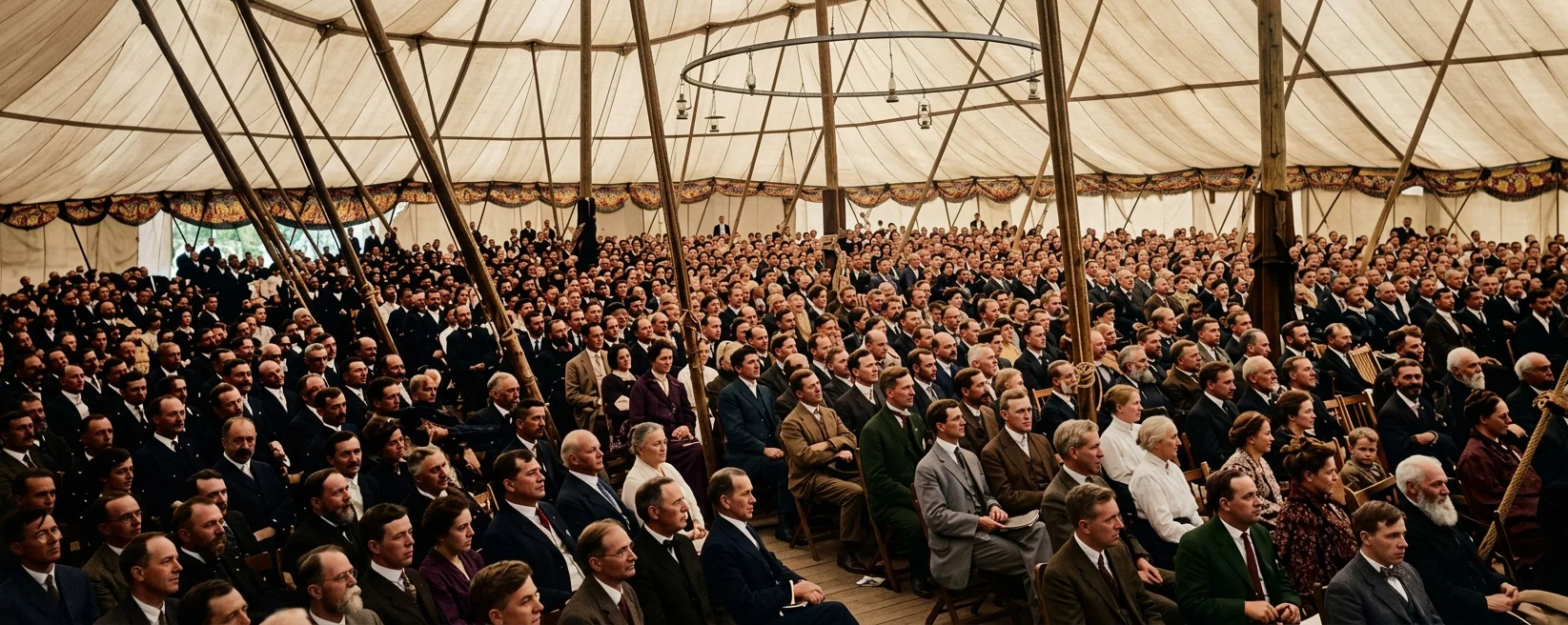
THE GENERAL CONFERENCE IN SESSION
Number 26 was read, recommending that the word division be dropped from the technical name for the North American and European Division Conferences. It was moved that recommendation 26 be eliminated from the report. The motion prevailed.
Item 27 was read, and question called.
Item 28 was read, relating to the West Indian Union.
G. M. Brown: I wish to call attention of the Conference to the fact that in the first part of the preamble it says, “In view of the request that has come from the West Indian Union that their Spanish territory be turned over,” then the recommendation is that the whole union be turned over. Now, brethren, there is such a thing as too much of a good thing. I believe the West Indian Union Conference representatives and delegates in this Conference would be in hearty sympathy with the idea of turning over this Spanish territory, but I do not believe these delegates would be in harmony with this resolution. And I believe, further, that there has not been the counsel with this delegation concerning this change of plan that there should have been. I move that this resolution be referred back to the committee for further consideration, and counsel with the union delegation.
The motion to refer prevailed, and the whole report was adopted, save for portions referred.
L. R. Conradi: I think there was a section of the General Conference constitution referred back to the committee on constitution. Brother Bartlett will please present the report. I would say this is the matter of delegation, whether the basis shall be one thousand or five hundred. The majority of the members favor a thousand; a few favor five hundred; but we all felt we ought to leave it as it is if it makes a long discussion.
W. T. Bartlett: The section referred back to the committee was Article III, Section 5. But the committee's report asks that a change be made also in Section 4.
[The two sections as changed will appear in these minutes at the close of the discussion, on motion to adopt. The change in Section 4 was accepted without discussion. The report on Section 5 recommended that the numerical basis of representation be one delegate for each thousand members, instead of five hundred, as in the past.]
E. R. Palmer: I do not wish to enter into a long discussion of this proposition, but, believing sincerely that it is wrong, and that it will work an unpleasant hardship in our conferences, I would not like to see it pass without some remark concerning it. I would like to state first practically the wise counsel that our president gave us a few minutes ago,—that we try this for a term and see how it works after this reorganization. We have been on this other basis for a considerable time. That basis has not been sufficient to enable our union conferences to send to this Conference the delegates that they desired to send, and at the opening of this Conference twenty or twenty-five representatives of departments and large institutions were admitted here as delegates at large because the five-hundred basis of representation, in several union conferences, did not admit of sufficient delegation. The foreign fields are not affected by this seriously, because they can control their delegation. We can do the same; but if we cut down the basis of representation, then we are limited in our union conferences and preventedfrom sending the delegates that the union conferences desire to send to the General Conference. It will work practically as it has in the past, something like this: When a union conference meets to select its delegates, and takes up the constitution, it will be found that it is entitled to one delegate from the union, one delegate for each of the conferences in the union, and another for each one thousand members. There will be officials, presidents, leading men in the unions and in the State conferences to fill this number of delegates. But suppose the union conference wishes to send a physician from its leading sanitarium, or from its training-school; or it wishes to send its general agent, who is in charge of its general work throughout the union; or it wishes to send other departmental members, that they may be present at these important departmental meetings, that they may gather encouragement and help and inspiration from a world-wide conference, it cannot do so; for the constitution will not allow of it. The working out of the details of our departmental work and our institutional work upon a broad, strong basis, requires that these men who carry such responsibilities come up to the General Conference, be seated as delegates, work on the committees, have part in these departmental meetings, and join in the work of the Conference. It costs something; but it is worth something to this denomination.
I should be very sorry to see, at the time when so many changes are being made, when they come with such confusing rapidity into this Conference,—I should be very sorry, before we have tried out this plan of divisions or seen where there might develop difficulties, to see our representation cut down in this way. I believe it would be a blow at our organized department work which would bring very serious results, and therefore I plead, notwithstanding the sentiment that a great amount of money has been spent in bringing so many here, I plead that the cut shall not be made in this way, for it will cut out only a little bunch of the delegation. It will not cut out our General Conference men; it will not cut out conference presidents throughout our field, although you say it may work that way; but it will mean that the fifty delegates that you cut out by this action will be cut out of our general agents, our publishing-house men, our sanitarium managers and physicians, and our school men, and heads of other departments; and there is where the real sinews of our organized work are found, so far as details are concerned, and these elements must be made strong and intelligent, and be kept together in a world movement by this splendid interchange of ideas.
If this were to carry, I should move that the words be inserted after “one for each union conference” “and one for each organized department of the union,” so that we might be assured from a constitutional basis that each union conference would have the right to send up to this Conference at least one member from each of its strongly organized departments.
L. R. Conradi: Would you not move an amendment that will help us? If you will move an amendment, we will test the question.
E. R. Palmer: I move that the report be amended by restoring the words “five hundred” in place of “one thousand.” [Seconded.]
The motion to amend was voted upon and passed.
The report was then voted upon, and, as amended, was adopted, as follows:—
[Article III, Sections 4 and 5, as adopted.]
Section 4. Regular delegates shall be such persons as are duly accredited by division conferences and missions, by union conferences not included in any division conference, and local conferences not included in any union conference.
Sec. 5. Each division conference or mission shall be entitled to one delegate without regard to numbers, an additional delegate for each union conference or mission, and for each local conference in its territory, and an additional delegate for each five hundred of its membership. Each union conference not included in a division conference shall be entitled to one delegate without regard to numbers, an additional delegate for each conference in its territory, and an additional delegate for each five hundred of its membership. Each local conference not included in a union conference shall be entitled to one delegate without regard to numbers, and one additional delegate for each five hundred members. Union missions and local missions not included in division or union conferences shall have such representation as may be decided by the General Conference Executive Committee, and accepted by the delegates in session.
A. G. Daniells: Brother Chairman, the officers were requested to name a committee to hear our memorial to the President. We submit these names: C. S. Longacre, J. O. Corliss, R. C. Porter, M. C. Wilcox, K. C. Russell, J. E. Jayne, W. A. Colcord, C. H. Edwards, and S. B. Horton.
L. R. Conradi: I understand that some of the standing committees are ready to report. The committee on plans has a further partial report.
Guy Dail (reading):—

Report of Committee on Plans

Whereas, In the providence of God our brother and fellow laborer, Elder George A. Irwin, has been suddenly taken from us by death,—
29. Resolved, (1) That we do hereby recognize his loyalty to the principles of the advent message, his devotion to its advancement, and his faithfulness in the work; and,—
(2) That we extend our hearty sympathy to all members of the bereaved family, commending them to the God of all comfort, who has provided a balm for wounded hearts in the blessed hope of a soon-coming Saviour; further,—
(3) That these resolutions be spread upon our records, and that a copy of them be furnished to the family of our deceased brother.
It is recommended,—
30. That the work of the North American Division Conference commence June 1, 1913, and that the tithe of the union conferences to the General Conference, and the per cent of tithe from the local conferences to the General Conference, be transferred to the North American Division Conference, beginning with that date.
31. That the Sustentation Fund be transferred at such time as the executive committees of these two conferences may arrange.
32. That the General Conference settle all obligations incurred in administrative work up to June 1, 1913, and that the North American Division Conference assume all obligations incurred in the administration of its work after that date.
33. That, reckoning from June 1, 1913, the North American Division Conference pay from its funds the balance of the appropriations made by the General Conference Committee for work in North America during 1913, as follows:— Atlantic Union ................$24,242 East Canadian ................. 12,586 Columbia Union ............... 21,100 Southeastern Union ............ 7,260 Southern Union ............... 12,720 Southwestern Union ............ 5,631 South Missouri ................ 1,200 Negro Department ............. 26,103 North American For. Dept. .... 12,500 Jewish Department ............. 1,500 International Pub. Assn. ...... 1,500 Loma Linda ................... 10,000 Total .......................$136,342
34. That the General Conference place in the treasury of the North American Division Conference the sum of fifteen thousand dollars as a working capital.
35. That the temporary headquarters for the North American Division Conference be established at Takoma Park, D. C., and that the question of providing permanent headquarters be referred to the executive committee of that conference.
36. That the following departments be maintained by the North American Division Conference: Publishing, Educational, Sabbath School, Missionary Volunteer, Medical, Religious Liberty, Foreign, German, Danish-Norwegian, Swedish, and North American Negro; that it also maintain the Press Bureau.
37. That the North American Division Conference assume the general watch-care of all institutions located within its territory.
Whereas, Medical missionary work is in no case to be divorced from the gospel ministry; and,—
Whereas, Instruction has been given through the spirit of prophecy that the two shall be as closely connected as the arm is with the body; and,—
Whereas, Without this union neither part of the work is complete; therefore,—
38. We recommend, (a) That, for the purpose of strengthening medical evangelistic work, all our larger nurses' training-schools make practical evangelistic work a part of their regular training, and, where necessary, strengthen their courses of study in the Bible, in hygiene, and in health and temperance principles. (b) That all our conference officers be asked to give careful consideration to the advisability of employing our graduate nurses in connection with conference efforts. (c) That all our evangelical laborers make diligent study of the gospel plan of combined medical and evangelistic work as revealed in the life of Christ and emphasized in the testimonies, and seek to make the plan a reality in our evangelistic labor. (d) That, for the qualifying of workers with advanced combined medical-evangelistic ability and evangelistic-medical ability, we recommend the College of Medical Evangelists, at Loma Linda, Cal., and that the work of the college be so arranged as to provide for strong practical evangelistic training, as well as to meet the requirements of State medical boards.
39. Resolved, That we recognize the Medical Evangelist as the official organ of our Medical Department for a medium of communication between our medical workers, and as a means of keeping before our people the progress of the medical work.
Believing that the efficiency of our sanitarium training-schools for medical missionary nurses should be increased, and desiring to see the educational standard of these schools raised; therefore,—
40. We recommend, That Dr. W. A. Ruble, Dr. H. W. Miller, and L. M. Bowen constitute a board of advisers to inquire into the standing of all our schools for nurses, to arrange a more uniform curriculum and course of instruction, and to counsel with the boards of the various sanitariums as to changes which would strengthen their work, also to plan for the affiliation of schools of smaller institutions which have a small faculty with those of larger sanitariums having larger faculties.
41. Resolved, That we request the North American Religious Liberty Department to produce a small book of authoritative quotations dealing with the fulfilment of prophecy by the Papacy, and upon the subject of religious liberty, suitable for general use by our laborers.
L. R. Conradi: Are there any further reports?
W. T. Knox: There is one recommendation that has not yet been acted upon. On page 233 of the Bulletin [page 566 of last week's REVIEW] there are recommendations from the finance committee of the General Conference. Nos. 1 and 2 have been disposed of, but No. 3 has not. I should like to move a substitute for No. 3 as follows: That the General Conference furnish the Loma Linda College of Medical Evangelists $16,000 to enable it to complete its hospital and its equipment, and to establish dispensary work in Los Angeles; and that an earnest effort be made at as early a date as consistent, to replace this in the General Conference treasury by donations from the churches of the North American Division.
The motion prevailed.
The Conference adjourned.