The King of the North

2%

Review and Herald Publishing Association · Takoma Park Station, Washington, D. C. · Dec 26, 1912

FromReview and Herald, Vol. 89, No. 52.

Read the full edition

The King of the North

“He Shall Come to His End, and None Shall Help Him”
The war between France and the king of the north was virtually brought to a close by the disastrous failure of the French army at St. Jean d’Acre, where Napoleon lost fully one third of his army. Conscious that every day made more precarious his situation in Syria, as from every quarter Turkish and Arab warriors were mobilizing for the defense of their country, Napoleon for the first time in his history sounded the note of retreat. By forced marches, through heat and burning sands, he returned to Cairo, carrying on litters more than one thousand sick and wounded soldiers.
In Egypt he was soon confronted by another Turkish force sent to recover their Egyptian dependency. After a fierce battle, disastrous alike to both sides, the attacking force was compelled to withdraw. From European papers, which he received while effecting an exchange of prisoners, Napoleon learned of the disasters that had attended the French arms in Europe. Assigning to General Kleber the command of his Egyptian army, he immediately returned to France.

France Surrenders Egypt

Early reverses were in store for the French under General Kleber, resulting in the entire surrender by the French of all that they had gained in their Egyptian campaign. Says the historian:—
General Kleber, whom Bonaparte had left in command of the French army in Egypt, and who had maintained himself against the English and the Turks and defended himself against an army six times as large near Heliopolis, March 20, 1800, was assassinated by a fanatical Mohammedan on the very day that his comrade, General Desaix, was killed in the battle of Marengo, June 14, 1800. His army, under his successor Menou, who embraced Islam, was defeated in the battle of Canopus, near Alexandria, by the English under Sir Ralph Abercrombie, who lost his life in the moment of victory, March 21, 1801. The French army, consisting of twenty-four hundred men, then surrendered on condition of being allowed to return home; and the whole French force, with arms and ammunition and all the treasures of art and science, was conveyed to France in English vessels. . . . As the French were now driven out of Egypt, and the island of Malta had been recaptured by a British squadron, nothing remained to contend for between England and France; and, to the great joy of both nations, a treaty of peace was signed at Amiens, on the twenty-seventh of March, 1802.—“Library of Universal History,” Vol. VIII, page 2662.

Resumption of Turkish Authority

The surrender by the French of all the fruits of their victory opened the way for the resumption of Turkish authority. This the prophecy of Daniel II clearly predicted. The prophet declares of the king of the north:—
“He shall enter into the countries, and shall overflow and pass over. He shall enter also into the glorious land, and many countries shall be overthrown: but these shall escape out of his hand, even Edom, and Moab, and the chief of the children of Ammon. He shall stretch forth his hand also upon the countries: and the land of Egypt shall not escape. But he shall have power over the treasures of gold and of silver, and over all the precious things of Egypt: and the Libyans and the Ethiopians shall be at his steps.” Verses 40-43.
The Ottoman power did indeed overflow and repossess herself of all that had been captured by the French. Turkish rule was reestablished in Syria, in Palestine, and in Egypt. Edom and Moab appear to have been untouched in the conflict. Egypt, the prophecy says, “shall not escape,” indicating that it would prefer another rule. French government in Egypt became very popular, particularly in Upper Egypt. John S. C. Abbott in his “Life of Napoleon Bonaparte,” Vol. I, page 204, in speaking of the rule of Desaix, the governor of Upper Egypt, says:—
Imbibing the humane and politic sentiments of Napoleon, he became widely renowned and beloved for his justice and his clemency. A large party of scientific men accompanied the military division, examining every object of interest, and taking accurate drawings of those sphinxes, obelisks, temples, and sepulchral monuments which, in solitary grandeur, have withstood the ravages of four thousand years. To the present hour, the Egyptians remember with affection the mild and merciful, yet efficient government of Desaix. They were never weary with contrasting it with the despotism of the Turks.
A heavy embargo in the way of tribute was placed upon Egypt by Turkey, amounting to a large amount of gold and silver and many thousand measures of corn and barley.

Troubled by Tidings

But the prophecy indicates that there would come a check in the prosperity of the king of the north. The troubler of others would himself become troubled. We read in verse 44:—
“But tidings out of the east and out of the north shall trouble him: therefore he shall go forth with great fury to destroy, and utterly to make away many.”
At the zenith of her power, the Ottoman empire was feared by all Europe. Christianity itself appeared menaced by the followers of the prophet, and had it not been for the great victory of Charles Martel against the Saracen forces in the eighth century, the subjugation of all Europe by this false religion might have become an accomplished fact. But with the decline of Ottoman supremacy, fear gave place to rivalry and jealousy, and later to covetousness, on the part of the other European powers. Turkey’s possession of the fairest of European provinces, her command of the great waterway of Eastern travel, together with her medieval civilization, oppressive form of government, and false and antagonistic religious system, created a deep-seated prejudice against her on the part of the so-called Christian nations of Europe. Russia particularly looked with covetous eyes upon Turkish possessions.
For four hundred years every Russian has been born to the hope that he may one day follow the footsteps of a conquering czar through a certain gate into Constantinople,—a gate through which ancient prophecy has said that the Russians shall pass in triumph to reestablish Christian worship in the Cathedral of St. Sophia. It has been walled up by one of the sultans in consequence of this prophecy, and remains walled up to the present day.—“Russia and Turkey in the Nineteenth Century,” by E. W. Latimer, pages 103, 104.

Turko-Russian Wars

To Russian aggressiveness does the prophecy primarily refer in declaring that tidings out of the east and out of the north shall trouble Turkey. The eighteenth century witnessed several wars between these two nations. The wars of 1770 and 1778 were particularly unfortunate to Turkey, robbing her of the Crimea and other territorial possessions. From 1774 dates the claim of Russia as the special protector of the Christian subjects of the Porte, a claim which was made the occasion for bitter conflicts in succeeding years. But particularly did the nineteenth century witness a waning of Turkish power and prestige. From nearly all her conquests she emerged weakened in territorial dominion. The four wars of this century which Turkey carried on against Russia are worthy of particular mention:—
1. The war of 1809. Of the results of this war to Turkey the New Werner Edition of the Encyclopedia Britannica, Vol. XXIII, page 649, says:—
In May, 1812, a treaty was signed at Bukarest, by which Bessarabia was ceded to Russia, the river Pruth becoming the boundary of the two empires. The Porte in this treaty promised to grant an amnesty to the Servians, to leave to them the management of their internal affairs, and to impose upon them only moderate taxes. These promises, however, were neither accepted by the Servians as a sufficient concession nor were they observed by the Porte. The Servians continued to fight, and ultimately secured their autonomy about 1817 without help from Russia.
2. The war of 1826. At the close of this conflict Turkey was compelled to make important concessions. Of these concessions the historian says:—
By the peace of Adrianople, Sept. 14, 1829, Turkey recovered Moldavia and Wallachia and all the towns which the Russians had taken in Bulgaria and Roumelia. Moldavia was to have an independent administration and free trade; and Russia was to have free commerce throughout the Ottoman empire and with all nations at peace with Turkey, and free navigation of the Black Sea. Turkey also agreed to pay a war indemnity to Russia, besides an indemnification for the losses of Russian subjects, and to acknowledge the independence of Greece.—“Library of Universal History,” Vol. IX, page 2777.
3. The war of 1854. The results of this war to Turkey are thus stated:—
The navigation of the Danube was opened to all nations. The Danubian principalities were granted entire independence, under the suzerainty of the Porte; and a small strip of Bessarabia was added to their territory. The boundaries of Turkey and Russia in Asia were restored to their position beforethe war; Turkey was allowed to participate in the advantages of the public law of Europe; the contracting powers agreed to respect and guarantee the independence and integrity of the Ottoman empire, while three of them,—Austria, France, and Great Britain,—perhaps a little distrustful of the others, pledged themselves collectively and severally to regard any infraction of any part of the treaty as a cause of war. Such were the chief provisions of the famous congress which brought the Crimean war to a close. It is perhaps worth while adding that the firman, under which the sultan promised to grant religious liberty and equality to all classes of his subjects, was never acted on; that the neutrality of the Black Sea was maintained only till 1870; that the strip of territory which was taken from Russia in 1856 was returned to her in 1878; and that none of the great powers, when the integrity of the Ottoman empire was assailed in the latter year, intervened in its defense.—“Cambridge Modern History,” Vol. XI, pages 323, 324.
4. The war of 1877. The results of this war to Turkey are summarized by Reginald W. Jeffery, M. A., in his book, “The New Europe,” page 357, as follows:—
The Russians agreed to a truce with the Turks on January 30, and on March 3 the treaty of San Stefano was accepted by the sultan. Turkey was to pay three hundred millions of rubles in cash, and the cession of Batum, Erzerum, and Kars was to be regarded as the equivalent of one billion one hundred millions more. The strip of Bessarabia which had been ceded by the treaty of Paris of 1856 was to be restored to Russia, while for its loss Roumania was to receive in compensation the Dobrudja. It was also agreed that Roumania, together with Servia and Montenegro, were to be recognized as independent powers, the last two also receiving small additions of territory. Bulgaria, stretching from the Black Sea to the Ægean, was to remain a tributary state, but to be autonomous.

Far-Reaching Effects of Turkish Imbroglio

The prophecy declares that the king of the north should “go forth with great fury to destroy, and utterly to make away many.” The wars which Turkey has carried forward have been most barbarous and bloodthirsty in their nature. Their effects have been far-reaching. Believing that Mohammedanism was the one true religion, and that all who did not submit to the prophet’s rule should be destroyed, and that the slaying of infidels in battle assured a passport to glory, Turkish soldiers have fought with furious intrepidity and with fanatical zeal. Particularly was the Crimean war most deadly. It brought “to the grave a full million of workmen and soldiers. It consumed a pitiless share of wealth. It shattered the framework of European civilization, and made it hard for any nation henceforth to be safe except by its sheer strength; so measured the enduring power of the nations engaged in it, that when the conflict was over their relationship as states of Europe was changed, and they had to be classed afresh.”
Huge and horrible as the death-roll was, it does not tell the whole story. From 1815 to 1854 the continent of Europe had practically enjoyed peace; no two of the great European powers had, at any rate, been engaged in war with each other. But from 1856 to 1878 the continent of Europe was afflicted with five great wars,—the Franco-Austrian of 1859; the Danish of 1864; the Austro-Prussian of 1866; the Franco-German of 1870; and the Russo-Turkish of 1878,—all of which can be lineally traced to the war of 1854. Thus the obscure and unintelligible dispute about the custody of the holy places [between Turkey and Russia] developed into a quarrel, which let loose war upon Europe, and terminated the forty years of peace which had followed Waterloo.—“The Cambridge Modern History,” Vol. XI, page 324.
This spirit of fury and destruction has likewise characterized the Ottoman empire in the terrible persecution which it has waged against the helpless Armenians, and others within its boundaries of an opposing faith. The Turkish people by nature are no worse than their fellows, but their religion has made them the implacable, fanatical foes of all professing Christianity. The religion of Islam stands to-day as the great enemy of the cross, and in their attitude toward Christian believers, the followers of the false prophet represent truly the ideals of their religious faith.

Loss of Territory

The king of the north has had just cause to be troubled by the tidings from the east and north. Well has he come to realize that, beginning with his decline of prestige, every conflict with his stronger Russian neighbor meant the weakening of his power and the relinquishing of territory. As a general rule, this has also been true in the later conflicts Turkey has had with other nations. The results to Ottoman supremacy of her wars in general during the last two centuries would have been even more disastrous had not some friend among the European powers always stood up to render Turkey assistance, and to intercede in her behalf; sometimes Austria, sometimes France or Germany or Russia, but usually Great Britain, acted this kindly part.
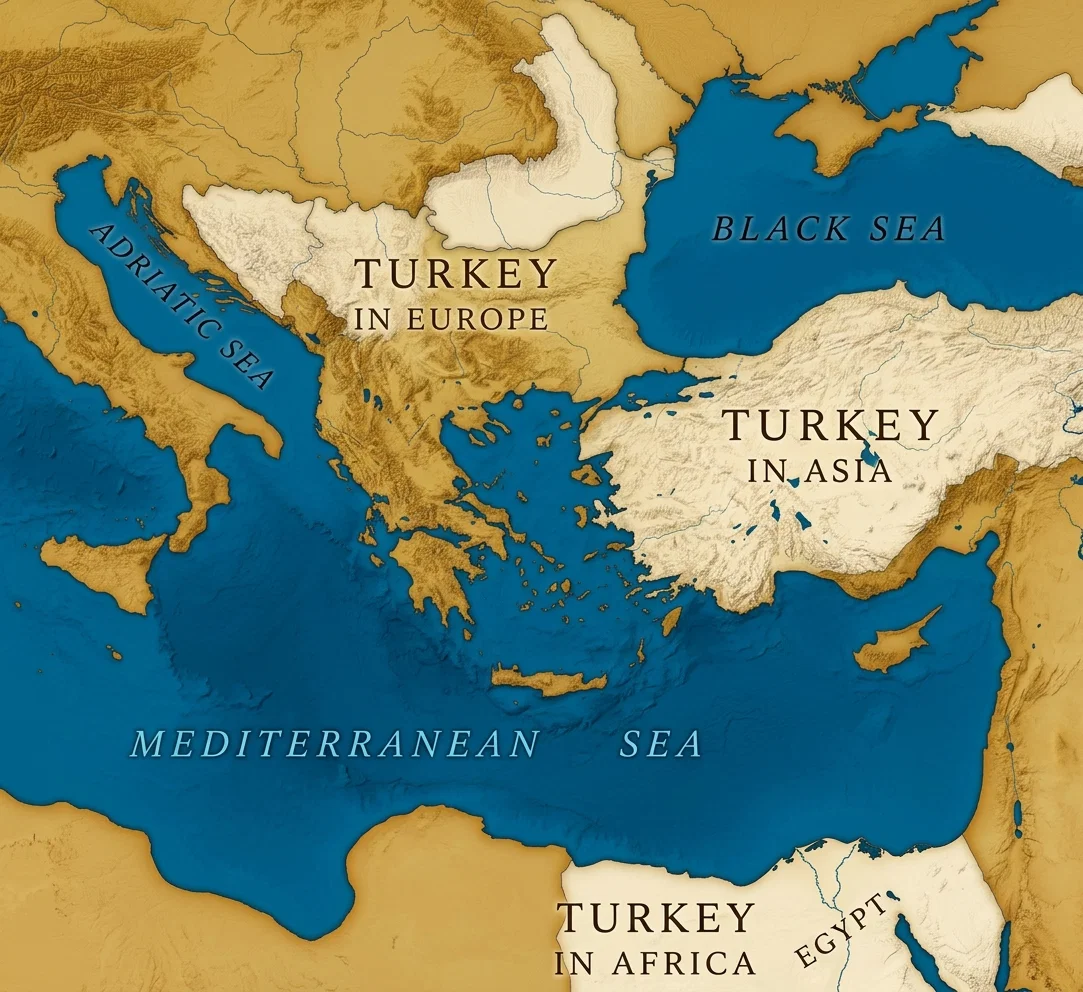
But notwithstanding this support which she has received from other nations, the ravages of time have continued to whittle away the once large territory of Ottoman supremacy. In the height of her glory, Turkey ruled over a vast dominion. This dominion reached from Persia on the east to Austria on the west, from Hungary on the north to Egypt on the south, and as far west as Algeria, covering a territorial area of more than two million square miles, with a population of more than fifty million people. But what a picture does Turkey now present to the beholder! The dismemberment of her territory has continually gone forward. Her arrogant pride has been humbled in the dust.
This dissolution of the Turkish empireis not alone indicated by the prophecy of Daniel II. It is shown in the prophecy of Revelation 9. In the sixteenth chapter of Revelation the Ottoman empire is symbolized by the river Euphrates, which the Scriptures declare shall be dried up during the sixth plague, in order that the kings of the earth may engage in the last great battle of Armageddon, and that then Turkey will become extinct. The drying-up process will have begun long before that date, because in the order of human history a nation does not come to its end at the zenith of its power; there must be a period of disintegration. For years this drying-up process has been steadily going forward. Note the following states and territories which have secured release from her authority:—
1. In 1783 Turkey was compelled to surrender to Russia the territory of the Crimea, including all the countries east of the Caspian Sea.
2. In 1828 Greece secured her independence.
3. In 1830 Algeria was ceded to France.
4. In 1867 Turkey was compelled to acknowledge the independence of Egypt.
5. In the same year Turkey lost the possession of Servia and Bosnia.
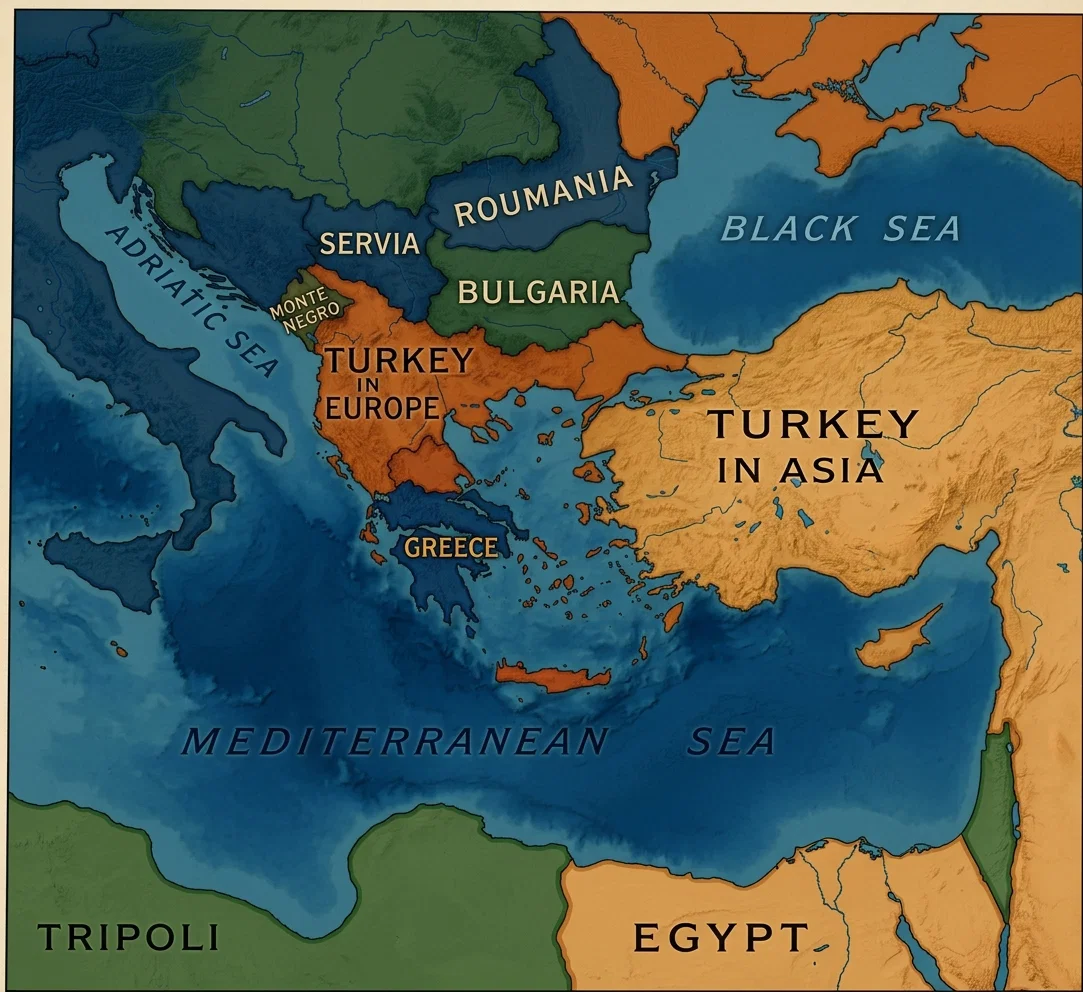
6. In 1878 the provisions of the treaty of Berlin provided for the autonomous government of Bulgaria, and the independence of Roumelia, Roumania, and Montenegro.
7. In 1912 Tripoli was taken over by Italy.
Thus Turkey has been divested of the fairest and fattest of her provinces. Slowly and steadily has the river of her power been drying up, and all this in spite of the fact that in order that the balance of power might be preserved in Europe, and thus the wild scramble for her territory by the powers of Europe delayed as long as possible, the preservation of her dominion has been repeatedly guaranteed.
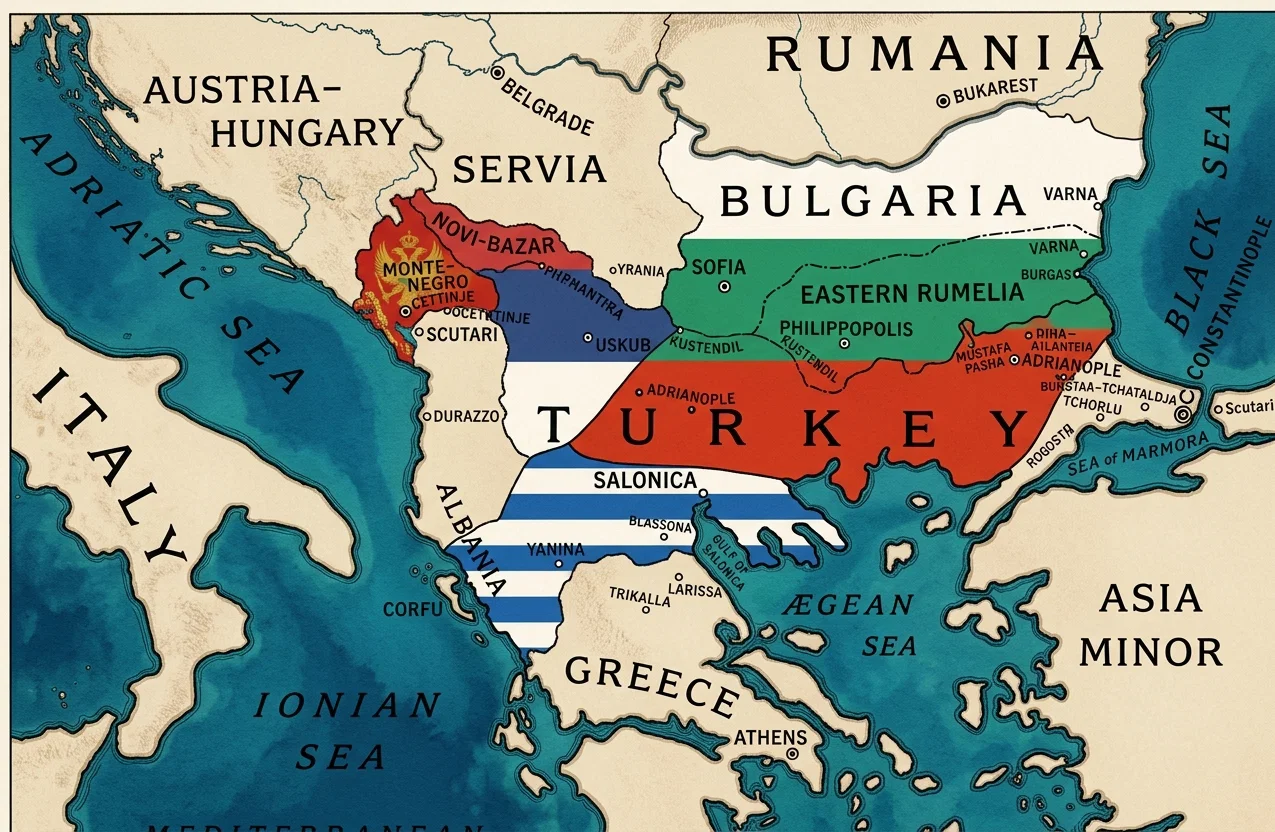
Of what further territory she will be despoiled in the closing days of 1912 or the beginning of 1913 remains to be seen. During the last few weeks the victorious armies of Turkey’s erstwhile dependencies on the north have overrun practically all her remaining European provinces, and at the present writing stand in battle array within twenty-five miles of the walls of Constantinople. In this conflict, as in the wars with Russia, “tidings out of the north” have troubled the government of the Porte. An armistice has been declared, and what will be worked out by the peace conference now in session in London has not yet been determined.

Removal of Capital to Jerusalem

According to the prophecy, but little remains to be enacted. The situation of Turkey in Europe has already become well-nigh intolerable. Soon there will be a decided change. Says the inspired penman:—
“And he shall plant the tabernacles of his palace between the seas in the glorious holy mountain; yet he shall come to his end, and none shall help him.” Verse 45.
For years Turkey has been upheld by the other nations of Europe. There will come a time when further help will be denied. She will be forced to withdraw to her natural habitat in Asia. And how reasonable it will be that she should make the ancient, holy city her seat of government. Over the possession of Jerusalem have the wars of the centuries been waged. The crusaders sought to dispossess Turkey of this cherished spot, but she has clung to it most tenaciously for centuries, and she will continue to cherish it until her end. All Europe, including Turkey herself, expects that the removal of the Turkish capital to Asia will be the conclusion of the present controversy.
THE BRILLIANT CAMPAIGN OF THE ALLIED BALKAN STATES AGAINST TURKEY
Many striking comments regarding the present European situation have been made by the editors of the various magazines and journals throughout the United States. The universal sentiment seems to be that Turkey is approaching her end. Illustrative of these comments, one by Hon. James Bryce, made while in private life, is to the point:—
It [the process of decline] advances with the steady march of a law of nature. Every European statesman knows this. Every thinking man in Turkey itself knows it. That hopefulness must be blind indeed which does not recognize that the problem now is not how to keep the Turkish empire permanently in being, but how to minimize the shock of its fall, and what to substitute for it.—National Geographic Magazine, November, 1912.
Rev. A. B. Simpson, D. D., in an article entitled “The Eastern Question and Armageddon,” appearing in the Christian Herald for Dec. 11, 1912, says:—
The drying up of the Euphrates is an appropriate symbol of the gradual weakening of the Turkish power, which has now been in progress for more than one hundred fifty years. . . . Steadily her cup of iniquity has become filled, until at last the overflow came in the recent Italo-Turkish war, through which her African possessions have been wrested from her, her navy utterly humiliated, and her prestige greatly weakened. The Balkan States have been quick to take advantage of all this, and now at last have united in a great religious alliance; and already half a million men are pressing forward to Constantinople. Whether this is to bring the final chapter in the fall of Turkey, God alone knows; but the most superficial observer can not fail to see that the Eastern world is facing a momentous crisis and that prophetic fulfilment is moving on apace. But the fall of Turkey is but the means to a greater end. The waters of the Euphrates are drying up in order that the way of the kings of the East may be prepared. . . . The forces of earth and heaven are rallying for Armageddon.
Current Literature for December, 1912, expresses its opinion that—the Turk may not have to evacuate Constantinople, but he will have to surrender his European empire. He must retire for a home into Asia, with his seat, perhaps, upon the Bosporus, dreaming of the great Moslem past that was his.
Referring to one of Turkey’s political leaders, this same magazine says:—
Upon the shoulders of Ghazi Mukhtar Pasha, one of the heroes of Turkey’s great period after the war with Russia, devolves the burden of getting the Moslems out of Constantinople into Asia Minor without such massacres of Christians as would bring the sultan face to face with an infuriated Europe.
Just how long after this removal before Turkey comes to her end we cannot determine. We have, however, reason to believe that it will be but a very short period. When that time is reached, this world’s probation will have closed. The prophet declares in Dan. 12: 1:—
“And at that time shall Michael stand up, the great prince which standeth for the children of thy people: and there shall be a time of trouble, such as never was since there was a nation even to that same time: and at that time thy people shall be delivered, every one that shall be found written in the book.”

The Establishment of the Heavenly Kingdom

The standing up of Michael is the assumption of kingly authority by Christ. He closes his priestly service, and with kingly robes of glory and with the royal scepter of power, comes to establish his kingdom. Sin and sinners will be destroyed from the earth. The earth will be purified by the fires of the last day, and will become the eternal home of the children of God.
By what is now taking place on the earth we may understand the portent of this our time, and the events soon to be enacted. With startling emphasis does the fulfilment of this prophecy of Daniel 11 before our very eyes appeal to us to-day. How thrilling is this hour! God in his infinite mercy is holding in check the winds of war. It is that we may be prepared. It is that we may sound to all the world his message of warning. Let us awake to our responsibility and hasten to our fellows the loud cry of the coming of the blessed King. “Now it is high time to awake out of sleep: for now is our salvation nearer than when we believed. The night is far spent, the day is at hand.” Soon he will come and will not tarry. His coming will be one of glory; his reign a reign of righteousness; his scepter a scepter of peace; his dominion of world-wide extent; and his rule one of power, majesty, and everlasting continuance. F. M. W.