Interesting Meeting of Rabbis in Detroit—“Higher Criticism” Prominent in Their Teaching—Adopting Sunday Services—Completed a New Translation of the Bible
By LEE S. WHEELER
The following very interesting article was sent us in July, but we have given space to so many important articles on the prophecies relating to war and the war spirit in these days that we have allowed this matter to go over till the present. The report is of such a character that its value is not lessened by this delay. It is significant that modern Jewish leaders are giving themselves to “higher criticism” and thereby placing the Old Testament Scriptures on the level of the writings of modern men. In view of this, it is not surprising that there should be a strong tendency in favor of observing Sunday.EDITOR.
The Central Conference of American Rabbis, which met in Detroit, Michigan, June 30-36, celebrated the twenty-fifth anniversary of the organization, it having been founded in 1889, by the late Isaac M. Wise, of Cincinnati, one of the most eminent of modern rabbis, distinguished for his ability as an organizer and leader. The movement had for its purpose the reformation of Jewish religious thought and life, the creation of new spiritual and social ideals, and the unification of Hebrew communities in America under the guidance of liberal influences.
The Central Conference as a body is dominated by the democratic spirit of the age; and while its fellowship is open to radical and conservative alike, the smallest minority rights are apparently most kindly and generously respected. Yet the passing of a quarter of a century free from the restraints of orthodox tradition has strangely changed its semblance, so that the personality of the typical rabbi was conspicuously missing from the form of the recent convention.
EXALTED TO THE RANKS OF THE PROPHETS
While retaining a racial interest in Hebrew ideals and the law, reformed Judaism claims the right “to reinterpret and to make new application of the law to the changed conditions of Israel’s life in America.” The Old Testament is no longer looked upon as the word of the Lord, but as showing the development of religious thought of the nation; and “illustrious spiritual teachers of modern times” are accorded a place in the honored ranks of the prophets “under the inspiration of Israel’s historic past.”
Rabbi Moses J. Gries, of Cleveland, Ohio, who was reelected to the presidency of the conference, referred, in his official address, to the persecution of the Jews in Russia, and to the appeal sent to the czar in their behalf by the Christian denominations of America. He said: “We welcome this evidence of the growing spirit of human brotherhood, and of the strong sense of justice and humanity. Let us as Americans never cease to protest against any encroachment upon or violation of the principle of human liberty.”
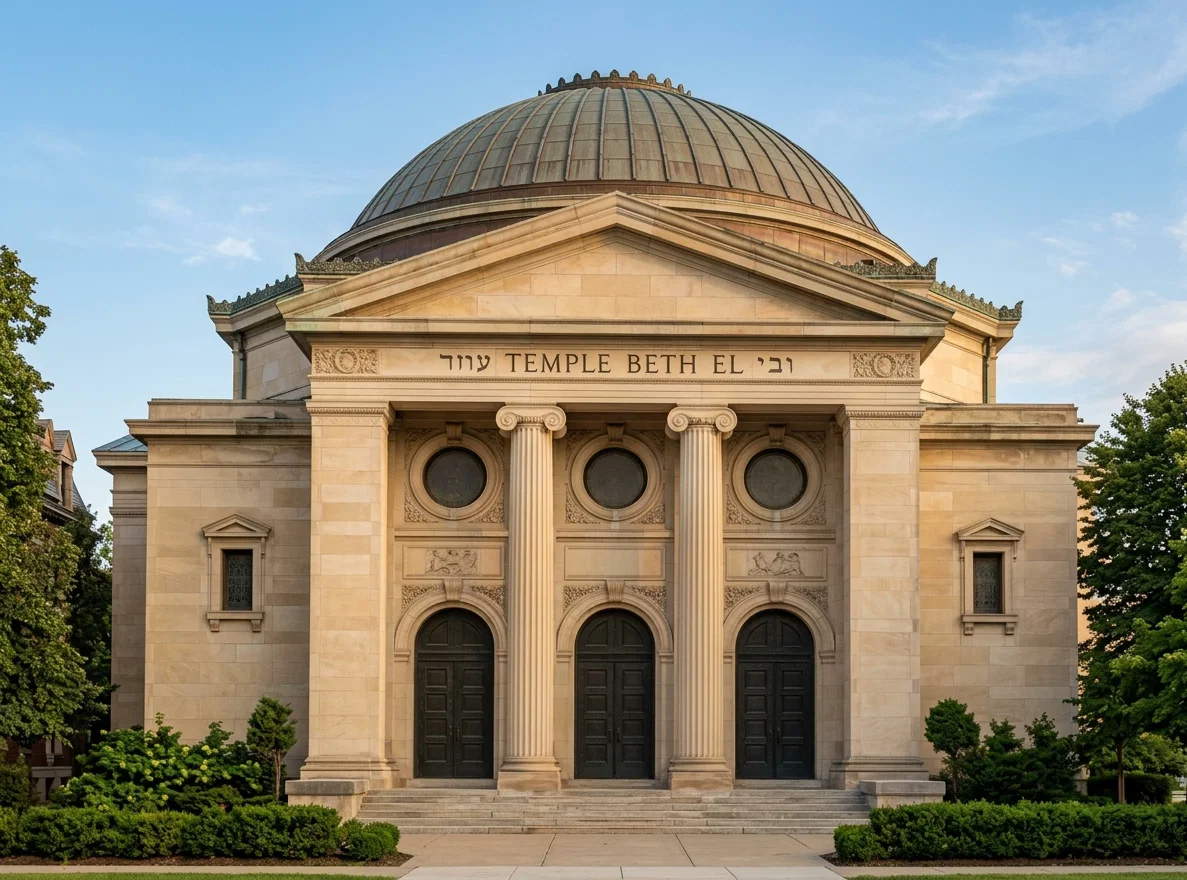
TEMPLE BETH EL, DETROIT, MICHIGAN, WHERE THE JEWISH CONVENTION WAS HELD
RELIGION IN PUBLIC SCHOOLS
Much attention was given by the conference to the matter of religious education. Rabbi Judah L. Magnes gave an address upon the work of the Bureau of Education of the New York “Community,” to meet the needs of the vast and congested Hebrew population in that greatest Jewish city of the world. Correspondence schools, Chautauquas, teachers’ institutes, etc., were discussed with much earnestness. The statements of Dr. Henry E. Cope, secretary of the religious Education Association, against the attempts to introduce the Bible and religious teaching into the public schools, were loudly applauded and it was evident that he voiced the feelings of the conference in the forceful expression of his views. He said:
“We should all stand unalterably opposed to the attempts that are being made to have the reading of the Bible in the public schools. It is said that we can all agree on certain fundamental principles which should be taught there. Perhaps that is true, but anything that all can agree upon would be so thin that nobody could stand on it. It would be a state creed in any case, and that we certainly do not want.
“When schools adopt the Bible, they adopt a creed of public schools; and a creed of public schools would be a creed of the state. When you try to teach a creed of the state to all its children, that creed becomes nothing more than an empty shell. Let the parents teach their children. Those who would have their children taught religion in the school are shirking the duty they should perform themselves. When you throw up the task of teaching religion to your own children, you throw up the children.”
REGARDING THE OBSERVANCE OF SUNDAY
The position which Jewish organizations should take toward the observance of Sunday was one of the most warmly discussed questions. Of late years, Sunday morning services have been introduced by the rabbis of various reform synagogues, and the custom has led to a difference of opinion which found strong expression at this convention.
In the ritual of the synagogues, this service heretofore has been published as “a week-day service”; but in reporting to the conference on “revision of the morning service,” Rabbi Joseph Rauch, of Louisville, said that “the conference should be brave enough to call it a Sunday service, and not masquerade under another name.”
This proposition, however, met with manifest opposition from many of the rabbis, who regard the movement as a revolutionary innovation. Rabbi Max Heller, of New Orleans, said that his congregation would never have a Sunday service while he continued as rabbi, although he did not oppose the publication of a book for those who wished Sunday services. He advocated, however, that it should be called a Sunday service book, in order that it might not be misunderstood.
OPPOSED TO SUNDAY FOR THE JEWS
Many delegates were on their feet at the same time to express their views upon the subject, some for and some against the change. Rabbi Charles S. Levi, of Milwaukee, was emphatically opposed to the change. “Can this conference afford,” he asked, “to have it go out in the world that we have adopted Sunday instead of Saturday as the Sabbath day? Judaism is broad enough to permit daily services, and why not call them week-day services?”
One rabbi said he was not opposed to the change for those who wished to hold Sunday services. “I want to be generous to my Christian friends,” he said, sarcastically; then seriously he said that to call the book a Sunday service book would be an extremely dangerous implication. “I am opposed728to the Christian Sunday being forced upon Jews,” he added.
Another resolution referred to the annual municipal Christmas celebrations as distinctively sectarian, and the conference put itself on record as opposed to such observances.
COOPERATION WITH SABBATARIANS
A noteworthy action of the conference was its decision to cooperate with Sabbatarian organizations to safeguard the religious rights of others.
The committee said further that “if a Jew observes the Saturday Sabbath strictly, he should not be forced to observe the Sunday Sabbath,” and recommended “that the conference cooperate in securing legislation to that effect in all states.”
Sunday laws have everywhere proved a menace to the oppressed Jew; and under the American flag, even exemption clauses, which are seldom more than a sop at the best, have always been an ineffectual substitute for religious freedom.
TRANSLATION OF THE BIBLE COMPLETED
The conference announced that the translation of the Jewish Bible into English, upon which the Jewish board of book editors has been engaged for five years, has been completed, and will soon be published to the world. The purpose has been, it is said, “to translate into English not only the letter, but also the spirit, the character, and the genius of the traditional and historic Bible of the synagogue.” The publication of this version is hailed with much rejoicing among the Reform Jews as a monument of American Jewish scholarship; and in recognition of the services rendered to Judaism by the completion of the work, the president of the conference, at the time of formal celebration, telegraphed this message to the Jewish Publication Society: “History will record with honor the unselfish labor and the scholarly service of our Bible editors and translators. May the Bible, through the new translation, become again the Book of the people for the people of the Book.”
AMERICA PREFERRED TO PALESTINE
It was significant that although a Zionist convention was in progress at Rochester, New York, and another at Leipsic, Germany, at the same time that the Conference of American Rabbis was in session here, little or no notice was taken of the matter. Social service, industrial relations, religious education, marriage, arbitration, church and state, and even eugenics, received consideration from the conference, while the fatherland of Palestine cut no figure in the program of the American rabbis, aside from some favorable mention in an illustrated lecture upon “Field and Mountain in the Holy Land,” and an endorsement by the conference of the use of the Hebrew language in the educational institutions of Palestine. It was evident that America, with its great commercial and industrial opportunities, rather than the country of Judea, is the Promised Land upon which the modern Jew has his eye.
In conversation with one of the prominent rabbis upon this subject, I learned that they have little interest in Zionism further than to give the scheme some moral and financial assistance for the relief of the unsettled and persecuted members of their race in Russia and some other European countries, since it offers a near-by refuge for the families of such, where, amid the associations of cherished religious surroundings, they feel at rest and at home.
TURKISH INFANTRY, ONE MILLION OF WHOM ARE ENTERING THE OLD WORLD WAR