Cuba

6%

Review and Herald Publishing Association · Takoma Park Station, Washington, D. C. · Apr 21, 1910

FromReview and Herald, Vol. 87, No. 16.

Read the full edition

Cuba

E. W. SNYDER
The workers of our field were much encouraged the past winter by the visits of Elder U. Bender and Prof. F. Griggs in January and of Prof. E. A. Sutherland and Mrs. E. C. Gray in February, the latter being of the Madison (Tenn.) school. The counsel and assistance of these in planning for the establishment of our school work in Cuba will certainly result in benefit to the cause in this needy field.
In company with the first two mentioned, a visit was made to the San Claudio school, where Brother S. H. Carnahan and wife have been laboring the past year. The burden on them has been quite heavy, and the sacrifices great, owing to the fact that in order to be self-supporting, Sister Carnahan has had to resort to private teaching in Cabañas, a town seven miles from the school. It was quite evident that if the facilities of the school could be enlarged so as to enable them to take in Cuban students from the neighborhood, as well as a few boarding students, they would thus be enabled to derive a support with what might be raised from the school farm.
The disposition of the brethren to recommend that some help be given them to provide a school building in order to enlarge their work, as above indicated, was an encouragement to all.
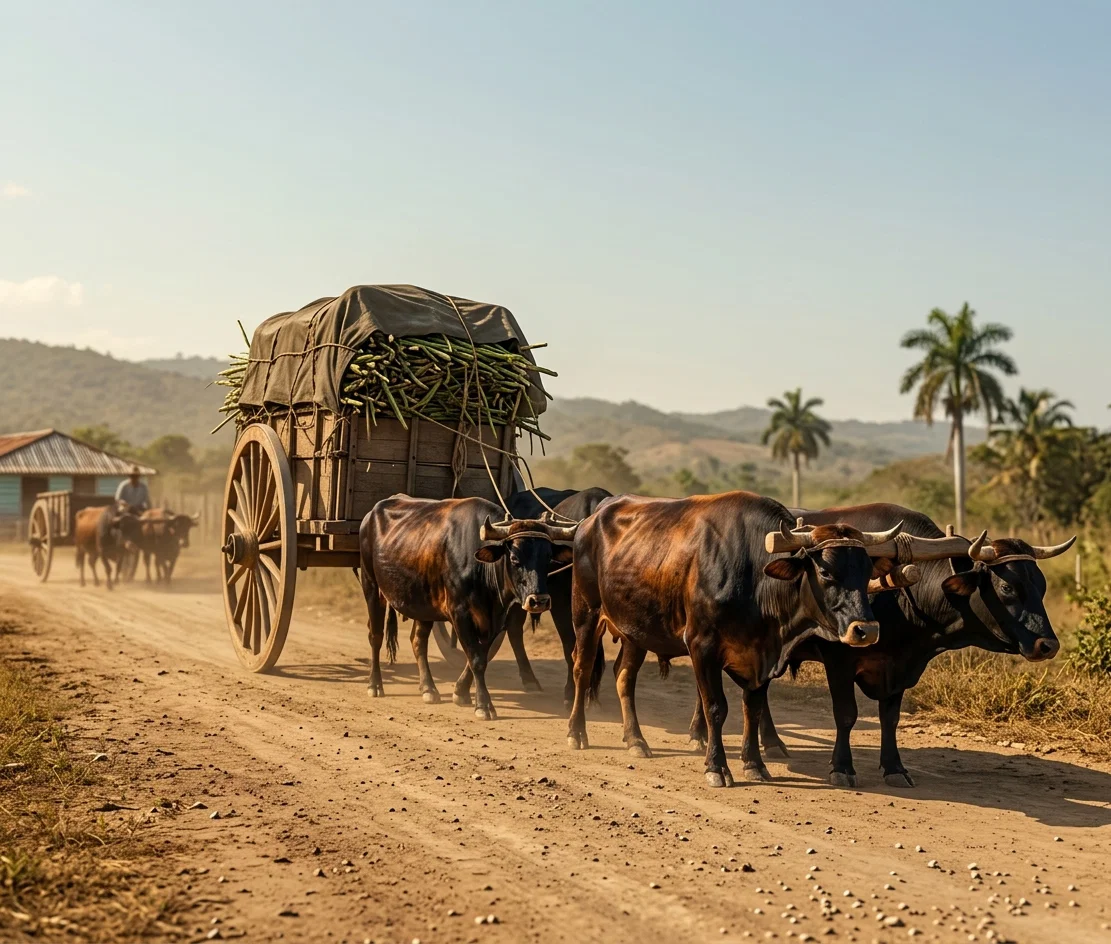
TEAMING IN CUBA
TEAMING IN CUBA
For more than two years we had been corresponding with Professor Sutherland concerning his making a visit to Cuba in the interests of self-supporting school work. Something of the benefits of this work have been realized from the efforts of Brother Guy Holmes, located at Minas; of Brother C. D. Kinsman, near Nuevitas; and of Brother J. E. Anderson and wife, at Las Tunas, Oriente province.
On our trip to eastern Cuba, in company with Professor Sutherland and Mrs. Gray, these workers were visited, and plans were laid to make their work more efficient. At Minas quite an interest on the part of the Cubans to hear the message was found, and before leaving, three were baptized, and four received into church fellowship. This interest was awakened by Brother Holmes's periodical work. He now has the assistance of a Cuban brother, who is very zealous also in the missionary work for his people. At this place and in the immediate vicinity there are eight or ten Sabbath-keepers, but at the time Brother Holmes went there, no one but himself and family were keeping the Sabbath. What the Lord has done through Brother Holmes we believe that he would do in many other places in Cuba if consecrated workers were found to enter the openings.
At Las Tunas we found Brother and Sister Anderson of good courage in their work. Although they have been there but eight months, Sister Anderson has acquired a fair use of the Spanish, being able to teach in that tongue. She has ten pupils in her school, which, with her private teaching in English, keeps her quite busy.
The experiment at Las Tunas is of considerable interest to us, as its success would give assurance to others who may desire to enter some of the many Cuban towns and cities in a similar manner.
Of these cities there are fourteen of more than ten thousand population, and thirty of more than five thousand. In view of the following conditions it is evident that the time is ripe for quite a number of private schools to be established in Cuba. First, the public schools as a rule are inferior and inefficient in the work they undertake to do; second, American teachers are popular with the Cubans, and have a good reputation; third, owing to the increasing commercial relations with the United States, and the consequent increased demand for teachers of the English language, English teaching can be made a good source of revenue in self-supporting work.
However, it is evident that in order not to have the work overburden the teacher, as well as for other reasons, there should be more attention given to agriculture, as the latter will always be an important factor in self-supporting work in Cuba. In order to consider what mold should be given to this work, Professor Sutherland called a meeting, at the home of Brother Holmes, on February 15. There were nine present at this meeting; and after the discussion in which all participated, it seemed to be the consensus of opinion that a site near one of the principal cities should be chosen with the object of establishing a central training-school for workers who may come to this field from the north. It was thought that the school site should afford sufficient land for all agricultural purposes, while its proximity to the city would give ample territory to the workers for personal labor among the people, and thus a command of the colloquial Spanish would be obtained. As a good Spanish teacher will be connected with the school, a thorough grammatical knowledge of the language will also be given.
In addition to the language study, instruction will be given in methods of labor among the Cubans, which will include practical house-to-house work with periodicals and Bible work.
Agriculture will be made prominent, especially that relating to the cultivation of the native products. After passing a year in the central school, it is planned that a teacher will be prepared to go out and establish an individual school, to be conducted on the same plan as the central school.
In view of the fact that at present there are those who are planning to come this way to take up this kind of work, it seemed advisable that Brother Sutherland and Mrs. Gray should come and look over the field, in order to become personally acquainted with its needs.
In conclusion, we are glad to say that the interest in Havana and its vicinity continues good. At our last quarterly meeting, held in January, four were baptized, and the tithes and offerings for the last quarter of 1909 indicated an increase of seventy per cent over those of the previous quarter.
Apartado.