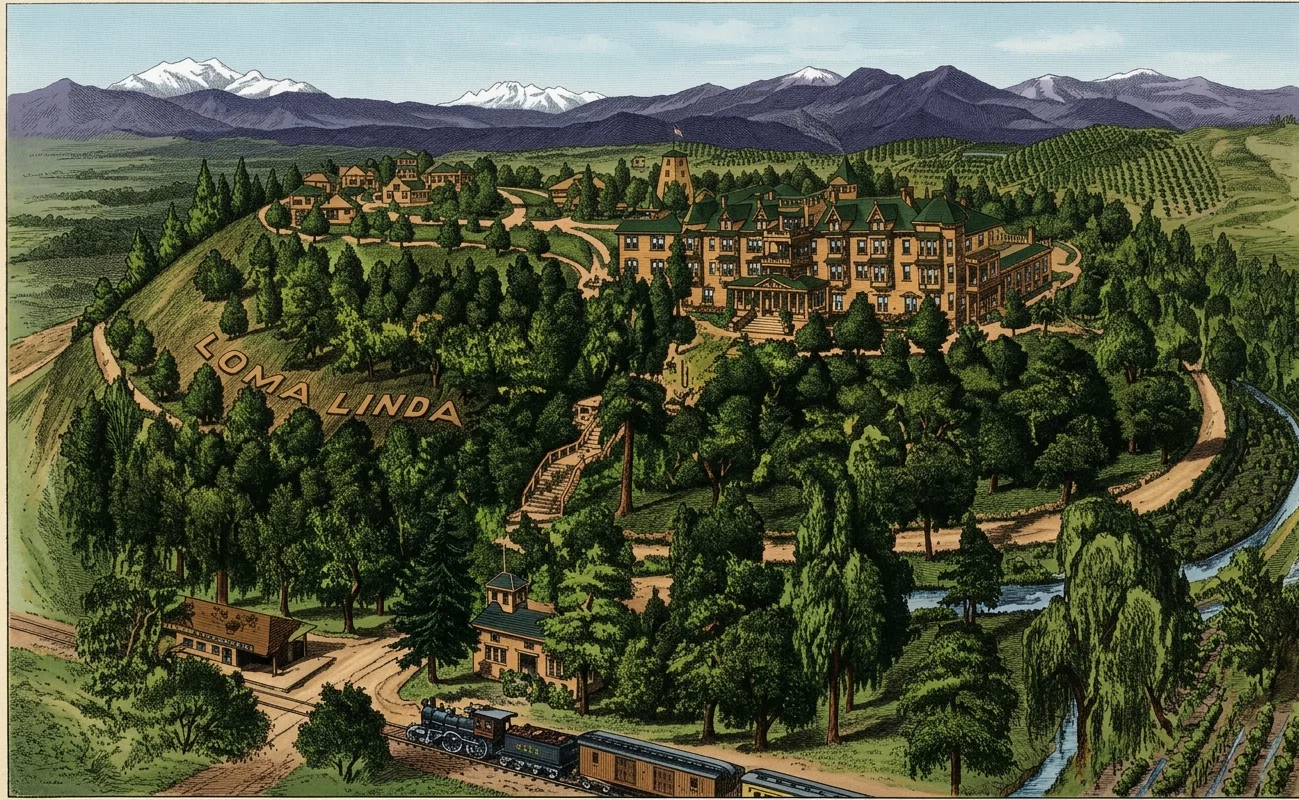
Visit to Loma Linda and Other Places on the Pacific Coast
By R. A. Underwood
Early in May it was my privilege, in company with a number of men representing the General Conference, the North Pacific, Lake, Central, Northern, Southwestern, and Pacific union conferences, and the Southern California Conference, to meet in council regarding the establishment of a medical college at Loma Linda, Cal. This was my first visit to this place. Some years ago I spent two years on the Pacific Coast, laboring from San Diego to British Columbia. At that time a portion of the present Loma Linda Sanitarium building was standing, and was known as the Mound City Hotel.
I entered the State at Needles. Here I was happy to meet Elders A. G. Daniels and W. C. White, with Prof. H. R. Salisbury, who also were on their way to attend the council. Together we continued our journey, reaching San Bernardino on Friday morning, May 6. This city, an old Spanish settlement, is the county-seat of San Bernardino County, the largest county in California. It is famous as the “city of mineral springs.” In later years the city has grown to large railroad importance, on account of its many machine- and carshops, notably those of the Santa Fé. It is also the distributing and outfitting point for mining districts to the north and east, and has a commodious and well-equipped county hospital. The population of the city, now estimated at fifteen thousand, is rapidly increasing.
We were met at San Bernardino by friends from the sanitarium, and driven across to Loma Linda, five miles distant.
Of easy accessibility, and within reach of a large population, yet remarkably isolated, Loma Linda is favored as to location. Situated upon an eminence about two hundred feet above the surrounding valley, and at an altitude of over thirteen hundred feet above sea-level, Loma Linda lies in the midst of the San Bernardino valley, sixty-two miles east of Los Angeles, on the main line of the Southern Pacific Railway running from San Francisco and Los Angeles to El Paso and New Orleans.
One visitor has written thus concerning the surroundings of the Loma Linda Sanitarium: “In the foreground, orange groves spread northward to the mountains; to the left, Colton glistens in the sunlight; to the right, Redlands reposes green against the upland; while nine miles across the foothills is Riverside. It is thus in the heart of the famous citrus belt of Southern California. Hundreds of acres of orange and lemon orchards are to be seen for miles up and down the valley; while still farther beyond, stretching from the extreme east to the west, tower the majestic mountains of the San Bernardino range, which for a part of the year lift their snow-capped peaks above the smiling verdure of the lower landscape — the land of perpetual summer.”
Loma Linda is not a town, or even a village, in the ordinary sense of the term. The sanitarium has its own railway station and ticket-office, post-office, bakery and food factory, cannery, stables, dairy, and gardens. For two miles round about there are only ranch-houses, surrounded by orange orchards and fields of grain; but a little farther on are several centers of population, connected with one another and with Loma Linda by well-kept roads; while at the foot of the hill is a Southern Pacific railway station, giving direct and frequent communication with Los Angeles and all other points. At night the electric lights of eleven towns and cities are in plain view from the verandas of the main building.
In order to give us a better knowledge of the surrounding region, the managers of the sanitarium arranged with friends who have automobiles to take us on a trip to Redlands, Colton, and Riverside. On this ride we were shown a rich district lying within a radius of ten miles from the sanitarium, with a population of fully one hundred thousand.
We first visited Redlands, four miles eastward. Twenty years ago this district was but “a waste of sage-brush and cactus.” To-day it is a beautiful little city of about twelve thousand, with an assessed property valuation of upward of twenty-five million dollars. Redlands is preeminently a city of homes. No saloons are permitted within its borders. Close by Redlands is “Smiley Heights,” a natural park, beautified by upward of twelve hundred varieties of shrubs and plants brought from many lands across the seas. As one visitor has testified: “Flowers are everywhere — a limitless wealth of color, fragrance, and beauty. This park, with the scenery which it commands, is one of the most fascinating of all the beautiful places made possible by the fertile soil and balmy climate of Southern California.”16
From Redlands we returned to Loma Linda for dinner, and then went on to Colton and Riverside. Colton is a growing town of about six thousand inhabitants, situated within four miles of Loma Linda, on the main line of the Southern Pacific Railway into Los Angeles. It is the center of the honey industry of Southern California, and is also an important fruit center.
From Colton we went on to Riverside, lying in the midst of what is perhaps the most noted orange district in the United States. In the Riverside valley there are over twenty thousand acres of orange groves. The product of these groves nets the growers over two and one-half million dollars annually, and nearly seven thousand cars are required to haul the fruit to market.
Just at the edge of the town is a rocky elevation known as Rubidoux Mountain. From the base of this mountain there has been constructed a broad road circling round to the top. The view from this road, as it winds for three miles up the sides of the mountain, is magnificent beyond description. From the top of the mountain one may behold a pleasing panorama of orchards and ranches, with their fruits and flowers; of beautiful cities and country homes; of the broad valley below, extending westward to the Pacific; while beyond, to the northward and eastward, rise snow-capped mountains to a height of more than two miles above the level of the sea; and to the southward tower in the distance the mountains of Old Mexico. My eyes never beheld a view more grand and inspiring, in any land, than that presented from the summit of Mount Rubidoux.
Returning to Loma Linda, we were the better able to appreciate the advantages of its location in the heart of this populous district. Five miles distant is Highlands, a town of about three thousand inhabitants.
The Loma Linda property now consists of 166 acres of land, including considerable valley land at the foot of the hill. All this is in cultivation, and under irrigation. The grounds on the hillside were laid out several years ago by a landscape artist, and are covered with pepper, eucalyptus, and other ornamental evergreen trees, with flowering shrubs and spreading lawns; while along the shaded walks and graded driveways flowers of many varieties bloom the entire year. A portion of the hill is covered with groves of orange, lemon, grapefruit, plum, apricot, and olive trees. The accompanying cut, showing the main sanitarium building in the midst of the various trees, will give the reader a good idea of the appearance of the place as one approaches Loma Linda.
THE LOMA LINDA SANITARIUM
A feature of the institution that is daily appreciated by patients and students alike, is the system of gardens under cultivation. Several acres are devoted to the growth of vegetables and small fruits. During our sojourn at Loma Linda, we had the pleasure of eating strawberries three times a day, oranges picked fresh daily from the trees, vegetables from the gardens, and olives from the orchard. Butter, milk, and cream were supplied in abundance from their modern dairy, while bread, crackers, and canned goods were supplied by the food factory and cannery owned by the institution, and located near the railway station at the foot of the hill. The patients, numbering about seventy-five, and the large family of students and helpers, were liberally provided with the bounties that were daily spread before us.
The main building of the sanitarium contains one hundred rooms. The ceilings are very high, and in many portions of the building the floors are double. The treatment-rooms are amply large for present demands.
Some distance from the main building, on the crown of the hill, is a group of cottages, half a dozen or more in number, and an assembly hall. These buildings have been utilized as quarters for the medical students and nurses. In the immediate future additional facilities must be provided in order to accommodate all who may come. Of this, others will speak in the REVIEW.
A neat chapel, with seating capacity of nearly seven hundred, has been erected near the main building. It is soon to be dedicated.
Our council-meeting was greatly favored by the presence of the Holy Spirit, and all our brethren in attendance came to see eye to eye. Plans were laid for the development of a well-equipped medical school without incurring a large debt. The consolidation of the sanitarium property with the medical college places the college on vantage-ground at the very beginning, and minimizes the additional expense that must be incurred in providing adequate laboratory and other facilities and appliances. The visiting brethren were pleased with the general outlook, and are hopeful regarding the future of the institution.
No great undertaking that has proved a blessing to the cause of God, has been developed without continued sacrifice and much labor. No doubt the Loma Linda College of Medical Evangelists will have the same experience; but we believe that it is destined to prove a blessing to those who may have the privilege of availing themselves of its training. Plans have been laid for its faculty; and the courses of study, in science as well as Bible, are strong and well balanced, and calculated to prepare our youth to pass with credit the examinations required by the State boards throughout the land.
At the close of the council, our brethren from the East separated, in order to visit various other institutions and churches in the State before returning to their home fields. It was my privilege to visit the Pacific Press, at Mountain View. I was greatly pleased to see their simple, inexpensive, and remarkably economical system of conducting business in unpretentious quarters.
I spent Sabbath, May 14, in Oakland, where I met Elder S. N. Haskell and wife and a goodly number of old associates, including several former members of the old North Bloomfield church in Ohio, representing the Chinook family. On Sabbath day I spoke to acquaintances and to those whom I had never before met, in their new church building on Twenty-fifth Street, near Telegraph Avenue. It was a great pleasure to meet here Miss Flora Jones Fulton, whom I took when but a little child of about four years, soon after the death of her father and mother, across the continent to our home in Mesopotamia, Ohio, where she was a member of our family for several years.
Monday, May 16, I reached the St. Helena Sanitarium, where I met, among others, Elder H. A. St. John; also Elder W. C. White and family. The St. Helena Sanitarium has grown to large proportions, and is enjoying a good patronage.
From the sanitarium I was taken up the mountain-side about five miles to the Pacific Union College, which is about seventy miles northeast of San Francisco. Here I met Prof. C. W. Irwin, the principal of the school, Elder G. A. Irwin and wife, Miss Hattie Andre, and Elder A. O. Tait, all native Ohio people. I spent two days with these old friends at the Pacific Union College. This school has the largest resources for developing a great educational institution in practical industries of any school the17denomination operates.
At present it owns over seventeen hundred acres of land. Considerable of this is mountainous.
There is estimated to be on this tract of land several million feet of saw timber, consisting of white pine, redwood, fir, and oak, besides an almost inexhaustible supply of fire-wood. There are about thirty acres of orchard and vineyard, so situated as to produce the best quality of fruit. The elevation at this point is seventeen hundred feet above the sea-level, making it especially adapted for raising a good quality of fruit. There are two thousand apple trees, over two hundred peach trees, ten acres of prune orchard, besides pears, cherries, blackberries, and some English walnuts.
They have thirty acres in alfalfa and a number of acres in garden and vegetables. This is all under irrigation from their own water-system, supplied with the purest mountain water. The farm is stocked with nineteen head of horses, two yoke of oxen, and about fifteen milch cows. There are eight or ten buildings on the ranch. The original cost of the buildings and the water-plant, including water-piping, etc., for the irrigation, was over forty thousand dollars. This does not include the price of the land. All of the buildings and equipment are now utilized for school purposes.
I took a trip over the school ranch with Prof. C. W. Irwin and his father, traveling with a team from fifteen to twenty miles to get a good view of the entire school plant. I should judge that five hundred acres or more of the land now unimproved can be utilized for orchard purposes, which would be especially adapted to raising apples and peaches. This property, including the farm, tools, stock, and buildings, which are in excellent repair, was bought by the Pacific Union Conference for $60,000, which I consider a very low price for a property of this character. The school has recently put in a saw-mill, and has just contracted for the sale of two thousands dollars' worth of firewood.
Each student is required to work two and one-half hours daily in addition to paying a tuition of eighteen dollars a month. The teachers and students are doing all the work, and managing the ranch. One student has charge of the blacksmith shop; this enables the school to shoe its own horses, etc. While I was there, teachers and students were sawing lumber for a new dormitory, to be erected the present year. They say they have a good market, right at their yard, for all the lumber they can saw.
Leaving California, I took the shortest route, the Union Pacific Railroad, for Salt Lake City. Just before reaching Ogden, we crossed Salt Lake on the train, a distance of a little more than thirty miles, giving one the impression of being at sea. This “cut-off” saves seven hours’ time in crossing the desert, and takes one over Salt Lake on the longest bridge in the world. Aside from the long miles of trestlework, the bridge for twelve miles rests on piling, each pile representing a tree standing on end. Some of these trees are said to be 110 feet in length. By this new route, three hundred sixty miles of the old railroad bed have been abandoned.
I was glad to meet with the members of the Salt Lake church, and to speak to them on Sabbath, May 21, in their comfortable church building in that growing city. Salt Lake has made rapid growth since I was permitted to preach in that city something like twenty years ago. At the close of the service I assisted the president of the conference, Elder S. G. Huntington, in the ordination of H. G. Gjording to the gospel ministry. Elder Gjording is to work in South Dakota, taking the place of Elder N. P. Neilsen, who goes to New York City. Salt Lake City is controlled by Mormons, fully three fourths of the city being of that faith. It is said that many of the Mormons still practise polygamy, and the city being under their control it is very difficult to enforce the law against this practise.
Leaving Salt Lake City near the close of the Sabbath, I reached Omaha on Monday morning. As I stepped from the Union Pacific train, in company with a gentleman who had been traveling in California for nine months, I was somewhat amused to hear him ask some railroad men the following question: “Can you tell me the road and the train that will take me to the best city in the United States? If I can find that city, I want to go to it.” A conductor, standing by, said: “Take the Northwestern Railroad and the train that stands on track No. 4. That will take you to Minneapolis. I think you will find what you are looking for.” I boarded the same train, and Monday night reached Minneapolis after an absence of a little more than three weeks.