Somabula (Africa) Mission

5%

Review and Herald Publishing Association · Takoma Park Station, Washington, D. C. · Jul 28, 1910

FromReview and Herald, Vol. 87, No. 30.

Read the full edition

Somabula (Africa) Mission

R. C. PORTER
On Tuesday, April 26, accompanied by Sister M. C. Sturdevant, I left Bulawayo for Gwelo. We reached Gwelo at 6:30 in the evening after an uneventful all day’s ride on a slow train. We were met at the station by Elder W. C. Walston and two of the mission boys with an ox-team. As they came prepared for camping, we soon transferred our baggage from the train to the wagon, and were on our way to the mission. After a three hours’ drive through the veldt, dotted here and there with scrubby trees, we camped for the night.
At five o’clock in the morning we were again on the road. Two hours later we camped on the river-bank for breakfast. As this was about four miles from the mission, I walked in after breakfast for exercise. We spent the afternoon looking about the mission and cottages. In the evening I was shown to my sleeping-room in the pole-and-mud mission house. The ceiling was thin white muslin. Elder Walston informed me that a short time before my visit, a large, venomous snake had poked its head through the ceiling, and looked down upon himself and wife; but while he was preparing to kill it, it drew back out of sight behind the ceiling and disappeared. Later, he said, they killed a similar looking snake in the yard before the door. With these thoughts I retired, and soon fell asleep. It may not be thought strange that I dreamed of snakes that night, and that in my dreams I killed them all.

The Farm

The Somabula Mission owns no farm, but is on a native reserve, which can be leased for only three years at a time. For this reason the buildings are constructed of poles set up on end, and daubed and plastered with dogger (mud). The roofs are thatched with coarse grass. Houses built in this way are comfortable, and very cozy and pleasant inside.
The main station holds a lease of one hundred acres of farming land, and the right to graze over five hundred acres of pasture land. Besides the main mission building, which is occupied by Elder Walston and family and T. J. Gibson and family, the mission has a store building, a wagon-shed, a twelve-by-thirty-foot house for girls, and ten new huts for boys. It also has a study-room for boys, a new kitchen, a dining-room, and a school building. There are now on the mission farm seventy head of cattle, consisting of twenty-one calves, sixteen cows, and thirty-three oxen. The mission workers have recently sold five hundred dollars’ worth of cows, with a view to buying a better class of dairy cows. They have also sixteen donkeys, which they use when, on account of cattle sickness, they can not drive the oxen to Gwelo.
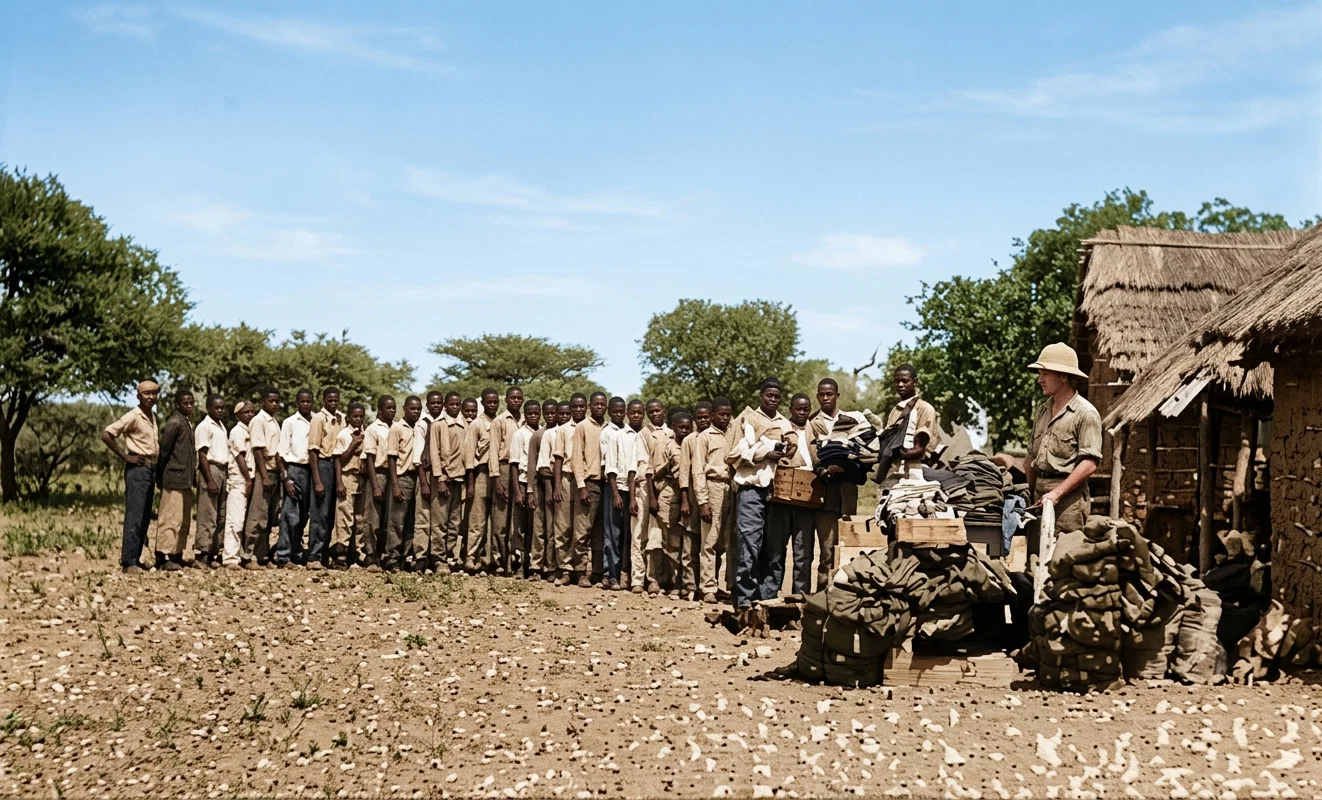
SUPPLYING MISSION BOYS WITH CLOTHES
The mission has about one hundred acres of mealies (corn), four acres of sweet potatoes, and two acres of garden truck. Last year about the same amount of mealies was raised, the workers selling 425 bags (1,500 bushels), besides saving enough to provide for the needs of the family and school. Five acres was planted to sweet potatoes last year, which yielded heavily. The profit from the store during this time was $400. The farming equipment, besides oxen and donkeys, consists of one breaking-plow, one disk-plow, one iron-tooth harrow, two double cultivators, one ox-wagon, one corn-sheller, one corn-grinder, a milk-separator, and a barrel churn.

The School

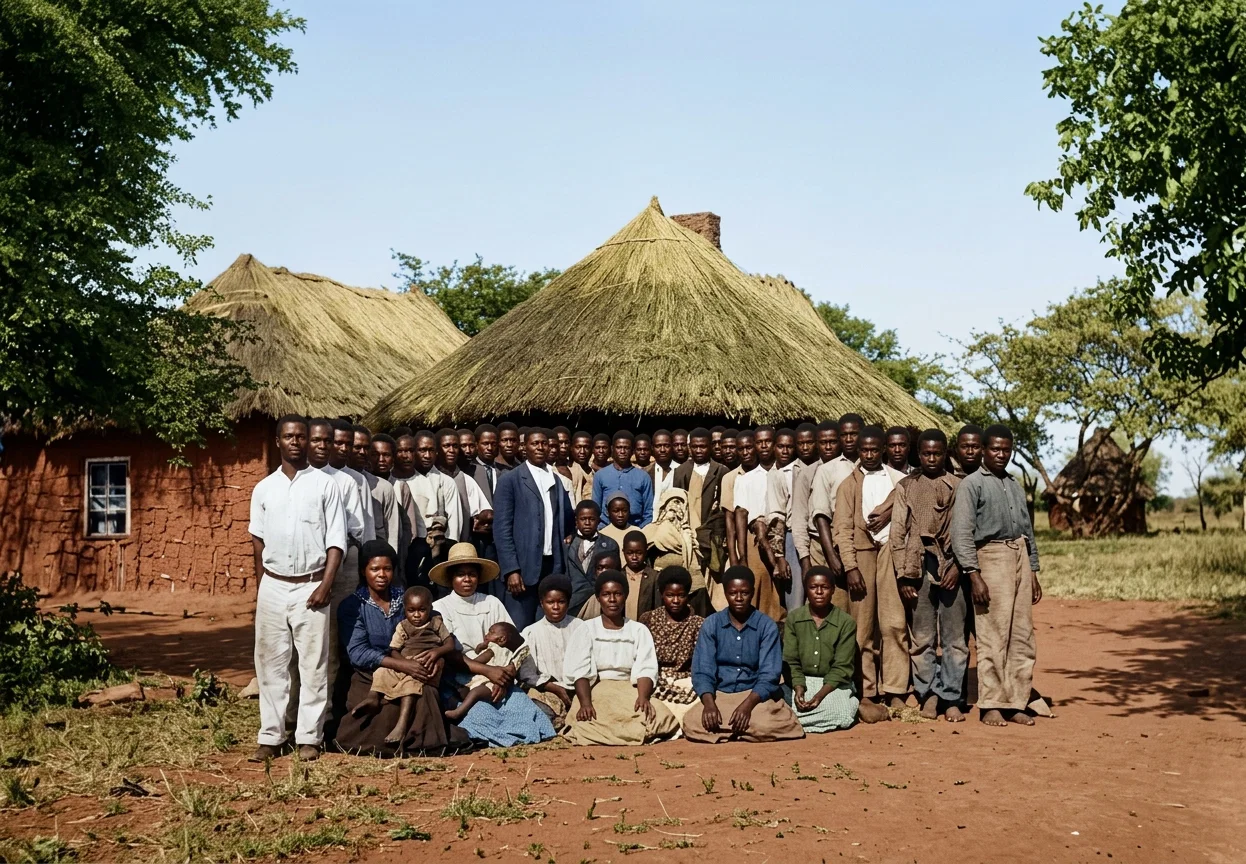
The main boarding-school is well managed, and is doing good work. There are fifty-four students now enrolled, eight of whom are girls. The three out-schools have an attendance of twenty-five students in each school. Their teaching force consists of four white and eight colored teachers. They have opportunity to start other out-schools on other reserves, if they can be supplied with white teachers to supervise the schools on each reserve. It is contrary to the law to have a white supervisor on one reserve look after the schools on another reserve. This law makes it difficult to extend the work at this station.
THE SOMABULA MISSION SCHOOL
Gold-mines are interspersed through this section of Rhodesia, and this makes it hard to hold the students long enough to get them thoroughly settled in the truth. However, the people must be reached, and I see no other way than to furnish the white supervisors and go forward.

Results

This mission has been in operation eight years. There are fifty-five church-members as the result of the work done during that time. Ten have apostatized, leaving forty-five who have remained faithful. Another class are now taking instruction preparatory to baptism. The tithe last year, including that paid bythe white teachers, was $150; Sabbath-school offerings, $25; annual offering, $25.
The outlook for the future of this station is very promising. If Brother and Sister M. C. Sturdevant go on to open the new station near Umtali, as they hope to do, Brother and Sister Walston will go to Solusi, to take charge of that station, and Brother and Sister Gibson will be provided with help, and will take charge of the work at this station.
We shall long remember our first visit to the Somabula Mission. On Sabbath there were 148 present at the services. One white sister walked twelve miles to attend the meeting, and the natives came in from the surrounding kraals, and paid respectful attention to the word spoken. Most of those present requested prayer, that they might have their sins forgiven and become Christians. When Brother and Sister Walston visited one of their out-schools on the Que Que reserve recently, they were made to weep as they saw the natives coming to attend the Sabbath service, singing the praises of God as they came. They had an audience of two hundred for the Sabbath service.
So the work goes forward. The Lord has it in hand, and it will soon close in glorious triumph. I now go to Nyassaland to visit the Malamulo Mission. Pray for the work in Africa.
Claremont.