Malamulo Mission

6%

Review and Herald Publishing Association · Takoma Park Station, Washington, D. C. · Aug 18, 1910

FromReview and Herald, Vol. 87, No. 33.

Read the full edition

Malamulo Mission

R. C. PORTER
After a long, slow journey of a little more than four weeks from Cape Town, I reached the Malamulo Mission, and was met at the railway station by Elder J. C. Rogers with a machilla team. We made the trip from the railway station to the mission, a little more than twenty miles, in about five hours. When within about four miles of the mission, we were surprised to meet Sisters Rogers and Etta Austen with a number of the boys from the mission, who had come to welcome us.
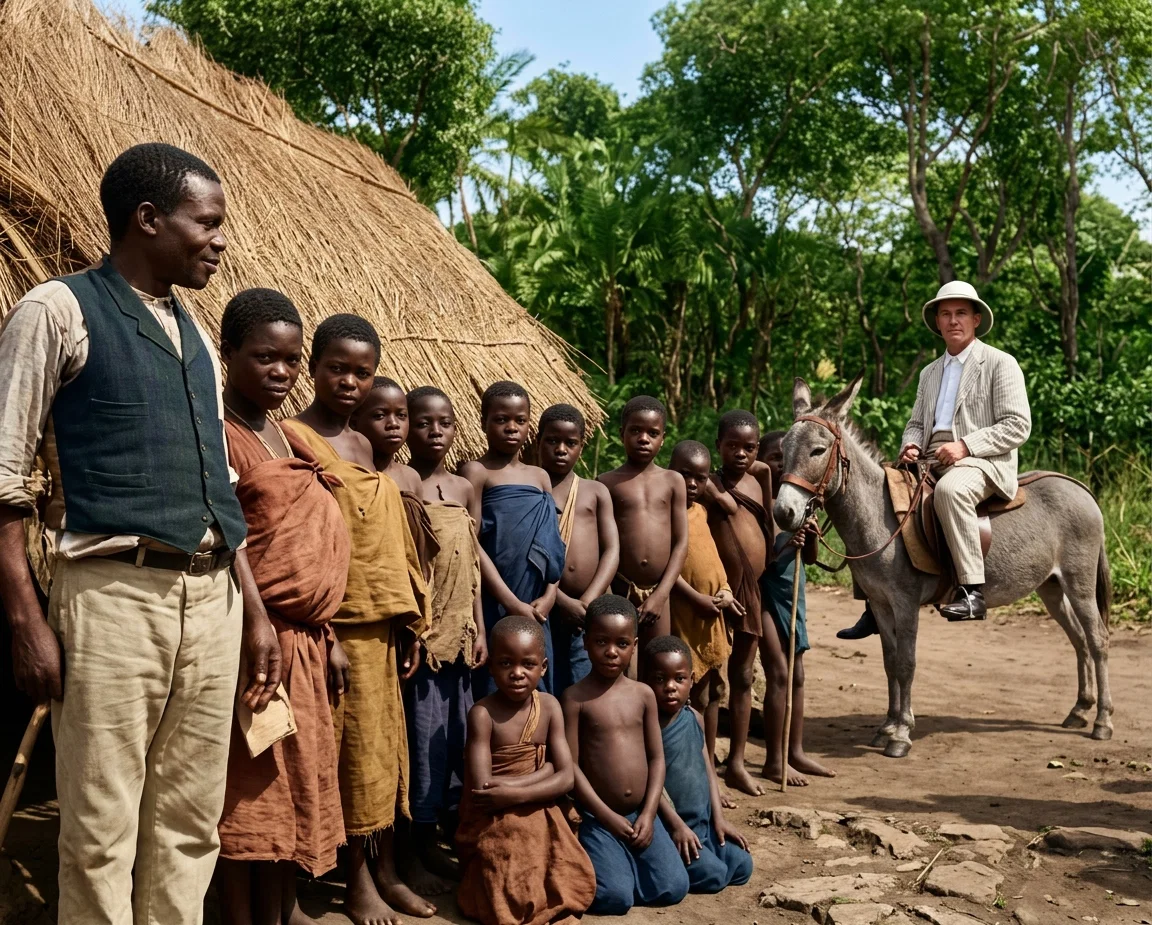
A NEAR-BY OUT-SCHOOL, WITH TEACHER AT EXTREME LEFT, AND R. C. PORTER ON MRS. J. C. ROGERS’S DONKEY AT RIGHT
It was a very pleasant experience, after being so often delayed on our journey to Blantyre. We were entertained the remainder of the way by the peculiar machilla yell, answered by other machilla teams, which echoed and re-echoed through the neighboring hills, and insured our safety against attack by any of the wild animals that frequent this section of the country.
We were happily surprised, when daylight broke next morning, to find one of the best located mission stations in South Africa. The main station is situated on an elevated plot of ground overlooking the surrounding country. In beautiful panorama the wooded hills and valleys stretch out before the eye for many miles, with Cholo Mountain lying near by toward the west, and Mlanje Mountain standing out boldly in the background, more than thirty miles distant, toward the northeast.
The superintendent's residence stands prominently in the foreground of the station. The front yard is beautifully decorated with a lawn and well-kept walks, lined with beautiful tropical flowers and ornamental trees, shade-trees, and well-laden lemon trees. Near by toward the west is the kitchen, and toward the east is the shop where goods, clothing, and groceries are kept for the trade. Adjoining this is the home for the superintendent of the girls. Standing still back of this are the girls' cottages. Farther north stand the well-built church edifice and the boys' dormitory.
All these buildings, except the girls' cottages, are of brick with thatched roofs. The kitchen, also of brick, has a shingled roof, which was put on as an experiment, but is giving good satisfaction. The advantage of a thatch-roofed building is that it is cooler in the hot weather. A house for married women, and a cheaply constructed schoolhouse westward from the church building, with a temporary carpenter shop and a brick building for the sewing department, completes the present campus.
Shaded avenues lead to the different near-by villages and springhouses. A milk-and-butter house stands east of the campus, and still farther east, across a brook, are the cow-barn and cattle-kraal. The workers are planning to build an additional cow-barn to provide for their increasing dairy herd. They will also build a feed-barn to provide protection for the food which is used at the station. Some of the cheaper buildings will be replaced by brick buildings when it is found necessary to rebuild them. The bricks are made on the ground, and the mission family do all the work. They will make tile roofing for one or both of the barns.
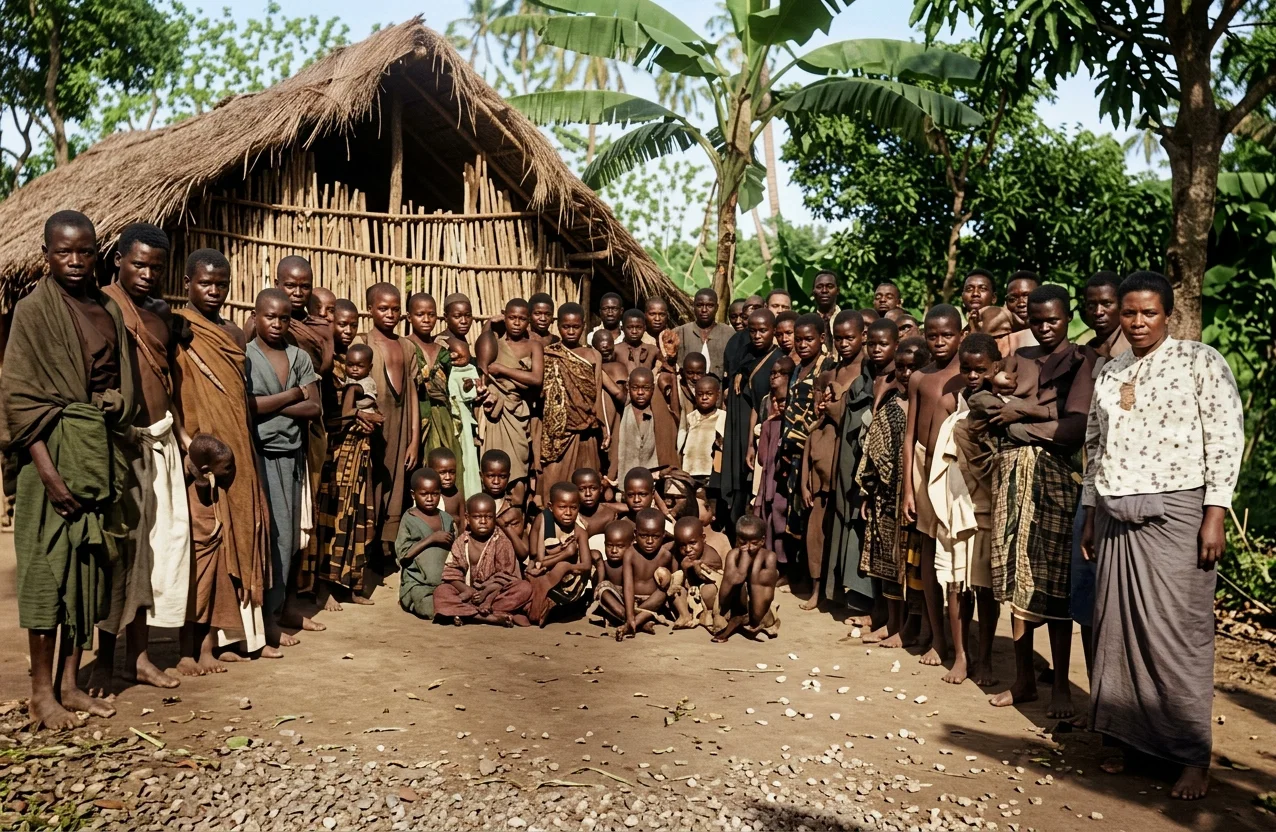
LATEST OUT-SCHOOL ESTABLISHED. TEACHER AT RIGHT
The farm consists of more than two thousand acres of very fertile soil. It is well watered by living streams, which are used for irrigating the gardens during the dry season. As a result, they have fresh garden produce the year round. Strawberries and peaches, as well as oranges, bananas, and other tropical fruits, do well in Nyassaland. The Malamulo Mission workers are planning to have a good supply of home-grown fruits and vegetables to supply the needs of the family and for the school as soon as possible. Already they have an abundance of lemons, bananas, and strawberries. They have other fruits in prospect from their thrifty young orchard.
They have five acres of peanuts, five acres of sweet potatoes, ten acres of beans, ten acres of other vegetables, twenty-five acres of cotton, and fifty acres of corn. The cotton field is all set to rubber trees, which are making a remarkable growth. The rubber industry now gives promise of being very helpful in bringing financial returns. Cotton is also a paying crop for this section. There is no market for corn, and it is profitable to grow only a sufficient amount for their own use. The mission is so far from market, and the shipping and freight rates are so exorbitant, that it is impossible to ship corn from this section.
This is a good stock-raising country, and dairying is very profitable. The mission owns one hundred head of cattle, and sells about five hundred dollars' worth of butter annually. This will become a profitable industry for the support of the mission. The present plan is to increase the dairy, plant larger fields of cotton, and increase the rubber-tree acreage quite materially, as these are all promising industries. Rubber trees begin to yield returns when three years old.
Two hundred students are now in attendance at the main Malamulo school. They are making excellent progress in their studies. They read well, and in mathematics they would keep many in our European and American schools, of the same grades, busy to surpass them in working problems with rapidity and accuracy. When it comes to Bible study, they are in advance of many who havehad better opportunities. The entire school will recite verses committed to memory by the half-hour, and give the references from the Scriptures. I was surprised at the remarkable memory of these darkened heathen. It seems that God gives them special help in committing to memory many portions of Scripture. The entire school is doing a high grade of work. The Bible class gives special instruction to candidates for baptism during a period of two years before baptism, in most instances. This gives them time to become well established in the faith, and those who are vacillating usually drop out before the time for baptism is reached. I had the pleasure of joining Elder Rogers in a baptismal service at the close of the school year, in which twenty-two followed their Lord into the watery grave. This makes one hundred fifteen names now enrolled upon the church record at this mission.
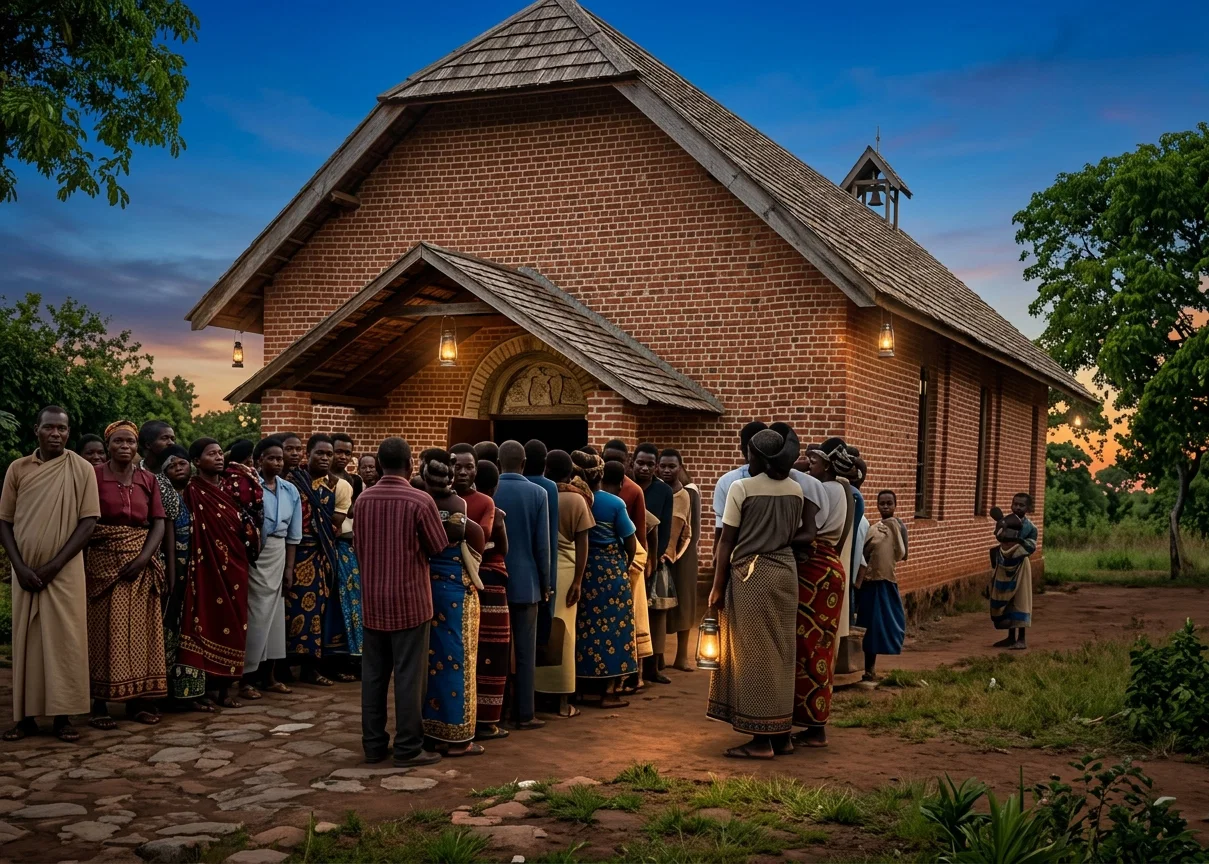
THE NIGHT-SCHOOL AT MALAMULO MISSION
There are nineteen out-schools, with a combined attendance of over five hundred students. It is remarkable to see the amount of work that is being successfully carried forward here in Nyassaland with six white teachers and their thirty native assistant teachers. Brother and Sister Rogers, Sisters Ina and Etta Austen, and Brother and Sister S. M. Konigmacher are the only white laborers connected with the work in this vast field. Were it not that we remember the miracle of the loaves and fishes, we would be inclined to say, “What are these among so many?”
One difficulty here is that there are no wagon roads out from the mission. All produce must be carried out, and all goods carried in, for several miles. The workers are now planning to make wagon roads so that much machilla and goods-carrying expense may be dispensed with. Machilla carrying is very expensive and unsatisfactory.
Nyassaland.