The First General Meeting in Siberia

7%

Review and Herald Publishing Association · Tacoma Park Station, Washington, D. C. · Sep 1, 1910

FromReview and Herald, Vol. 87, No. 35.

Read the full edition

The First General Meeting in Siberia

MRS. J. T. BOETTCHER
Early Monday morning, June 13, we left the city of Moscow en route for Siberia. The weather was very hot and dusty; but as we succeeded in obtaining, without extra expense, a small compartment alone, we found ourselves very pleasantly situated for our long inland journey. We enjoyed the privilege of having with us for four days Elder E. Gnedjen, who was on his way from Caucasia to Manchuria.
When night came, we could make up our beds and rest as comfortably as in a sleeper. We had a little table which we arranged for our books and papers, and for our meals. We could read and hold our worship undisturbed, and as we could lock ourselves in, we were not obliged to lie awake at night to watch our baggage. All travelers going long distances in Russia provide themselves with teakettles, as all the larger stations furnish the passengers with hot water free of charge. The water is clean and boiling hot, so that it is easy to make a good cup of cereal, or any other kind of drink, right on the train. Thus wewere always provided with wholesome drinks on our journey, and thought it a great improvement over the ice-water tank and common drinking-cup found in our American trains. At most of the smaller stations hot milk in bottles can be bought for two cents and a half a quart. In fact, the Siberian trains are among the most comfortable in the world. They are very clean and well kept.
<|DELIM_1e3|>[[FIGURE]]<|DELIM_1e3|>
We passed through many great cities, and through innumerable towns, villages, and hamlets; over broad rivers and by quiet lakes. Valleys, plains, and high mountains succeeded one another in rapid succession. But our hearts were made sad to realize that in all this long journey we were not passing one church or group from which the light of present truth is shining. Yet God has caused this great railroad to be built that the third angel’s message may be carried to these nations sitting in darkness. We saw church buildings enough everywhere, both Orthodox and Mohammedan, many of them grand and imposing; but they do not teach how Christ can set the burdened sinner free. While in Moscow, we visited some of the churches there,—vast treasure-houses, where the wealth of the earth is stored, gold and silver, precious stones and jewels, pictures and relics. Truly she sits a queen, and is no widow!
A church sexton took us into a chapel where the ancient relics are most carefully preserved in costly cases. We were shown a long row of such cases, closed except for a little round hole in the top of each, through which one can see a bit of bone or cloth, or a piece of wood, or a nail. Each case is carefully labeled, describing the contents,—a bone from the body of St. John, one from St. Luke, and also one from St. Stephen; here a bit of Mary’s dress, and there a piece from the Saviour’s cloak; one of the nails which pierced his hand, and also a piece of the cross. We found one case containing, it was claimed, a bone from the prophet Daniel (evidently the Orthodox church does not dispute the fact that such a man as Daniel existed). Whole beds, covered with most costly draperies, are to be seen, whose only occupant is a small piece of skull from some great saint, put in a case and laid among the pillows, to be kissed by the believers. Often one sees a mother lifting her child up so it can kiss these bones.
Then there are the holy pictures, which are said to work miracles. We asked, “What miracles?” and were told that the blind had been restored to sight. Yet just outside the church door we had given money to a blind beggar. The people are most enthusiastic in their worship, bowing their faces clear down to the ground many times, and kissing every picture and relic with great reverence. This seems to be the whole of their worship. O, how great is the darkness!
And as in the Orthodox church, so also in the Mohammedan mosque, the worship consists of dead works, which can never create a new and clean heart.
Of late the liberties of our people in the Russian Union have been greatly restricted, and so it was decided not to hold the Siberian general meetings in the cities, but far out in the country. Consequently, Friday morning, about six o’clock, we left our comfortable train at a small Tartar station called Mamlutke. The conductor did not want to let us off at such a place, as he felt sure there must be some mistake. But we were following the directions of Brother H. K. Loebsack, and he had written that a brother would meet us with a team at this station.
As we stepped out upon the platform, we found the air piercing cold, and we were thinly dressed. The brother who was to meet us was not yet there, so we went into the depot, and ate our breakfast. Before we had finished, our brother arrived, and we started for the place of meeting, which he said was about twelve miles distant. It was a cold ride indeed,—as we could not unpack our warm clothing,—but a very interesting one, passing, as we did, first through a Tartar and then a Russian village. The Tartar houses are made of mud or clay, with flat roofs. These houses are very low, but they have windows, and in many of those we saw there were house plants in bloom.
Leaving the villages behind, we rode over the prairie and through the woods, until we came to a small settlement consisting of nine families, most of them Seventh-day Adventists. The houses are built close together, and the location is pleasant, with a small lake on one side and woods on the other. We received a most hearty welcome. Elder Loebsack had arrived the day before, and other brethren and sisters were beginning to come.
(Concluded next week)
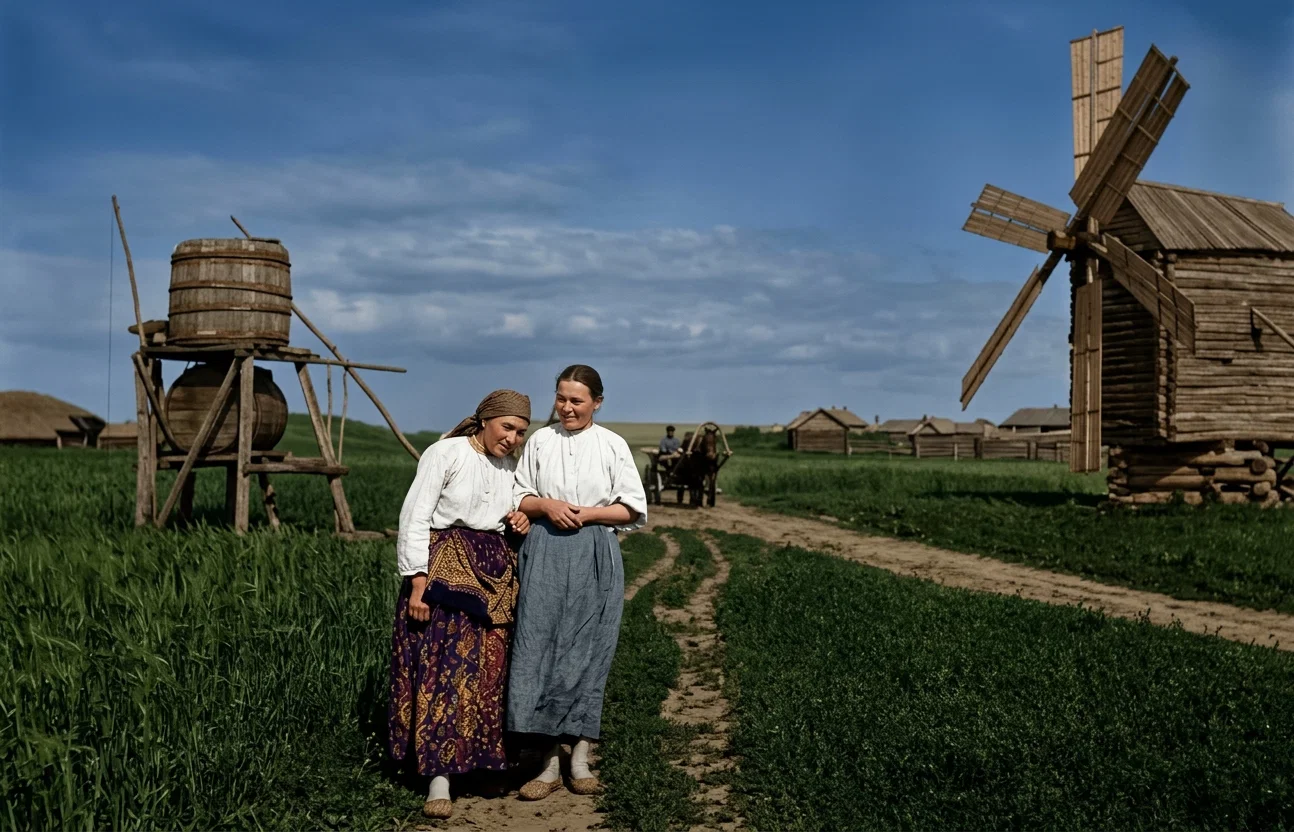
A RUSSIAN WINDMILL
A RUSSIAN WINDMILL