Lima, Peru

8%

Review and Herald Publishing Association · Takoma Park Station, Washington, D. C. · Sep 15, 1910

FromReview and Herald, Vol. 87, No. 37.

Read the full edition

Lima, Peru

A. N. ALLEN
Four hundred seventy-seven years ago on August 29, Pizarro and his men strangled Atahualpa, the Inca emperor. This was the death-blow, struck in foul injustice and treachery, to the most powerful empire in the western hemisphere. Atahualpa ruled absolutely from Panama to Chile, and from the Pacific Ocean to the uninhabited jungles of the Amazon valley. Cuzco, the capital, with its temples and palaces covered and lined with gold and silver, and reflecting the light of the tropical sun, the god of the Incas, sat as a queen over this vast empire. And an appropriate throne it was for those who worshiped the sun; for it is eleven thousand feet above the sea, and is thus nearer the sun than any other city of its size in the world.
From Cuzco radiated well-kept public roads to all parts of the empire. Dr. Tschudi, the famous Australian archeologist, speaking of these roads, said: “Even in the existing state of our knowledge, and with modern instruments of labor, they would be deemed worthy of the most civilized nation now on the globe.” “Of all the ancient monuments whose ruins invite our attention, there are none which, by their astonishing character, their immense extent, and the seemingly impossible labor which their construction demanded, impress us more profoundly than the royal roads which traversed the entire empire from north to south.”
The irrigation system was another of the public works which merits notice. The ditches are yet to be seen, and many of them are still in use. Mountainsides so steep that a goat can scarcely scale them are made to blossom as the rose by the magic touch of water brought to them by ditches carved along the side, often sustained by masonry, sometimes passing through tunnels, and, like the veins and arteries of the body, carrying the life-giving fluid to every part. In some places the water was carried underground for long distances through tunnels dug for the purpose. Thus the land was made to support a much larger population than now exists in the same territory.
Between the capital and the remotest corner of the empire a perfect system of communication existed. Runners were continually going to and from established posts on all the royal roads. Running as swiftly as possible from one post to another, one runner took a message, and carried it to the nearest post, then another carried it to the next post, where it was taken by another runner, and so on till the capital was reached.
The method of recording facts and dates was by knots tied in rows of short strings, or cords. There was a large cord, with perhaps fifty smaller ones fastened to it by one end, thus giving the appearance of a fringe. The art of reading this writing, if such it can be called, has been lost. If we could read it, we might know much more than we do about the history of the Incas.
From the time the Spaniards landed in Peru, the country has been repeatedly involved in war. The public interests have been sacrificed to the interests of the few. The Indians became the instruments in the hands of the Spaniards with which to make war. Countless numbers were sacrificed in wars in which the Indian had no interest. Thousands more were sacrificed to the god of gold and silver in the mines. One of the sports of the Spaniards was to hunt the defenseless Indians with dogs, as the hare is hunted in England. Even today the Indians on many farms are practically slaves. They are kept continually in debt to their masters, and can not leave till they have paid the utmost farthing. Not being able to read or write, they are easily deceived, and usually die before the debt is paid.
Three fifths of the inhabitants of Peru are Indians, few of whom speak any but the Kechua language. This has many dialects, so those learning to speak the dialect of one city are almost helpless in another. The Aymara language is also spoken by a large number. Many of the younger generation are now learning to read and speak the Spanish language. Ecuador, Peru, and Bolivia are each doing much to educate the Indians. Many new schools are established each year.
There are perhaps two blessings which Spain gave to South America,—the overthrowing, at least in name, of sun- worship; and the giving of one language to a country where before there were perhaps hundreds. In ancient times whole nations were destroyed for their adhesion to sun-worship; but a remnant was spared to hear the gospel.
To try to give the gospel to the Indians in their own languages is not practical. As the only ones who can read in those languages can also read Spanish, nothing is gained by printing in the many dialects. The sale of books in the native tongues would also be so limited as to make it unwise to go to so much expense. Those who teach the gospel among these people will, of course, speak the language; but the younger generation are being prepared to receive the gospel through the Spanish language, and they can teach it to the older ones.
The seed which has been sown during the past few years is beginning to bear fruit. Last year ten were baptized, and the number of believers was nearly doubled. This year we hope to reach those who have been waiting so long, instruct them more, and baptize them. Let us pray and give for the work where we have brothers who are ignorant of Christ.
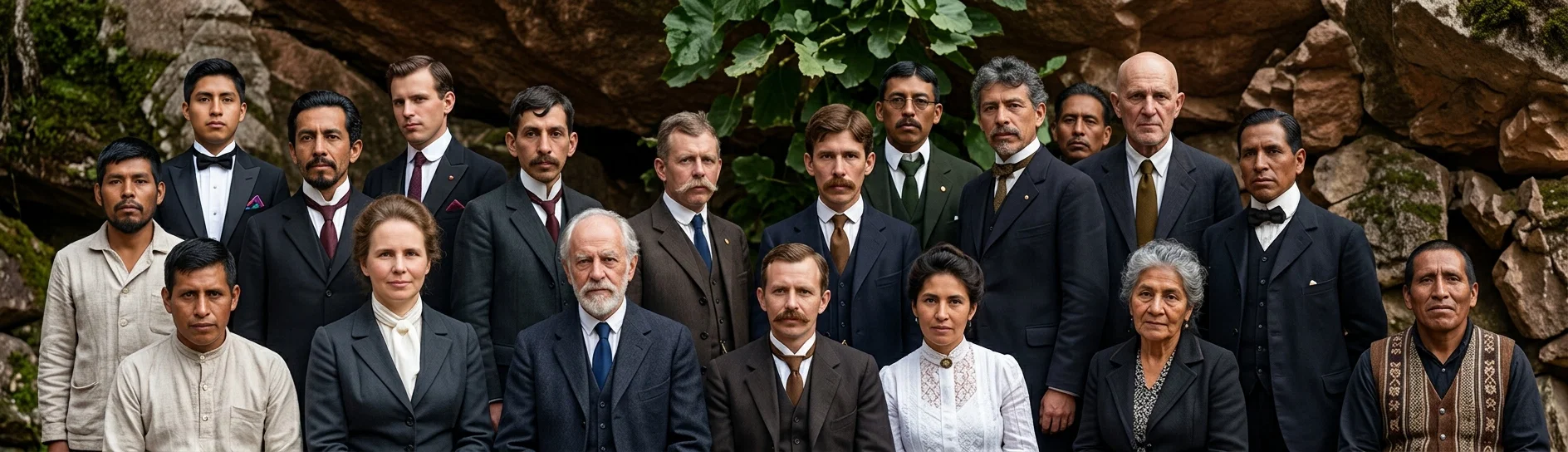
WORKERS ATTENDING A GENERAL MEETING IN PERU