[This report was written just before the death of Elder J. C. Little.—Ed.]
In company with Elder J. C. Little I arrived in Barisal, East Bengal, to attend an annual conference of our Bengali people. Arrangements had been made for a four days’ meeting. Through the influence and kindness of a Bengali gentleman, we were able to secure a tent that would seat between three and four hundred persons. As we were able to provide seats for only a portion of the tent, many who came had to sit on the ground.
Barisal being an educational center, many of the people were able to understand English, and requested that the evening meetings be conducted in that tongue. The first evening Brother L. G. Mookerjee spoke in English, the tent being well filled. The writer was to speak the next evening, and announced at the close that he would address the people in English, the subject to be, “Why Have We Come to Barisal?” But as I thought over the matter, and because some said they did not understand English, also for the reason spoken of in 1 Cor. 14:8, 9, 19, I decided that I would speak through an interpreter.
Barisal is one of the centers of the Swadeshi (India for the Indians) movement, and the government sent police to see that nothing was said or done that would be in the nature of sedition. For this reason I knew it was not only necessary to be most careful what I said, but also that I be not misunderstood. After stating my reasons for speaking through an interpreter, I told my hearers, in brief, that the Lord is sending a message to all the nations of the earth; that through this message he will gather out a people for his name; and that he desires the people of Barisal to be among the number. This was the reason we were among them, and why they were in the tent,—that they might hear the invitation, “Come, for all things are now ready.”
I never spoke to a more interested or orderly people. J. C. Little and A. G. Watson spoke to them on the prophecies, portraying with clearness the history of the world and the events that are now transpiring, showing that the end is near.
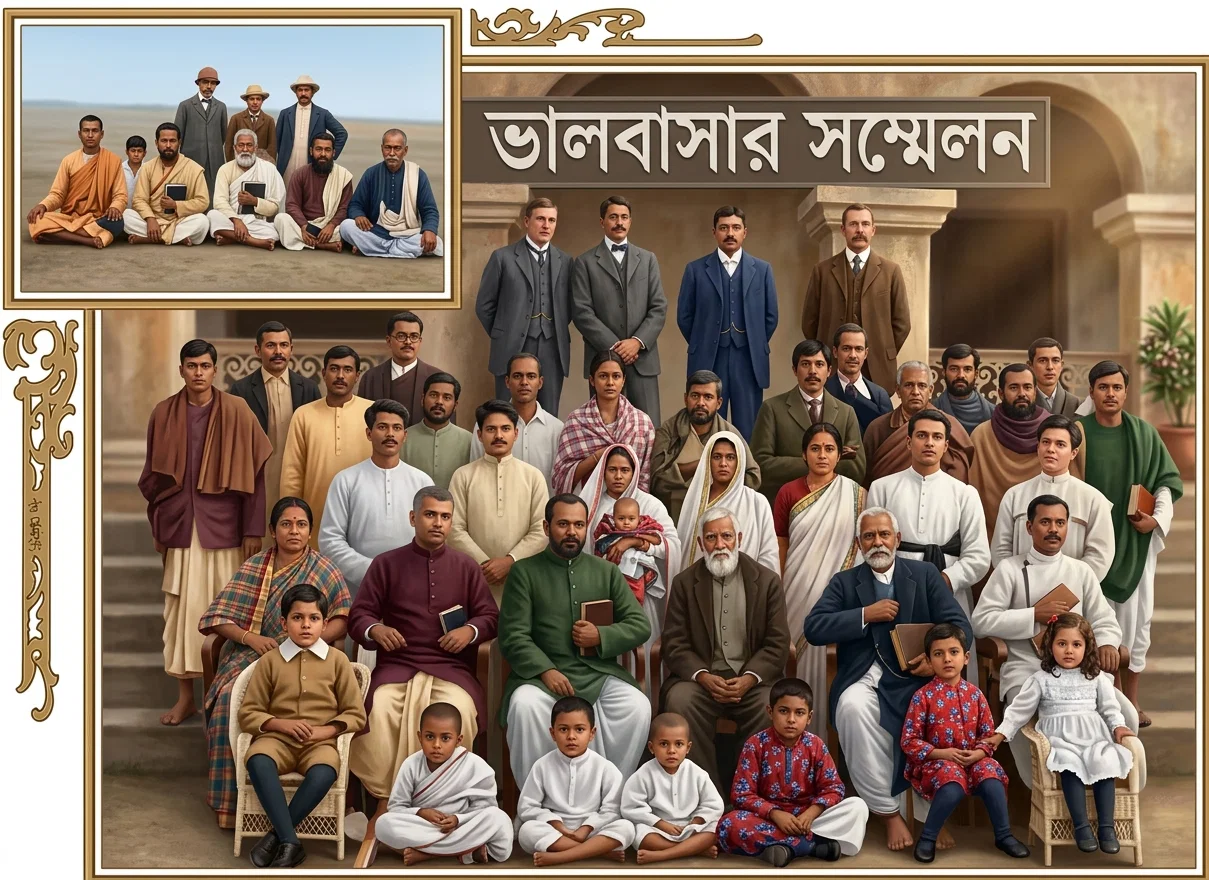
From early morning until late at night the people came to inquire about our work and belief. We had a sign put up over the front door of the tent, which read, “Behold, He Cometh!” and many were the inquiries, “Who is he that is coming?” “When is he coming?” etc. The sign was printed in Bengali, and appears just above the heads of the company in the picture. The picture is of our own people only. Had we been able to take a picture of those attending the evening meetings, it would have shown between three and four hundred Bengalis.
The small picture represents the Bengali (India) Conference of believers in 1909. The other their gathering in 1910. Standing at rear, left to right: J. C. Little, A. G. Watson, L. G. Mookerjee, W. W. Miller.
The attendance at the evening meetings indicated that God is moving the people of India to listen to the last message; and why not? for really it is due to the whole world. The heavenly timepiece has struck the hour, “Go ye into all the world, and preach the gospel to every creature.” Where are the workers to-day who are saying, as they see the needs of this field, “Here am I; send me”? Where are those who are standing idle in the market-place at this eleventh hour, saying, “No man hath hired us,” but who are willing to go and work and be content with their wages?
Near the close of the meeting we baptized twenty Bengalis, and organized a church of twenty-six members. At the baptism a Hindu embraced one of the men when he came out of the water, saying, with tears in his eyes, “May God bless you,” showing that his heart was touched by the scene.
We celebrated the ordinances on the Sabbath, and I must say that I never attended an ordinance meeting where my heart was so touched as at this time. To see our poor old leper brother, whom the Lord healed in answer to prayer, washing Brother Little’s feet, with his fingers almost gone, and Brother Little washing his feet, which were off up to the instep, was enough to melt the hardest heart. In the case of this leper it can be truly said that he returned to give God the glory. [The healed leper spoken of sits in the front row, the fourth from the left, with his crippled hands under his cloak.]
As these native brethren sang, “We will bear the cross of Jesus,” it filled our souls with joy unspeakable, and at the same time made a lasting impression upon our minds that these people understand and appreciate the love of Christ for them. The leper brother was healed by prayer many years ago; and when he learned that Jesus kept the Sabbath, he decided at once to keep it, saying that he would gladly follow in the footsteps of him—who had healed him.
Since our meeting ten more Bengalis in East Bengal have accepted the truth, and many more are interested. Brethren Little and Watson are constantly receiving calls to present the truth in the villages. The work in East Bengal is going forward more rapidly than ever before, and we hope to see a large company of believers gathered out of this part of India.