The Shanghai Meeting

2%

Review and Herald Publishing Association · Takoma Park Station, Washington, D. C. · Mar 18, 1909

FromReview and Herald, Vol. 86, No. 11.

Read the full edition

The Shanghai Meeting

This important gathering met in the city of Shanghai, China, January 12-22. All the foreign workers in China were present at the first meeting; also Brother N. P. Keh, a native worker from the Amoy Mission. It was a great privilege for me to meet the workers assembled at this meeting, though I had already met them in their respective mission fields during my visit to the various mission stations in China. It must be remembered that most of these families had been isolated in their respective fields during the last two years, as the workers had not met together since Prof. W. W. Prescott was with them in 1907. Those in the home land can hardly appreciate the pleasure it gives the workers in foreign fields to attend a general meeting of this kind, where they can exchange experiences, and receive the inspiration and help that come by being in touch with the influences that generally prevail at such a gathering. At best, the influence of heathenism is very depressing. Those in a heathen land, surrounded year in and year out by this depressing atmosphere, certainly need the uplift that comes by gathering together. Even in the home land, where we have Christian environment throughout the year, we find our courage greatly strengthened by our annual meetings.
The brethren in Shanghai had rented a convenient hall, heated and lighted, for the meetings. An effort was made to secure an outside attendance; however, very few could be induced to attend our meetings from the outside, though they were freely advertised in the daily papers, and circulars were distributedadvertising the themes to be presented.
The first part of the meeting was occupied with interesting reports from the field, nearly every one reporting progress in the conversion of souls. At one station in Honan, fifty-two persons had already identified themselves with the truth, while forty-six others were keeping the Sabbath, and were interested in Bible truths.
The Sabbath service was one long to be remembered by all present. The Spirit of God was present, and united hearts in such a way, as, we believe, will greatly help to advance the work in China. Nearly all present endeavored to clear away any stumbling-stones in the way of their fellow workers.
All phases of the work were considered at length, and many recommendations were adopted for the advancement of the message in this great country. In order to facilitate the advancement of the work, the field was organized into local mission fields, with a superintendent and working committee in each division.
Following are some of the recommendations adopted:—
“Whereas, The Chinese empire, comprising eighteen provinces and four dependencies, has an area of four million two hundred seventy-seven thousand square miles (being over two thousand miles from north to south, and two thousand five hundred miles from east to west), with a population estimated at from four hundred millions to four hundred thirty-three millions; and,—
“Whereas, Modern improvements in the way of transportation in China are far behind those of most other civilized nations, thus causing much loss of time in traveling, during which little or no work can be accomplished; and,—
“Whereas, It seems that we could facilitate the spread of the message in China by subdividing the territory, and locating at least two families of workers in each province and dependency; therefore,—
“1. Resolved, That we subdivide China and its dependencies into ten mission fields.
“2. Resolved, That each of these ten mission fields shall have its own superintendent.
“3. Resolved, That this council select from the present staff of workers as many superintendents as they can spare for this work.
“4. Resolved, That the General Conference Committee supply the remaining mission fields with superintendents.
“5. Resolved, That in addition to these superintendents the General Conference Committee be requested to at once select and prepare for entering China, during 1909 and 1910, not less than forty families, and that of this company a sufficient number of physicians be sent out to locate at least one in each mission field; and,—
“6. Resolved, That these forty families be apportioned as follows: Manchuria, two families; Tibet, two; the Northern Division, six; Northwestern Division, four; Eastern Division, six; Central Division, eight; Western Division, six; and that the dependencies of Mongolia and Turkestan be referred to the General Conference Committee, with the suggestion that a physician and evangelist be prepared to enter each of these fields as soon as the said committee deems it advisable.
“7. Resolved, That each mission field shall have a superintendent and an advisory committee, which shall consist of the superintendent and the chairman of the provincial committees, and such other members as the constituency of the mission fields shall agree upon.
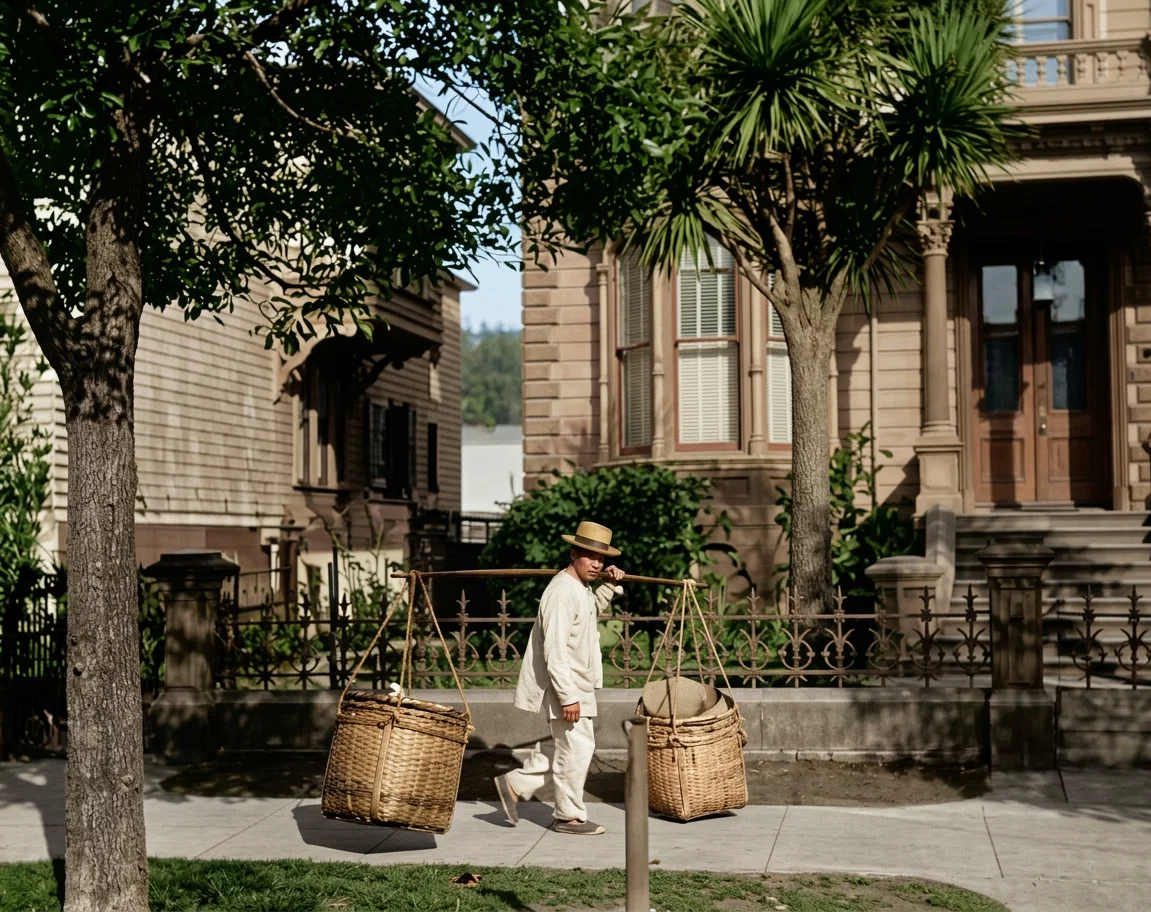
A STREET SCENE IN THE FOREIGN PART OF A CITY IN CHINA
“8. Resolved, That the superintendents of these mission fields be appointed by the General Conference Committee.
“9. Resolved, That there shall be a general advisory committee for all China, which shall be known as the China Mission Committee, with headquarters at Shanghai, to be made up as follows:—
“(a) The chairman, to be the superintendent of the work in the Orient, who shall be appointed by the General Conference Committee.
“(b) An assistant superintendent, to be appointed by the General Conference Committee.
“(c) The superintendents of the different mission fields.
“(d) The secretary and treasurer of the China Mission.
“(e) The manager of the publishing work.
“(f) The secretaries of the medical and educational work.
“(g) The general canvassing agent, and such other persons as may be deemed advisable from time to time.
“10. Resolved, That the China Mission Committee shall carefully study requests for appropriations, and after they have settled upon an equitable distribution of the funds required for China, shall pass the same on to the General Conference Committee for its approval.
“11. Resolved, That a general meeting of all foreign workers (and such other workers as the China Mission Committee shall see fit to invite) of the China Mission shall be held biennially for the purpose of laying plans for the development of the work and the spiritual upbuilding of the workers themselves, and that this meeting shall not be held in the winter.
“12. Resolved, That each mission superintendent be held responsible for securing all necessary statistics and inventories of the work in his field, and shall forward the same to the secretary of the China Mission.
“13. Resolved, That we hereby suggest to the General Conference Committee the advisability of erecting a one-story printing plant with a two-story frontage, the lower part to be used for the storing of paper, books, etc., while the upper floor will be used for offices, the rest of the building to be on the ground-floor plan. We suggest that this building for the press be made to accommodate three cylinder presses, three job-presses, a wire-stitcher, a foundry, a composing-room, a bindery, and an engine-room.
“14. Resolved, That all workers be required to pursue a systematic course of language study, which shall be made out by the China Mission Committee, and that language examinations be held yearly by the superintendent of the mission field, or some one whom he may designate, and a competent Chinese teacher.
“15. Resolved, That the China Mission Committee outline this course of study as soon as possible, so that the workers may understand definitely what work is required in a year.
“16. Resolved, That the superintendents of fields render all possible help in the selection of suitable language teachers.
“17. Resolved, That a literature committee shall be appointed, consisting of three sections; namely: Mandarin section, three members; Wen-li section, four members; English section, three members; this committee to examine all manuscript submitted for publication, and approve the same before it is printed.
“18. Resolved, That no worker in China shall cause to be published any literature bearing on the third angel’s message without first submitting his manuscript to the literature committee, and receiving its approval.
“19. Resolved, That the China Mission Committee shall suggest from time to time to the literature committee such literature as they believe should be brought out in the Chinese language, designating in which dialects the same shall be published.
“20. Resolved, That the China Mission adopt the educational policy of the General Conference of Seventh-day Adventists.
“21. Resolved, That, as far as possible, in every company of believers where there is a sufficient number of Seventh-day Adventist children of schoolage, we encourage the opening of a church-school.
“22. Resolved, That intermediate schools be established in the various provinces as rapidly as the constituency of believers will warrant.
“23. Resolved, That special attention be given to training evangelists, colporteurs, and Bible women for field work.
“24. Resolved, That all in charge of mission stations be earnestly requested to give special attention to the training of Chinese church-school teachers.
“25. Resolved, That we enlarge upon the medical missionary work already undertaken in China.
“26. Resolved, That we suggest to the General Conference Committee the advisability of establishing a small sanitarium on the land which we have already purchased in Shanghai, in which there shall be apartments, in separate buildings, for the accommodation of both foreign and Chinese patients.
“27. Resolved, That, at all our general meetings, medical instruction be given by our physicians on such topics as,—
“(a) Care of the health.
“(b) Treatment of fevers and maladies prevalent in the Orient.
“(c) Dispensaries, and the training of workers to supervise this line of work.
“28. Resolved, That the medical secretary shall keep in close touch with our workers in China, counseling them from time to time regarding the care of their health.”
Many other recommendations were adopted bearing on various phases of the work, but space will not permit them to be quoted at length here.
The following officers were elected: Assistant superintendent, Elder J. N. Anderson; secretary and treasurer, H. H. Winslow; superintendent Northwestern Division, Elder J. J. Westrup; superintendent Eastern Division, Elder J. N. Anderson; superintendent Northern Division, Elder R. F. Cottrell; superintendent Southern Division, Elder W. C. Hankins; superintendent Western Division, Elder F. A. Allum; superintendent Central Division, Dr. A. C. Selmon; manager publishing work, Dr. H. W. Miller; secretary medical work, Dr. H. W. Miller; secretary educational work, Elder B. L. Anderson, secretary Sabbath-school work, Mrs. B. A. Roberts.
It was left for the General Conference Committee to appoint a general superintendent for the China Mission field, and local superintendents for the dependencies of Manchuria, Mongolia, Eastern Turkestan, and Tibet.
Elder J. N. Anderson and wife and three children, Sister Ida Thompson, and Brethren A. C. Selmon, Esta Miller, and O. J. Gibson returned to the United States for various causes for a short length of time. Brethren Anderson and Selmon are delegates to the General Conference. Brother Anderson’s wife and Sister Thompson were in poor health, and came home on furlough.
I esteemed it a great privilege to meet these dear workers in Shanghai, and trust that the good spirit that possessed our hearts at this meeting may continue in the lives of each of the workers, and that they may have rich blessings from the Lord in their service for the Master in the year to come. It really seemed painful to leave them and hasten away, as we had to, before the meeting finally adjourned. We closed the meeting on Friday noon, January 22, in order that those who were going to leave on the boat could make arrangements. The last meeting was one of the best that I have ever attended. A few remarks were made by the writer, and then we had a social meeting, in which all the brethren and sisters present took part. Each one bore an earnest testimony of consecration to the service of God.
During the council, it had been recommended that Brethren E. H. Wilbur and F. A. Allum be ordained to the work of the gospel ministry. Their ordination followed the social meeting, and these brethren were set apart by prayer and the laying on of hands.
Thus closed one of the best meetings that I have ever attended. A large measure of the Spirit of God was with us in our work, and all our hearts were united in the bonds of brotherly love and renewed consecration to the service of the Master.
I. H. EVANS.