German East Africa

7%

Review and Herald Publishing Association · Takoma Park Station, Washington, D. C. · Mar 25, 1909

FromReview and Herald, Vol. 86, No. 12.

Read the full edition

German East Africa

A. C. ENNS
VERY little has been heard of us through the pages of the REVIEW since the beginning of our work in German East Africa. While we do not in any way intend to exclude our work here from the knowledge of our people, for some reason the reporting of it has been neglected in our general church paper. Hereafter we hope to do better.
Our experiences have been varied, as is always the case in African lands. One day we are made happy and hopeful by having six or eight promising youth apply for instruction in the Word of God, with the view of baptism. After a few days we are made sad to learn that their real object is only to receive some small gift, or to be taken under shelter. The government demands every tribe to keep to the highway that passes through the district of that tribe. But the natives abhor this restriction, and of course are punished if they fail to obey the order. Then they wish to be protected by some one who has influence with the officers, and thus they come to their only friends, the missionaries. The natives know that the missionary can believe none but those whom he can trust, so they win his confidence, that they may profit by his recommendations to the very officers.
Thus we have to deal and reckon with disappointments from the beginning. While we have a much larger congregation from the start, compared with the population, than we have in more civilized lands, yet the conversions are probably less. We must always remember that these people do not reason as we do, nor are they touched in the same way. If a man can read, he may be given some Bible truth in print, and he is then constantly under the influence of that, according to the amount of time he spends in reading it. But these heathen can not read. Because of this, the missionary himself must be the open book for them to read, and it becomes necessary for him constantly to stimulate in them the spirit of inquiry, that he may instruct them about the texts they need. Thus the missionary has a much smaller field of influence, because he can not very well duplicate himself.
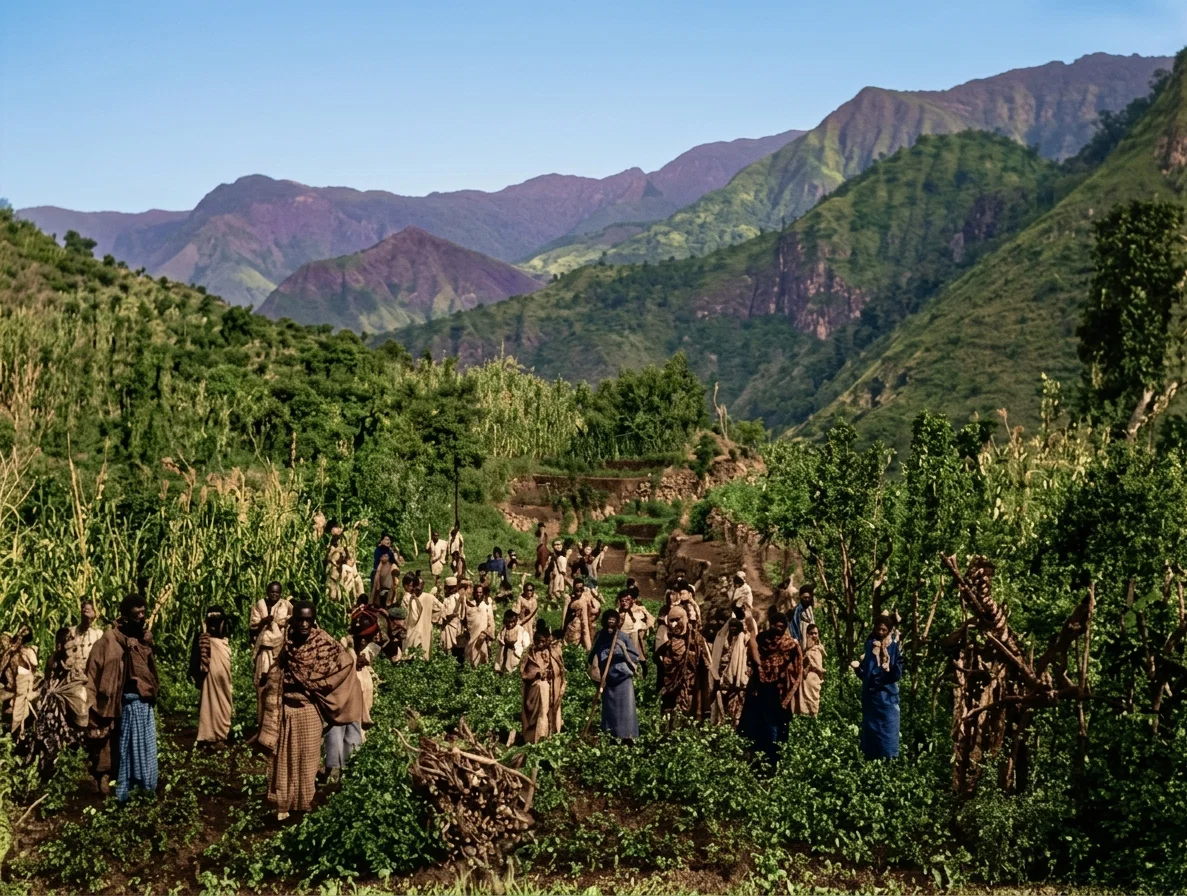
NATIVE GARDENERS AT VUASU, GERMAN EAST AFRICA
Our first-fruits must of necessity be expected from among those who are immediately about us day after day—the house boy, the cook, but most especially the language teacher, because the missionary is constantly questioning him about some text in the Bible, in his work of preparing a sermon or in translating. The next most favored are the children of the school, who, a part of every day at least, are under the immediate influence of the worker. Last of all are those whom he can visit only occasionally, or who come to Sabbath meetings.
It will be seen that our work is not to be judged by the same standard as that in America, or Europe, or any other field where people can read. We are confronted by disappointments from day to day. The young laborer usually comes here with a volume of courage, and many plans. But generally these are seen to be of no value during the first two years, and then the missionary's courage is likely to be severely tested. It is here that the true missionary bows himself, and asks, “Upon what have my hopes been founded?” He learns to wait upon the Lord for help. It must be remembered that the richest pearls are not picked up by the wayside, nor do diamonds lie about in piles, but men search for them, and sometimes find them among a great amount of worthless trash. Diamonds in their rough, unpolished state do not glitter, but look very much like the dirt and pebbles among which they lie. It is only by the patient work of polishing again and again that one eventually finds the worth of the mine. We must never give up in despair. We must continue our patient efforts in laboring for the heathen, and hold to the promise that Jesus gives us: “Lo, I am with you alway.” And keeping this in mind, we shall not only not faint, but shall find some precious jewels for Jesus' crown.
We have had sad experiences with our workers since beginning here. Three were unable to stand the climate, and three others died here on the missionfield. Of the fourteen who have come out in the course of five years, eight are left at present.
In 1903 we began our labors, without any knowledge of the tropics. Nor had we had any help in the written or oral language. We had to feel our way along as well as we could, asking questions by motions with the hands and feet, and by mouth in English, so as to get the meaning of their expressions and the names of objects. If a person is in a strait, he must learn. And so we soon learned to understand and be understood. On the third day we were able to buy land from the native chief. We asked him, “Isanga ili kurora rupia ngah?” which is to say, “How many rupees does this piece of land cost?” The answer came, after a lengthy discussion among themselves, “Rupia mia”—“One hundred.” Thus six words had made the ‘bargain, although we had a long query about what the word mia meant, before we understood; nevertheless, after we knew, we never forgot it. And the next time we learned another word. And so we had to master their words one by one, until we now have all the four Gospels translated, which will go to press as soon as they are recopied on the typewriter. We also have other books—a good grammar, a primer, and a hymn-book containing about sixty hymns—in this native language.
We can report some fruits for our labors. We have been able to baptize six natives, and there are others who will be ready for baptism before the end of this year [1908].
My work has been at Vuasu for the last two years, since I returned from British East Africa, where I went with Elder A. Carscallen, to assist in opening a mission for the British Union Conference. Since then we have put up the buildings here. We have built a stone house at a cost of one thousand dollars; a carpenter shop, also of stone, costing fifty dollars; primitive buildings for the native mission helpers—one for the boys, costing forty dollars, and a hut, for forty dollars, where I had my abode until the stone house was finished. We did not intend to use this building after I moved; but it has been repaired and strengthened, and is now holding over one hundred children, as a school, although they are cramped for room. We have not yet the means to build the much-needed schoolhouse. Our school is at present managed by Brother Max Ponig. I have one class of about sixty regular students, whom I teach in one of the rooms of the house. On account of the crowded condition, it is very unhealthful. We hope to prepare another room to hold my class, for which we have been promised fifty dollars. Then we shall be in good condition to do extensive work.
At present some of the advanced pupils are under instruction in the Word of God, with the intention of being baptized later. Our prospects are very good. Although we have had to learn to wait, we have now something real to look upon, and we rejoice in the realization of what in past years were promises. Our prayer is that the Lord will send still more laborers into this field; for the fields are white for the harvest.
Post Mombo.