A Trip to New England

5%

Review and Herald Publishing Association · Takoma Park Station, Washington, D. C. · Apr 8, 1909

FromReview and Herald, Vol. 86, No. 14.

Read the full edition

A Trip to New England

MONDAY, March 15, the chairman of the Religious Liberty Bureau and the writer left Washington, D. C., for a nine-days' trip to New England. Tuesday evening, March 16, we spoke at a mass-meeting at Hartford, Conn.; the next day we attended a hearing at Albany, N. Y., where thirty Sunday bills have been introduced during the present session of the legislature; following this, we conducted a two-days' religious liberty institute with the students of the South Lancaster Academy, and later held meetings at Boston, Melrose, and Springfield, delivering, in all, twenty-eight addresses during the trip.
The mass-meeting at Hartford was held in Unity Hall, and was fairly well attended. It was reported that six State senators were present. The speakers of the evening were Elders C. H. Edwards, president of the Southern New England Conference; W. R. Andrews, religious liberty secretary of the conference; C. S. Longacre, religious liberty secretary of the Atlantic Union Conference; K. C. Russell, and the writer. Many strong and convincing arguments weremade in the five addresses delivered, which we have since learned made a good impression on some who were present.
One particularly interesting case connected with this meeting came to our attention. During the meeting, we noticed a bright, intelligent young man, whom we took to be a reporter, sitting near the front, taking notes of all that was said. After the meeting was over, and Elder Russell and I had gone to the station to take a late train for Albany, this young man came to us and sought an interview. He stated that the question of Sunday enforcement by law had come up for consideration in his home church, the Episcopalian, and that he was to take the negative side of the question in a discussion to be held in the church a little later. That morning he had gone to the town library to see if he could find some work against Sunday legislation to aid him in preparing his argument, but was informed by the librarian that there was nothing in the library of the character he wished. Upon looking over the morning paper, however, he noticed an announcement of our mass-meeting at Hartford in the evening, and he at once decided to attend this. He had to travel about ten miles by train to do so, but he seemed to feel well repaid for his pains. We had a pleasant talk with him, and supplied him with some literature, took his name and address, and are now corresponding with him.
During the day previous to the mass-meeting, we spent some time at the large library in the State capitol building, looking up and copying off the old Connecticut Sunday “blue-laws” as far back as 1721.
The following day, Wednesday, March 17, a hearing took place at the capitol on the various Sunday bills which have been introduced into the Connecticut Legislature this session. A strong effort, headed by the mayor of Hartford, and supported by the mayors throughout the State, has been made to liberalize the present Sunday laws of the State, and also to secure such amendments to these as would bring about uniformity in their operation. One measure introduced, like the Johnston Sunday bill, contains thirty exceptions, over one half of the bill being devoted to these. On account of the hearing at Albany coming on the same day, Elder Russell and I could not attend the hearing at Hartford. The brethren who did attend it did not get an opportunity to present any arguments, but were permitted to ask questions, and by this means were enabled to make clear the nature of the proposed legislation.
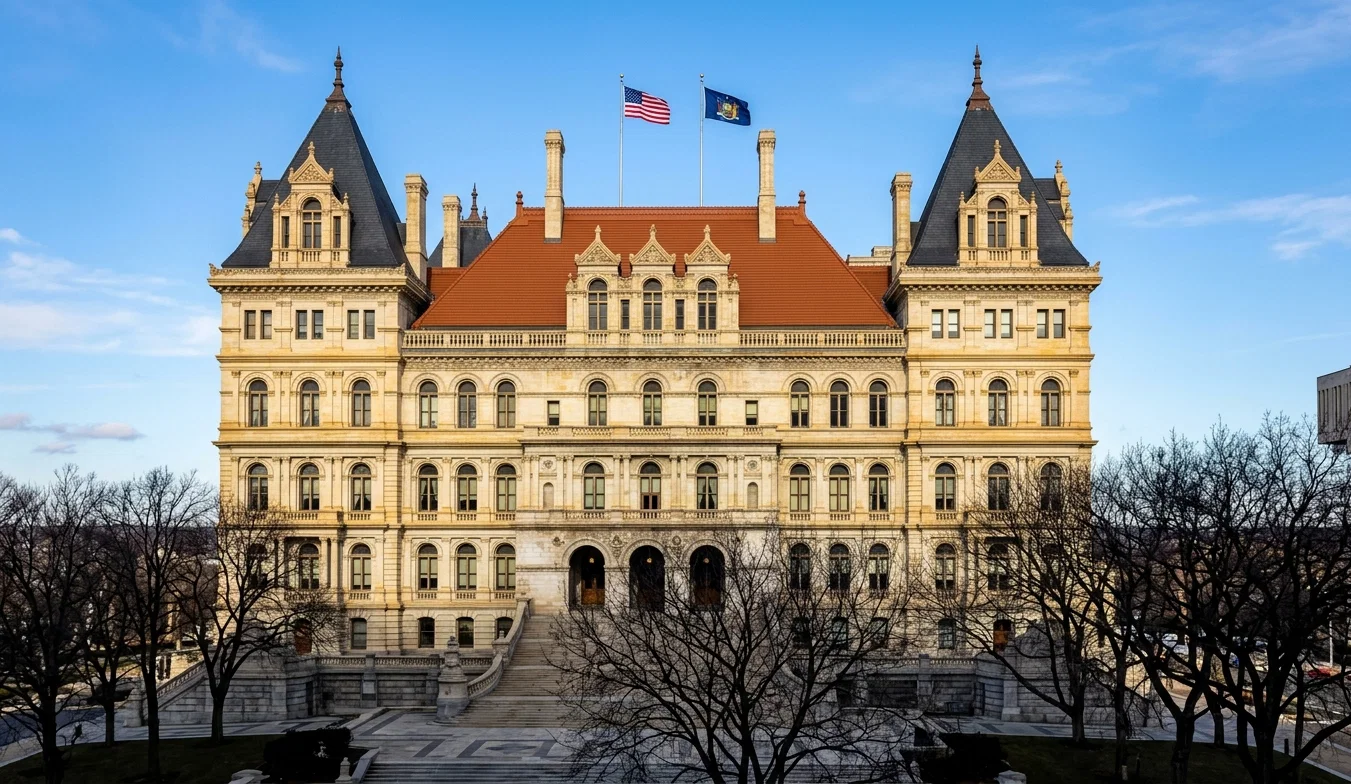
THE STATE CAPITOL, ALBANY, N. Y.
The hearing at Albany took place Wednesday afternoon, March 17, and was a particularly interesting and lively affair. It was held in the capitol building, before the committee on codes, and continued for over four hours. An unprecedented number of Sunday bills had been introduced, thirty in all, and in order to consider all of these, hearings had been set for three successive Wednesdays, this being the first. Through the courtesy of the chairman of the committee, and some wise planning on the part of Elder A. J. Clark, who has been looking after matters in the interest of religious liberty at the State capital this winter, we were permitted to speak upon any of the bills at this hearing, and deal with the question of Sunday legislation in general. Many of the measures introduced were for liberalizing the present laws, and reducing the fines and penalties; some were for making them more stringent; and some to amend the exemptions touching the observance of the seventh day, particularly in the interests of the Jews. The latter were introduced by Jews, there being no less than five Jews in the present membership of the Assembly.
Fully two hundred persons were present at the opening of the hearing. The retail grocers, who appeared in large numbers, asked for legislation requiring the closing of shops and prohibiting trade on Sunday, on the ground that the opening by some while others closed was “unfair competition.” They said: “We don’t believe in this thing of keeping stores open on Sunday. We are going to stand by our American flag, and we want a clean Sunday. All creeds should submit to the American principle that no unnecessary work shall be done on Sunday. Sunday opening keeps employees away from church. What we want is the enforcement of law.”
Against a measure known as the McGrath Sunday baseball bill, prominent clergymen and churchmen from all over the State appeared in full force, including Rev. W. S. Hubbell, of the New York Sabbath Association; Rev. Dr. Ward, Presbyterian, of Buffalo; Prof. A. N. Housted, of the State Normal College, Albany; Mr. Farrell, of the Christian Endeavor, of Albany; Rev. Fred J. Tower, of Rochester; Dr. Laidlaw, of the federation of the churches, of New York; Rev. Dr. Wood, representing, as he claimed, the Baptists of North America; Mr. W. I. Sotherton, of the Brooklyn Sunday-school Union; Canon Chase, of Brooklyn; and Mr. Robins, of the State Sabbath Union.
Dr. Hubbell marshaled the church forces against the bill, reading letters from the Catholic archbishop of New York and leading Protestant representatives, protesting against it.
Dr. Ward, claiming to represent all the Protestant churches of western New York, presented letters of protest from Bishop Walker, Episcopal; and Bishop Colton, of the Catholic diocese of Buffalo. He said he did not oppose the bill on religious grounds, but because Sunday baseball tended to “demoralize the youth, and break down the American sabbath and American citizenship.” He emphasized “the necessity of preserving the sanctity of Sunday,” and said that “this is the only day that is given to religious and moral instruction.”
Mr. Streibert said: “I believe that in this country the majority conscience should be respected, and not the minority conscience.”
Mr. Martin, of the Secular League of New York, was the first to speak of the un-American principle involved in Sunday legislation. He said, “I do not speak against the church, but against the church interfering in matters of politics.”
Although the committee had been together nearly four hours when we began speaking, we were given about forty-five-minutes' time, and a very respectful and attentive hearing, the chairman, when we suggested cutting our remarks short, asking us to continue, and remarking that they were interested in what we were saying. Elder Russell spoke first, followed by the writer, then Elder F. H. DeVinney, president of the New York Conference, and Elder Clark. A good impression, we believe, was made upon the committee. During the hearing, over thirty speakers took part, and thirty-five speeches were made.
At the close of the hearing, Canon Chase requested an interview with us. He stated that he agreed with much that we had said, but thought us mistaken in some of our ideas, and sought to set us straight by citing the “Christian nation” decision of the Supreme Court of the United States. We soon convinced him that he would not himself subscribe to all the decisions that had ever been rendered even by this august body, and that the decision referred to, and all religious legislation included, was contrary to the Christian and Protestant idea of civil government, and in direct conflict with the spirit and express terms of the national Constitution itself.
At the station, as we were taking the train for South Lancaster, a man who had been at the hearing and listened to all the arguments presented, came to us,and, after stating that he was a Presbyterian, said, “You gentlemen who spoke last were the only ones who spoke straight on the question,” which showed that some, at least, who were present were able to discern the difference between truth and error.
We spent a most interesting two days at South Lancaster, giving instruction on religious liberty principles twice daily before the entire body of students at the academy, and holding one evening service in the church, which was largely attended.
Our meetings at Boston, Melrose, and Springfield were likewise well attended, and we believe good was accomplished by them.
On our return we visited an eighty-acre farm near Concord, Mass., recently purchased by Elder F. C. Gilbert as a home for converted Jews: not far away is the battle-field where the first forcible resistance to British aggression on American soil was made, April 17, 1775, by the “embattled farmers,” afterward known as “minute men,” who “fired the shot heard round the world.”
W. A. C.