SHIKOKU is one of the large islands of Japan. The fourth in size, it is a little less than two hundred miles in length, and not quite one hundred miles wide. It is so mountainous that there are no railways, except several narrow-gauge lines, only a few miles in length. There are some good ’riksha or wagon roads, but these are disconnected in many places by high mountains, over which a traveler can pass only by walking.
The island is divided into four provinces, and has a population of approximately four millions. On account of their separation from foreigners of all classes and the remainder of Japan, the people are comparatively simple, and not so greedy and dishonest as those who have come in touch with the foreigners.
For several months I have desired to visit Shikoku. We have never had a worker there, and I felt called to go. Consequently, when the committee met in February, they decided to let me visit the island.
There is a small body of water between Shikoku and the main island, called the Inland Sea. In this small sea are hundreds of little islands, many of them inhabited; and as the steamer passed among them, stopping at many towns on the coast of Shikoku, it was indeed a pleasing picture; for scenery more beautiful than any painting, seemed everywhere to greet our eyes.
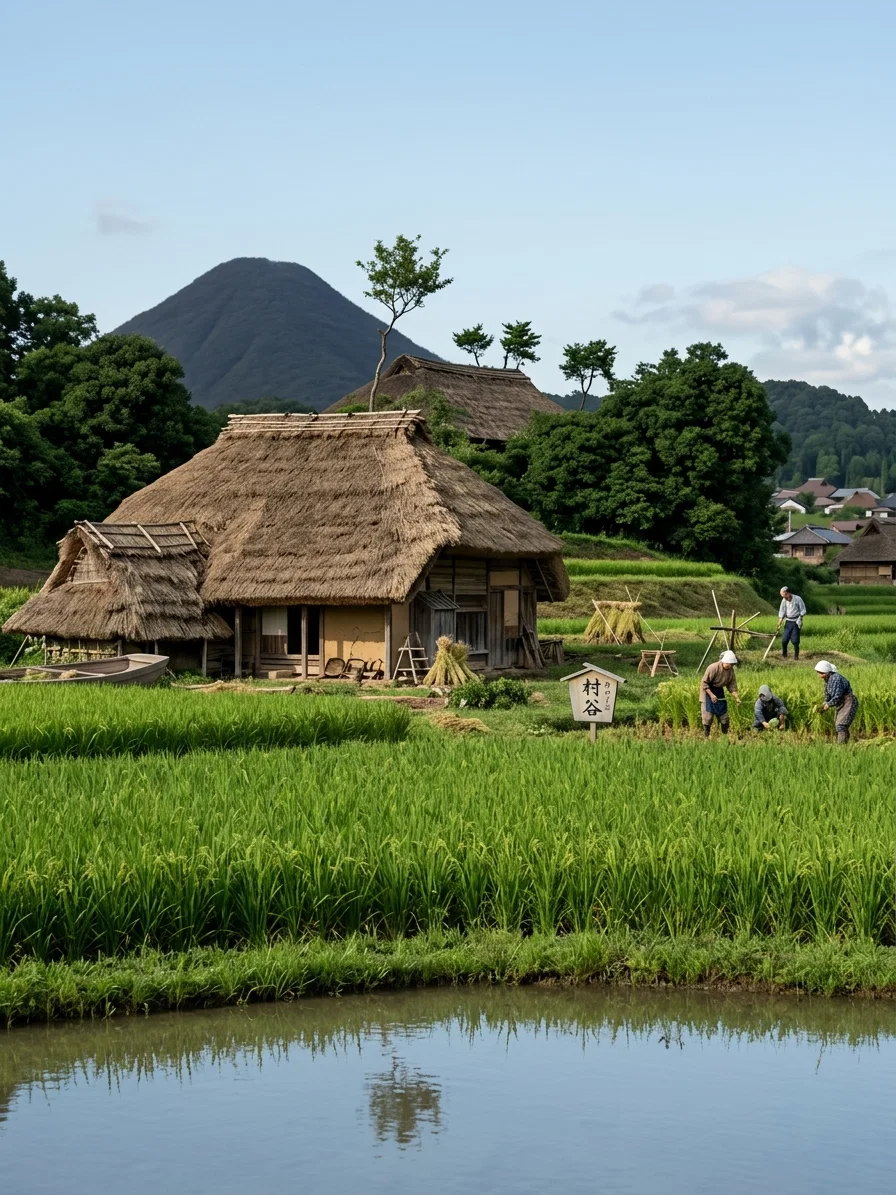
When well down on the north coast, I left the steamer to make a short trip inland. In passing up the valley, we went through many villages. Some of these have a population of several thousand. Most of the houses have thatched roofs, and walls of straw or bamboo and mud. After a ride of about ten miles in the ’riksha, we came to a village of at least five thousand. This is entirely surrounded by mountains, and has a beautiful stream of water passing through it. The town appeared to be very old, and in one part is a high bluff overlooking the river. On this hill once stood a castle, the home or stronghold of a feudal lord. During the afternoon, I decided to continue my journey by land over the range, and get a still better idea of native life. Tourists who have spent only a few months in Japan during the best season and visited no places but the large cities on the railroads, or some of the famous temples, are inclined to give their friends in America the impression that there is nothing in Japan but cherry blossoms. There are some14cherry blossoms here; but tourists fail to see the extreme poverty, the terrible misery, and the gross darkness that enshroud the people. They see only the conveniences, because they are careful to remain where these can be had. One missionary said to me, “You are the first foreigner I have seen for five months. Our bishop visited us then, and before that I do not remember when a foreigner was in this town, and I have lived here twelve years.”
A JAPANESE THATCHED COTTAGE
On my first trip by land I rode and walked about thirty-five miles through the country, and much of the time a heavy rain was falling. The steamer then passed down the west coast, stopping at many villages and towns. It was necessary to change boats several times, in order to see the more important places.
Several times I was warned to keep off the small boats. But as the larger boats all turn back at a village called Sukumo, because of the many rocks and big waves on the south coast; and as I wanted to pass around the islands, for the ’riksha fare was too high from Sukumo to where I could take the large steamers, there remained nothing to do but take a small steamer, or return the way I came. Within half an hour our little steamer was on her way to face the open sea. Progress was slow, however, and about dark we passed into a small inlet for the night. That evening the captain and his sailors came into my cabin, to spend the time talking and asking questions. The room was nine by six feet, a door in each end, tatami on the floor, and hibachi (box for coals) in the middle of the room. All night the boat kept up an uneasy motion, which did not help my seasickness. At three o’clock in the morning we started. It was raining. The wind became strong as the boat passed the first point of rocks. I could see a storm was approaching. It soon struck us. The sea was lashed to foam; the steamer was tossed about like a cork on the water; and the waves sounded like the roar of thunder on the rocky shore. I could see the water turn white as it dashed itself over the many rocks in the distance.
My seasickness continued to increase as we passed on, but I had no fear, for I realized the nearness of help. As we came to several villages, attempts were made to get some of the passengers ashore, but were unsuccessful. Some of the Japanese thought I was dying, and I thought so, too. No doubt in that condition I saw things in a somewhat exaggerated light. Our boat was only sixteen feet wide, the deck had only a canvas cover, and the rain beat in from both sides.
At my first opportunity, I went ashore. After resting one hour, I rode in a ’riksha nine miles, passing through a fine country on the way. The rain continued to fall; consequently, the roads were bad. There were many mountains. The ’riksha man refused to go farther. I was unable to find another ’riksha, so walked, and carried a thirty-pound suit case, through a heavy rain, from eleven until eight o’clock in the evening. The roads were rough, and it took one hour and a half to climb one mountain. During that twenty-five mile walk, I passed through many towns and villages. Many of the people seemed like children, and often twenty or more men, women, and children would follow along, all wishing to talk to me at once, except a few more timid ones, who perhaps saw a foreigner for the first time.
That night was spent at a very simple hotel by the roadside. The building was poor and old, but I had eaten nothing for two days, for I was still a little sick. For supper I had a few dried minnows, tofu (bean curd), and a bowl of rice, which contained one part of pebbles to six of rice. The people had all retired when I arrived at this village of twelve huts, but in a short time all of them but a ’riksha man had come in to see the foreigner. For more than an hour I answered their childlike questions. Many times during the trip, among other questions, those poor people asked, “What god do you worship?” They worship the sun, moon, an idol, a sacred mountain, the emperor, their ancestors, or the nation’s heroes.
I will not tell more of the little experiences that attended the journey, but I long to be among the people. I long for the time when I can freely speak their strange tongue; when this weak instrument can fully understand their dark sentences; when these eyes shall see some waiting for the kingdom of God. Can those who read this say, “I can do no more this year than I did last for missions”? Perhaps you did nothing last year. But if you saw thousands of poverty-stricken people every day,—people in the depths of sin, with not a warning of their approaching doom,—tell me, could you say, “I can do no more”? Now, in this time when the glory of earthly powers is passing away, remember the missions in your prayers and offerings. Meditate upon these things: “For what is a man profited, if he shall gain the whole world, and lose his own soul?” “Render . . . unto God the things that are God’s.” “For we brought nothing into this world, and it is certain we can carry nothing out.”