RABBI DRACHMANN, of New York City, president of the Sabbath Association, was the first speaker to defend the bills exempting observers of the seventh day. He spoke of the patriotism and loyalty which the Jews had manifested in this country, and said that they had done nothing at any time to discredit or repudiate American institutions. He said he supposed America was a free country, and that people who came here were granted equal privileges with all other people, as far as religion was concerned. He told of the hardships the Jews had to endure by being compelled to lose one day each week from their labor if they kept the seventh day and were not allowed to work on the first day.
He said that it was a great surprise to him to think that in this land of freedom and liberty, people should attempt to terrorize American citizens by telling them what might happen if they sought to exercise and enjoy inalienable rights, which were theirs as citizens. It was a surprise to him to hear such statements from the lips of men in this country, and he almost wondered whether it was a land of freedom as people generally considered it to be.
He made a very strong plea in behalf of the rights of the Jews, and made some very vigorous and telling points in behalf of the rights of conscience. He appealed to the committee and to the representatives of labor, to give to the poor Jews what they asked and desired for themselves. He thought it was only fair to give to one class of citizens what was desired and demanded by every other class of citizens.
He plainly stated that they were not discussing the matter from the standpoint of their fullest rights, but he thought that certain things should be done for the Jews so that there would not be oppression brought to bear upon them. While his speech was very telling and very touching, still the real point of religious freedom and religious liberty was weakened. He wanted the Jews to have the privilege of doing on Sunday what other people were allowed to do on Saturday, and this because they were Jews.
A Jewish lawyer followed him, and promised the committee that if the Jews were given the privilege of attending to their business on Sunday, he would see to it that all seventh-day observers, whether Jews or Seventh-day Adventists, would keep the Sabbath conscientiously. This was rather a surprising statement, to say the least; and we wondered whether he proposed to do by the seventh-day observers as the Sunday-law guardians propose to do with Sunday observers. This lawyer told the committee that he would see that every Sabbatarian who desired to observe the seventh day should register with the prosecuting attorney of the county, and make a clear statement that he actually refrained from labor on that day, and did it conscientiously. We were certainly glad we were not found on that side of the bill.
The last speaker favoring the bill was Mr. Aaron J. Levy, a member of the Assembly. His speech was very interesting, instructive, and profitable. He showed that all that the Jews were after was an extension of Penal Code 264, giving the Jews the privilege of opening their stores on Sunday, as well as performing work and labor, since it has been established by the courts that work and labor did not include the opening of places of business.
After ably discussing the bills from the standpoint of the Jews, he turned his attention to the constitutional view of the subject, and delivered an able speech on true religious liberty. He told the committee that they had not asked all that belonged to them, as the first constitution of New York State, and every constitution since that time, granted full and complete religious liberty. He confessed that there was more that belonged to them than they asked for, but they would be satisfied if they could receive what they requested.
The speaker then paid a most glowing tribute to the Seventh-day Adventists. It was one of the most eloquent eulogies given to any people that we ever heard. It was not given by way of flattery, for he had nothing to gain by it; but his earnest manner and his forceful presentation showed that he was speaking from the depths of his soul. He said that they were a class of people who were Christians, and emphasized the fact that they were different from the ordinary Christians, and, though they believed, in principle, concerning the Sabbath question as did the Jews, they could not stand with them that day in favoring the bill. It was not, he said, because they did not believe in the Sabbath, nor in the principles of religious liberty; but because they were so conscientious in their faith, and were so strongly entrenched in the true principles of civil and religious liberty, that they could not, under any circumstances, violate their consciences by asking for any privileges which rightfully and lawfully belonged to them. They did not and could not favor any exemption, and therefore could not stand with the Jews in speaking in favor of the bills. He further gave the committee and the people to understand that the Seventh-day Adventists held different views of Christianity from those held by other people who called themselves Christian, and they seemed to follow the Bible more closely in their practises.
It was indeed encouraging to hear such words from the lips of an able Hebrew concerning Seventh-day Adventists, and it impressed the writer very much with the fact that the Lord has a key for his people to unlock many Jewish hearts that they may be opened to receive his blessed truth.
The chairman of the committee then announced that time would be given to the Seventh-day Adventists. Elder A. J. Clark made a few remarks, and I followed, speaking for about fifteen minutes. I told them we regretted very much that we were obliged to oppose the bill on the ground that it was class legislation. The state has no right to give to any one class of citizens privileges which can not be enjoyed by every other class. The Lord graciously helped us to present the true principles of religious liberty, while at the same time we had an opportunity of telling the committee as well as the Jews that we were Sabbath-keepers. We showed them that we were keepers of the seventh day, not as Jews, but as Christians; that we observed the seventh day as the Sabbath because Christ commanded it.
We called their attention to the fact that, viewed from any and every standpoint, legislation in behalf of Sunday observance is religious, and religious only. That they might appreciate this fact, we showed them that all the Sunday forces were doing everything in their power to compel all classes to observe the first day of the week as a sacred day, and furthermore, that the prime movers in this whole movement were the ministers and religious enthusiasts. Their attention was further called to what these people proposed to do to all who dissented from them and who had no reverence for this man-made religious institution, by reading the following statement, written to Pastor J. S. Washburn, Hawleyville, Iowa, by Rev. M. A. Gault, clergyman of the Reformed Presbyterian Church, District secretary of the National Reform Association, and District secretary of the American Sabbath Union: “I see most of your literature [referring to literature circulated by seventh-day observers] in my travels, and I am convinced that your folks will die hard. But we are helping Brother Crafts all the time to set the stakes and get the ropes ready to scoop you all in. You will kick hard, of course, but we will make sure work.”
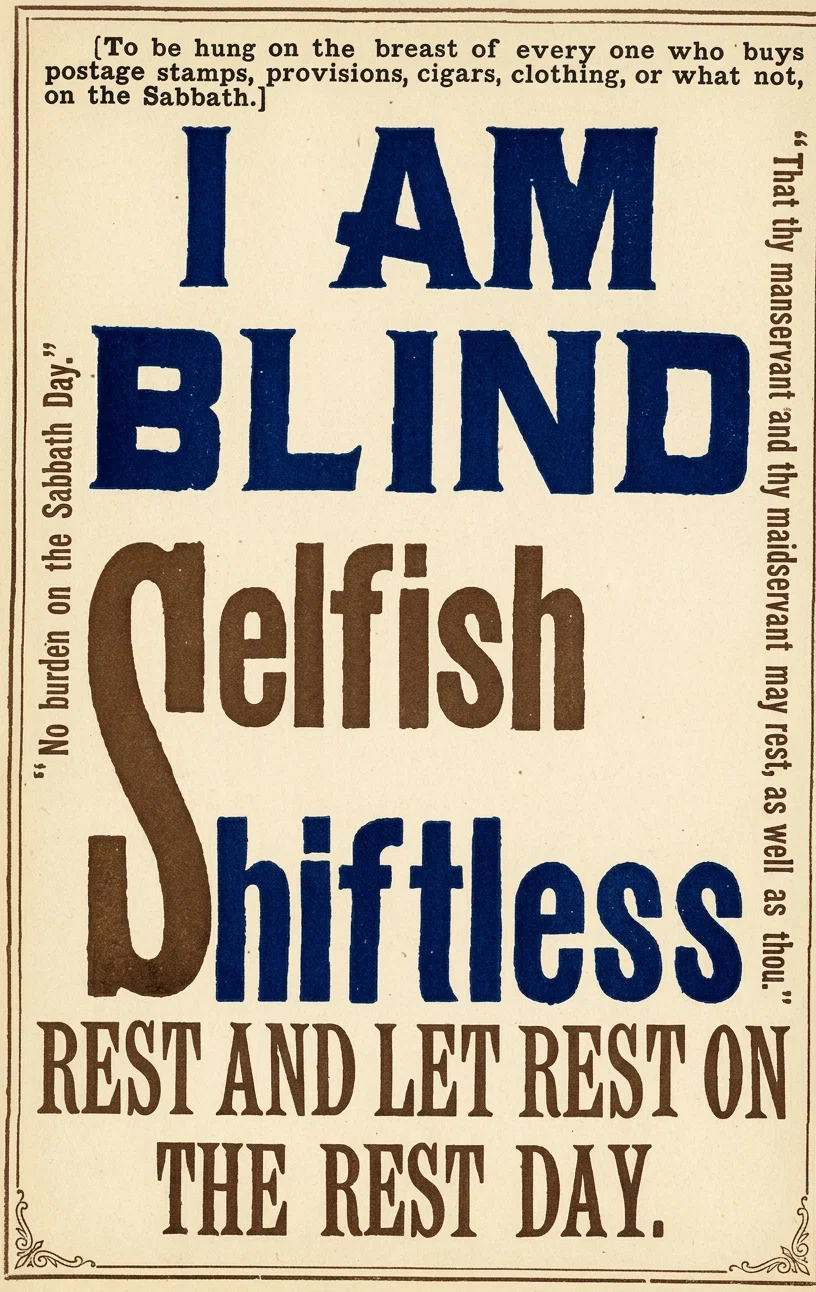
We then showed them the accompanying placard, copies of which were scattered broadcast by the American Sabbath Union, in the days when Wilbur F. Crafts was editor of the Sabbath Reform Library. It was quite a revelation to the committee, and it was a20great surprise to some of Mr. Crafts’ lieutenants. At first it was doubted whether he wrote it, but when we showed them the name and the stamp, they confessed that it must have been even so.
At the close of the talk one of the members of the committee inquired how or where our freedom was abridged. He wanted to know if we did not have full and free liberty. We told him that as long as there was one Sunday law on the statute-books, our liberties were abridged. I then told him that there had been a large number of arrests made in different States of persons who observed the seventh day, some of these honest men being obliged to work in the chain-gang with the vilest criminals. He wanted to know if they were not arrested for violating the Sunday law rather than for working on the seventh day. I told him that if the Sunday law were not on the books, there would not have been any arrests. He said no more, but saw the point.
Elder F. H. DeVinney, of Rome, N. Y., and Elder A. J. Clark, of Hudson, N. Y., made brief remarks, declaring their belief in full religious and civil liberty.
The committee were very kind, and it was apparent that many of them appreciated these God-given principles of religious liberty. One of them said it was an education to them, and they desired very much to have our people come there as often as we could.
After the hearing was over, I met several of the Jews, and they expressed themselves still further concerning Seventh-day Adventists. They admitted we had the truth on these points, and appreciated the fact that we were endeavoring to do the Jews more good than they were doing themselves.
We felt to thank God for the victory he gave us, and for the privilege of presenting what truth we did. We are in the midst of the battle. We need, beloved, to keep on the armor. We need to pray much that the Holy Spirit will open the eyes of many of these people, both Jews and Gentiles, that they may see the light and truth involved in this whole question. F. C. GILBERT.