Scholarship Plans

4%

Review and Herald Publishing Association · Takoma Park Station, Washington, D. C. · Apr 29, 1909

FromReview and Herald, Vol. 86, No. 17.

Read the full edition

Scholarship Plans

Since the time our publishing houses, State tract societies, and schools joined interests in favor of a book scholarship plan, there has been marked improvement in both school attendance and book sales. Even the existence of a book scholarship plan seemed to inspire many young people with a stronger desire for an education. It has stood as a constant reminder of the possibility of even those who have no money securing an education. It has cemented the common interests of our educational and publishing institutions, and has brought better days for our young people, publishing houses, and schools. The scholarship plan has proved to be a great help to many of our young people. It has filled our schools with a very desirable class of hard-working, conscientious students, who could not have entered any of our schools without this help, but with it they were able to provide themselves with an education that will render them capable message workers. It has very materially increased the output of our publishing houses, and has given the message to thousands through the books sold.

The Magazine Scholarship Plan

While the book scholarship plan has proved to be a great blessing in many ways, and is still to be strongly promoted, and to be made more and more a constant source of encouragement to the young, there have come so many pleas, from a large class who can not sell books, for scholarships to be given on magazine sales, that the General Conference Publishing Department finally submitted to our publishing houses and schools the following magazine scholarship plan:—

The Plan

1. That our schools and publishing houses join in offering full-year and half-year scholarships, at a discount from regular cash charges, to all students who will earn such scholarships wholly by the sale of our ten-cent magazines.
2. That the publishing houses furnish the ten-cent magazines to such students at the regular agents’ rates, and tract society discount, but upon being notified by any State tract society or school that the required number of magazines has been sold, and that the money necessary for a scholarship or a half scholarship has been deposited by the student, to apply on said scholarship, the publishing house will remit direct to the manager of the school the student will attend, the difference between the amount paid for magazines, and three cents a copy, thereby making the final cost of the magazines to these students three cents a copy, regardless of the number ordered at any one time.
3. That schools make a discount of ten per cent from their regular charges on all such scholarships, it being agreed that the full amount of the scholarships shall be paid in cash before thestudent enters upon his school work.
4. That any person desiring to earn a scholarship shall make full and satisfactory arrangements with the State tract society for doing so, ordering all his supplies through the tract society, and working in harmony with the society’s regulations, in order to be entitled to the scholarship benefits.
5. That, in case any student, after having earned a scholarship, is unable, through sickness or other misfortune, to attend school, his scholarship may be transferred to any one whom the officers of the State tract society may recommend, and whom the authorities of the school can accept as a student.

The Plan Appreciated

The leading publishing houses in the United States promptly adopted the plan as already given, and it is expected that our schools will report their adoption as soon as they can secure formal action by their boards. The prompt acceptance of the plan by the publishing houses and the schools will be seconded by a large number of promising young people who will take up the magazine work at once, and be ready to enter our schools in the fall.
On the part of the publishing houses the rate allowed in the plan is quite liberal. In fact, the final charge of only three cents a copy in small quantities, in addition to allowing the tract societies the usual five-per-cent discount, leaves practically no margin for the publishers on the magazines furnished to the scholarship workers. On the part of the schools the discount of ten per cent from the price of a regular scholarship is also liberal, yet the advantage of getting the money for the scholarship in advance, the sure result of increased attendance, and the general educational interest created and maintained throughout the school’s territory, by having a plan whereby it is made possible for the poorest of our young people to secure an education,—all this will far more than remunerate the schools for the small discount the plan provides for them to make on magazine scholarships.

Why It Is Needed

There are a large number now attending our schools, and a still larger number out of our schools, who can not or will not sell books, but who either want to sell our magazines to earn scholarships in some of our schools or can be induced to do it. If, therefore, the magazine plan was not provided, many of those who would never otherwise enter our schools, or those who are attending but can not remain in school, where they would be prepared for strong work in the cause, would themselves be lost to the message as workers; and the good they would do in the publishing of the message, while they earned their way through school, would be lost. The need of the plan, then, is evident from the standpoint of providing ways for the enlargement and development of a great number of workers, and of heralding the message through the circulation of our magazines.

The Scholarship Magazines

The magazines to be used in the magazine scholarship plan are the Signs of the Times Monthly, The Watchman, Life and Health, Liberty, The Protestant Magazine, and the special Temperance number of the Youth’s Instructor. Any worker may sell (one at a time) Life and Health, Liberty, The Protestant Magazine, or the Temperance number of the Instructor, and the combined sales of all will be allowed on the scholarship account. To illustrate: a worker may go into a town and sell the Temperance number of the Instructor, then go over the city with Life and Health, following with Liberty, and then with The Protestant Magazine. The sale of all these may be applied on the scholarship account.

The Simplicity of the Plan

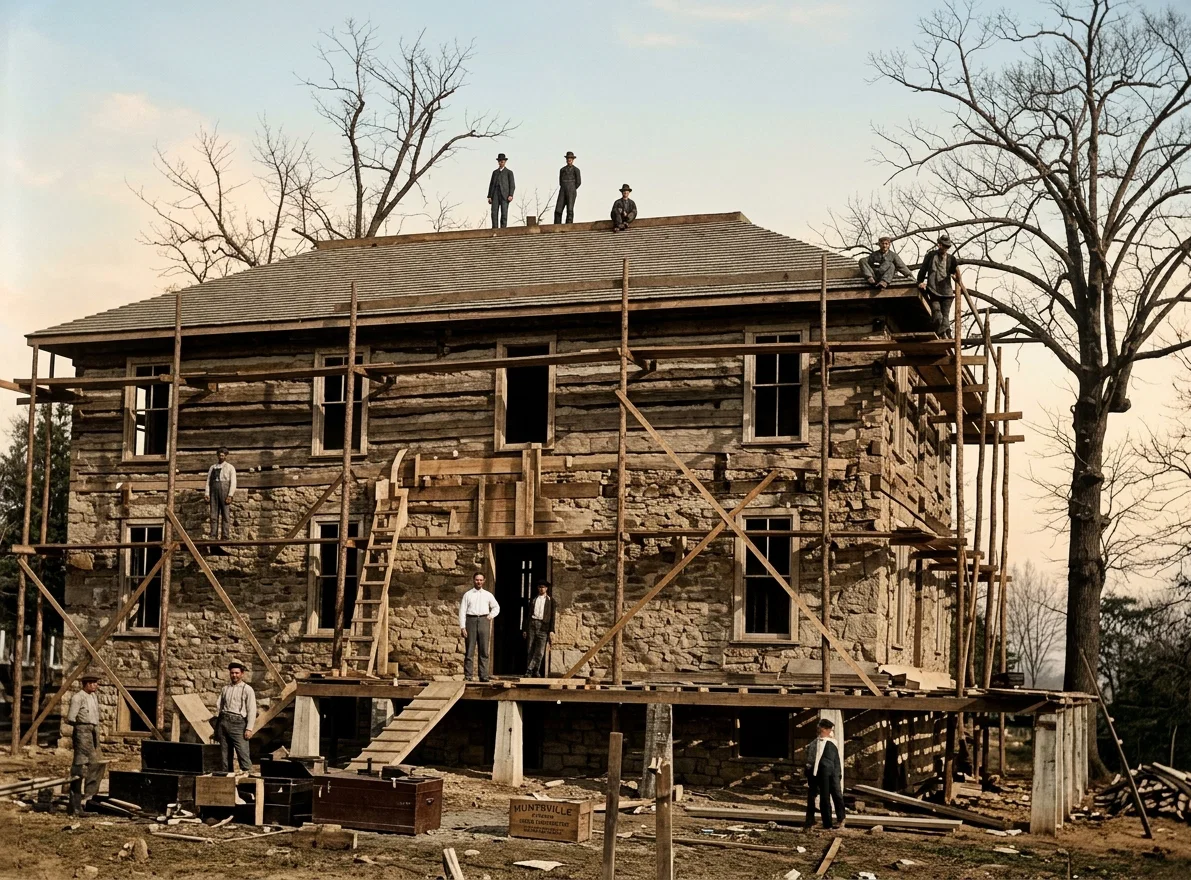
SANITARIUM BUILDING IN PROCESS OF ERECTION AT HUNTSVILLE, ALA.
The simplicity of any plan is the first requisite to its success. Complications bring confusion, and finally discouragement. The worker for magazines has only to arrange with the State tract society for the scholarship agency, a consignment of papers, and territory. The papers, together with a suggestive canvass, and a booklet, “How to Earn a Scholarship,” will be forwarded without delay; and after a short time devoted to studying the papers and the canvass, one will be ready to make a beginning.

Detailed Instruction

All State tract societies will have in stock all the different publishing houses’ printed detailed instructions for agents. These will be supplied on request; also any other information desired will be cheerfully furnished by all State tract societies. We invite all who are interested to send for the publishers’ booklets on plans for magazine work.
D. W. REAVIS.