Ethiopia

9%

Review and Herald Publishing Association · Takoma Park Station, Washington, D. C. · Apr 29, 1909

FromReview and Herald, Vol. 86, No. 17.

Read the full edition

Ethiopia

JULIUS PERSSON
Since the death of Abba Salama, the history of Ethiopia is very obscure, and the space of about five hundred years records merely a list of names of rulers. During that time, however, a great many convents were established, and monastic orders founded, and the Abyssinians became a Christian nation, according to the fashion and conception of the Middle Ages.
We now ask, “How was that doctrine introduced into Abyssinia?”—Mainly in the same way as in the Alexandrian church at the time of the later fathers of the church. The Abyssinian church has no symbolic books, from which its teachings might be understood. The most remarkable differences between it and the Protestants, in general, relate to the Holy Spirit, baptism, circumcision, etc. Circumcision has been preserved, also baptism. The male children are baptized forty days, the females eighty days, after birth.
Saint worship was not to be spoken of, and during the first period, but at present their saints are quite numerous.
The first book among these people was the Bible. But as this was written on pergaments, it never became a book for common people. It was written in Chez, the old, holy language of Abyssinia, and is still preserved. It is called Semania ahadu; namely, the book of eighty-one separate books. Besides our canonical books, it contains also the Apocrypha, and other writings, as, for instance, the apostolical constitutions and church establishments, letters of Clemens, Hermas, Herden, the Abyssinian ecclesiastical law, etc. From the Biblical catalogue of Ludolf, 1681, we know that at that time the Ethiopian Biblical canon was exactly the same as a Lutheran canon; and because of this, the change must have been made during the eighteenth century.
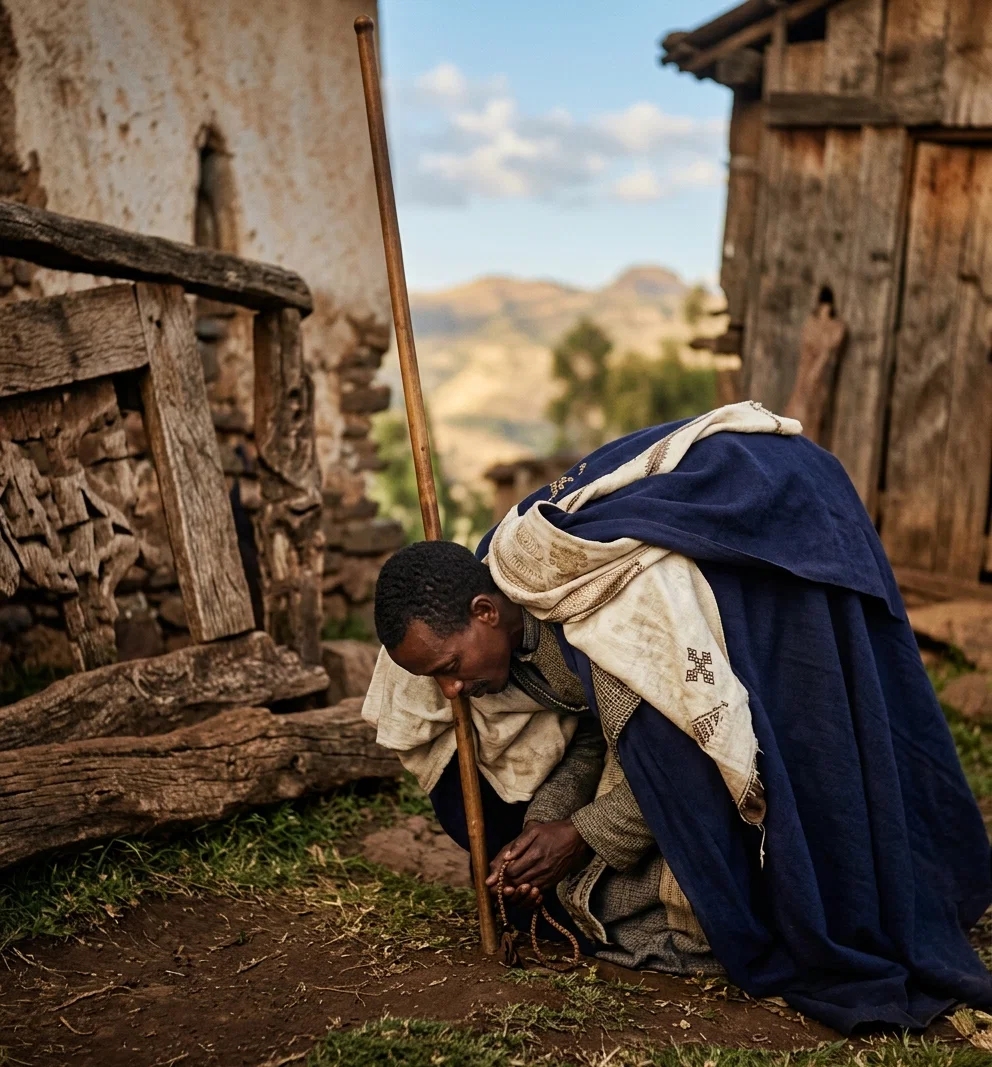
AN ABYSSINIAN MONK AT WORSHIP
But the Bible is not the only book of religious importance among the Abyssinians. The second on the list is “Fetha Negust,” that is, “The Kings’ Rules.” This contains statutes for the nuns and monks, as well as for the clergy in general; prescriptions for the holy supper, the baptism, the mass, etc.
The third is “Mary’s Miracles,” a large book with about seventy illustrations, showing what Mary can and will do for all who trust in her. After these come different volumes commenting upon some of the epistles of Paul, as those of Afe Work, Kerlos, and Epiphanes. The book of these last-mentioned authors is at present in my home. A friend of mine, a member of the Abyssinian church, has loaned it to me. It can be bought for about seventy dollars. There are also other, smaller books. In one called “Creation,” the author claims to know that God created Jerusalem in four hours, but that it took him five hours to create the air. Many of these books were written only to earn a few dollars and a reputation as learned.
Another peculiarity of their religious views is the observance of both Sabbath and Sunday. The first is called Kadam, which means the first or the small Sabbath; the latter Sembet, or the new. It is remarkable that Satan has succeeded here also to throw a shadow upon the memory of creation. Before I came here, I was informed that this was a Sabbath-keeping people; but, so far as I have been able to comprehend, the first, and not the seventh day of the week, is regarded as the day of rest, all kinds of work being performed on Sabbath as well as on Sunday.
Asmara, Eritrea.