Sewing

6%

Review and Herald Publishing Association · Takoma Park Station, Washington, D. C. · May 6, 1909

FromReview and Herald, Vol. 86, No. 18.

Read the full edition

Sewing

Manual Training for Our Primary Grades—No. 8

Sewing
If desired, books may be made in which to preserve the sewing models until the close of the year. Twelve sheets of heavy manila paper, about eight by twelve inches, will be required for each book. Punch a row of holes a half inch below the top; sew through these forward and backward, and tie securely in the center. Write the pupil’s name on the cover. Pin the models to the leaves in order, and write the date when each was finished.
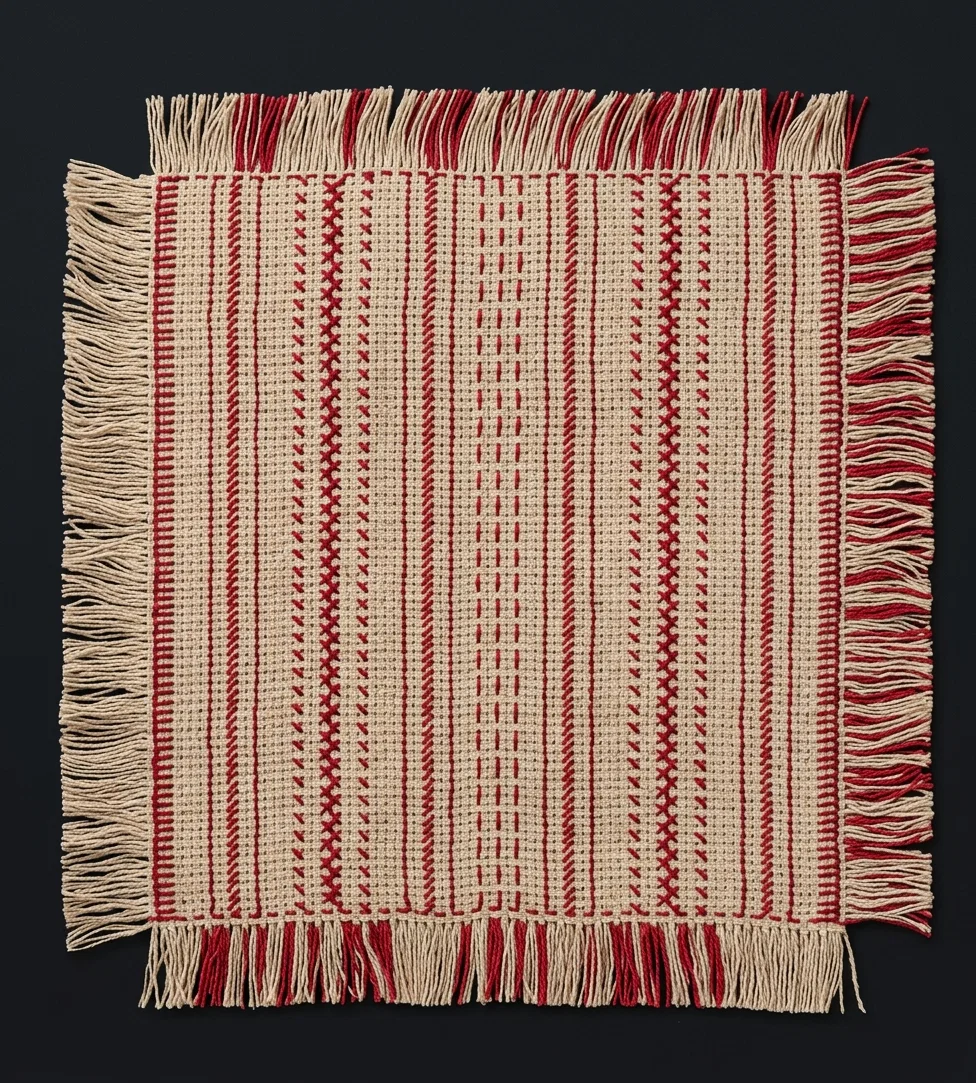
For the second model Java canvas is used, together with No. 12 Turkey-red, H. B. working cotton; the same needle as before.
The Java canvas is double-threaded like the first, but differently woven and softer. It may be had in eighteen- and thirty-six-inch widths, the price varying, with the width and quality, from twenty-five cents to one dollar a yard. Twelve squares to the inch is about the right mesh. One yard of the thirty-six-inch goods will make sixteen models, each nine inches square. The work of this model is simply a repetition of the stitches used in the first model, which may seem unnecessary if one does not understand the importance of thoroughly mastering first principles; but it is none too much repetition to enable the pupils to become familiar with the stitches, which in succeeding lessons must be used under much more difficult and exacting conditions. Do not forget that this work has been arranged for the purpose of making it possible for the pupils to do the work of each lesson correctly and without assistance, though not without instructions. By the time of the completion of this model, the correct position and habits of working should be thoroughly established.
The length of thread directed for the first model should be used throughout. As you start the various rows, expect the pupil to recognize and name each stitch.
Fold the canvas in the center lengthwise; insert the needle from the under side ten squares from the right end of the fold; open the fold and put a row of basting down through the center, taking up one square and leaving two; let the row end ten squares from the left end. All thread ends on this model should be left long enough to reach to the edge of the model; they require no fastening at either end.
At each end of this row of basting put a row of running across the width of the cloth to mark the beginning and ending of the various rows of stitches. Two squares each side of the center row of basting put another row of the same.
Notice that the work of this model consists of groups of three rows each. The corresponding groups each side of the center are the same, hence directions will be given for one side only. Unlike the others, the first, or center, group is made up of only one stitch.
The second group begins with a row of backstitching three squares from the last basting; two squares away put in a row of overhanding; and two squares farther another row of backstitching.
The third group is begun with a row of hemming four squares from the second group; two squares farther a row of cross-stitch, followed by another row of hemming two squares away.
The fourth group is a duplicate of the second, and is four squares from the third.
THE MODEL
THE MODEL
Four squares from the fourth group put in a row of blanket stitch with the loops outward. Pupils should expect no help from the teacher on the second side.
Next take No. 50 white spool-cotton and the same needle, and overcast the four sides of the canvas, over the row of squares next to the blanket stitch on the sides and next to the running stitch on the ends. If the rows of unused squares on the four sides are unequal, trim off those that are superfluous. Press the model on the wrong side with a damp cloth over it, and then fringe down to the overcasting.
Many valuable lessons in regard to materials and their manufacture may be interwoven with the work of these models, if the teacher has access to books from which she can obtain the desired information. Where and how cotton, wool, and silk are obtained, and their manufacture into thread and cloth, as well as the origin and manufacture of needles, spools, and thimbles, will be matters of liveliest interest to the children, as well as a means of education.
MRS. E. M. LONG.