Woman's New Era in the Far East

4%

Review and Herald Publishing Association · Takoma Park Station, Washington, D. C. · May 6, 1909

FromReview and Herald, Vol. 86, No. 18.

Read the full edition

Woman's New Era in the Far East

CHINESE women are at last awakening to the advantages of education. Traveling from Canton to Macao, I had an interesting conversation with a young Chinese wife and mother, who was enthusiastic upon the subject of female education and the enlightenment of Chinese women.
“I know so little,” she lamented, almost pathetically; “but I am willing to devote myself, body and mind, to the women of China, for their ignorance is indeed deplorable. My husband is the founder and physician of a hospital at Canton, and I have my little children to care for; but some are girls, and that makes me all the more anxious to help raise the standard of education for women. Of course, there are some of my sex—and the number is increasing—who feel an interest in their own advancement; but there are others who don't care much. They are so used to being shut off from all outside life that it seems to them right to continue so.”
“What have been the results, so far, of the new era?” I asked.
“Well, the antifootbinding movement is one thing; then education of women, more independence of thought and speech, and lastly, a strong disposition to break down some of the barriers that separate the classes. The people are objecting to the kow-tow [a Chinese form of obeisance, in which an inferior kneels and touches the ground with his forehead], and an effort has recently been made to do away with it. This would have been carried, but some member of the nobility protested against it. I should like to visit other lands,” she continued, “to study conditions and bring home new and advanced ideas from progressive countries to my poor benighted sisters.”
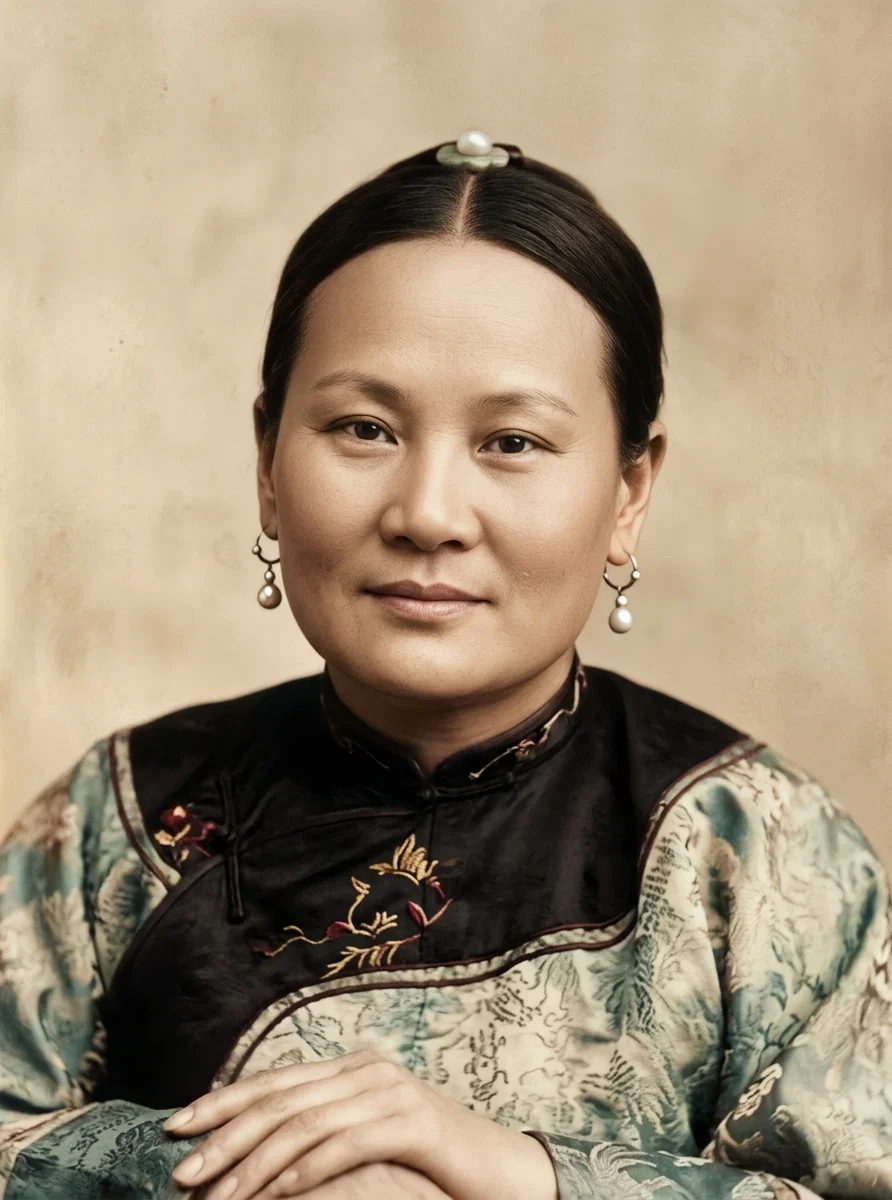
Another lady, in whose society I have found much pleasure, is Mrs. Ah Hok. She is the pioneer in China of woman's cause. She was the second Chinese woman to go to England; the first was the wife of an ambassador. She went to persuade English women to come to China to help her countrywomen. It is eighteen years since this brave and talented woman took the first step toward the relief of her Chinese sisters.
By courtesy of the Christian Herald
MRS. AH HOK
By courtesy of the Christian Herald MRS. AH HOK
Mrs. Ah Hok's husband was a wealthy merchant and philanthropist. He was interested in education, and gave ten thousand dollars (Mexican) to the Anglo-Chinese College, at Foochow, where he resided, and where Mrs. Ah Hok still lives. . . . He was the means of saving the lives of hundreds of baby girls by providing rice for them, when their parents would have drowned them or sold them for slaves. Those parents, poor and miserable, say: “We can not afford girls. They soon leave us (at about seven or eight years old) to work for their future mothers-in-law; so why should we have the expense of feeding them?”
Mrs. Ah Hok's home is a charming one, as Chinese homes go. Its doors and ventilation screens are richly carved. When I visited her, I was ushered into a small reception room, the most conspicuous objects in which were a small ebony table and two elaborately carved ebony chairs. They stood on a slight elevation, the table between the chairs, and all placed close against the wall. I seated myself in the chair nearest the door; and when Mrs. Ah Hok entered, she at once took my hand and led me to the one farthest from the door. Inadvertently, I had done the proper thing, and madam had politely insisted upon my “going up higher,” which meant taking the seat farthest from the door. . . .
“Until Christian schools were introduced into China,” said Mrs. Ah Hok, “there were no schools for girls; they received no education whatever. Now, there are Chinese day- and boarding schools. Many of the heathen girls, however, attend Christian schools. This is a distinct advance, too, as at first it was almost impossible to get pupils.”
“Heathen families were afraid to trust their children to Christians?” I suggested.
“Yes,” replied madam. “One father made me responsible that they should not put out his daughter's eyes before he would allow her to cross the threshold of the school.”
I afterward learned in a visit to Miss Lee's school, one of the largest in Foochow for high-class girls, that Mrs. Ah Hok's influence in enlightening the parents to the advantages of education was very great. When Miss Lee's school was first started, they paid pupils to come; but after six years she had one hundred girls, all from heathen families, and paying $1.50 (Mexican) a month.
“Do the mandarins' daughters mingle freely with the other girls?” I asked Mrs. Ah Hok.
“O, yes! the only people who are clannish are the field people. They are practically the farmer classes.”
“Do the high-class girls still bind their feet?” I inquired.
“O, there has been a great change in that respect! It was hard to bring this reform about among the upper classes. It was their badge of aristocracy, and they clung to it; but now they see how hampered they are by the custom, and so they are not binding the feet of the young children, and are unbinding those of the older girls. Parents are beginning to take some pride in the education of their daughters. I think this is really not because they are so anxious to have them acquire knowledge as it is the dislike to have them appear to know less than their neighbors' daughters who are being educated,” and Mrs. Ah Hok laughed as she spoke of this very human trait in her countrypeople.
“Tell me,” I urged, “something about the education of a Chinese girl of today.”
“The parents now feel sufficient interest to come to the school to arrange. They generally like to make a pretty good bargain financially. This is not to be wondered at, for some of the most aristocratic have but little money for so extravagant a thing as education. Upon opening day, the girl appears, carried in a sedan-chair, for no high-class Chinese girl would think of walking in the street. She would surely be looked at, and that, from a Chinese standard, would be unpleasant and mortifying—a thing not to be thought of, outside of the lower classes. Her wardrobe, which is usually a very scant one, is folded in a piece of cotton cloth. Among her belongings will be found a luncheon box and a fire-basket. These she will not be allowed to carry into the class rooms, but may have in the corridor or bedroom. It is rather difficult to get our girls to take exercise; they are accustomed to an indoor life.”
“Do you teach the languages?”
“We teach English only. The Chineseare not linguists, but every girl is anxious to know English. The usual course includes astronomy, geography, mathematics, algebra, and some Chinese classics—quite much,” said Mrs. Ah Hok. “Calisthenics are taught, and music—the pupils are very fond of that; also drawing, painting, lace-making, and embroidery. Embroidery is considered the most important branch of a girl's education, and great stress, too, is laid upon the study of etiquette. This means the serving of tea, the bowing and reception etiquette and table conventionalities. Certain phrases are demanded on different occasions. Well-bred persons will make no mistakes. It is the polite thing to go as far as the outer door with a departing guest. In that case, the guest will say, ‘Please go within;’ but if the parting is inside the house, then the departing one says, ‘Please be seated,’ which means, ‘you must not take the trouble to go to the door with me.’ The person addressed usually insists upon doing so.”
“Is there any disposition toward co-education?”
“Not much; that must come very slowly in China. But who can say?”
When I asked whether any religious instruction was given in the schools, madam replied by asking, “What religion would you teach? Of course, the Buddhist religion is instilled into the pupils in heathen schools, just as we try to bring Christian influence to bear in Christian schools. But even in the latter schools, it is difficult to teach Christianity to girls of the higher class.”
“Are Chinese girls bright?”
“Some are bright, and some are not bright, some are lazy, and some industrious,” was the quick reply.
When, at parting with Mrs. Ah Hok, I congratulated her upon the methods of Chinese education, she answered, brightly: “I like yours better.”—Evelyn Clark Morgan, in The Christian Herald.