Ethiopia

11%

Review and Herald Publishing Association · Takoma Park Station, Washington, D. C. · May 6, 1909

FromReview and Herald, Vol. 86, No. 18.

Read the full edition

Ethiopia

JULIUS PERSSON
According to Abyssinian tradition, Cush, the son of Ham, came to the land now named Abyssinia, or Ethiopia, and built the city Axum. He is said to have had twelve sons, one of them called Ethiops, who gave the whole land the name of Ethiopia. This is in harmony with the most reliable historical facts. The word Abyssinia, however, is probably derived from the Arabian Habesch, and among the Abyssinians Habesha is still used.
The history of Axum is interwoven with the tradition of the queen of Sheba. She is supposed to have been queen of Ethiopia, and to have been succeeded by her son, Menilek Ebu Hakim. This Menilek is said to have reigned in Ethiopia about twenty-nine years. This belief, that their royal line comes from the queen of Sheba, is so deeply rooted in the minds of the Abyssinians that to doubt it is to contradict the Bible. So much for the tradition as to how the people of this country first came in contact with the chosen people of God. And many are the evidences of its truth, as we shall see later when studying the rites of the church. From the time of Menilek Ebu Hakim till the time when Philip preached Christ to the Abyssinian eunuch there is a space of about eleven hundred years, of which scant information is obtainable.
The following is a historical fact, showing when the gospel was first preached in Abyssinia and the Bible was translated into the language of the Ethiopians:—
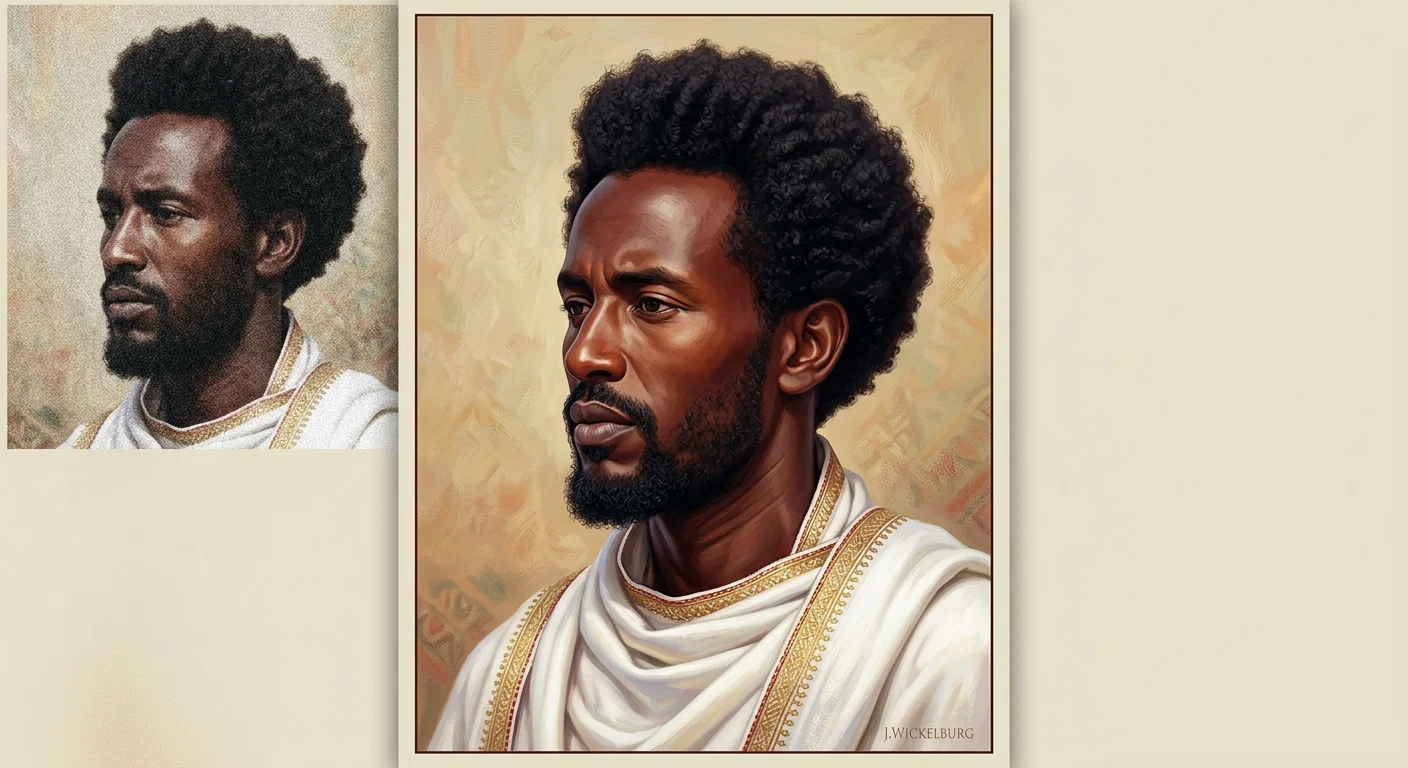
A TYPICAL ABYSSINIAN
“About 330 A. D., a Christian merchant named Meropius, traveling along the shores of the Red Sea on business, together with his two young clerks, Frumentius and Aedisius, landed in the present Massua.” The merchant and all the sailors were killed by the ferocious inhabitants. Only Frumentius and Aedisius escaped death. They were taken to the court as captives. Here they were kindly received, and the king, Parah Din, entrusted them with high official positions. By their direction other Christians entered the country, and soon a small church was raised up, consisting of Christian merchants and some converted natives.
Some years later, the clerks returned to their home land. At that time Athanasius was archbishop in Alexandria. Aedisius was ordained priest, with the church in Tyrus under his direction. But Frumentius went to Athanasius, beseeching him to send “a shepherd” to the small church in Abyssinia. The archbishop did not know any one more fitted for this task than the petitioner himself, and he ordained him bishop, and sent him back to Abyssinia. Arriving at Axum, he immediately began the translation of the New Testament, and the seed of truth was now scattered all over the land. From this time Athanasius is named Abba Salama (father of peace), and under this name he is best known among the Abyssinians in this period of their national history.
Asmara, Eritrea.