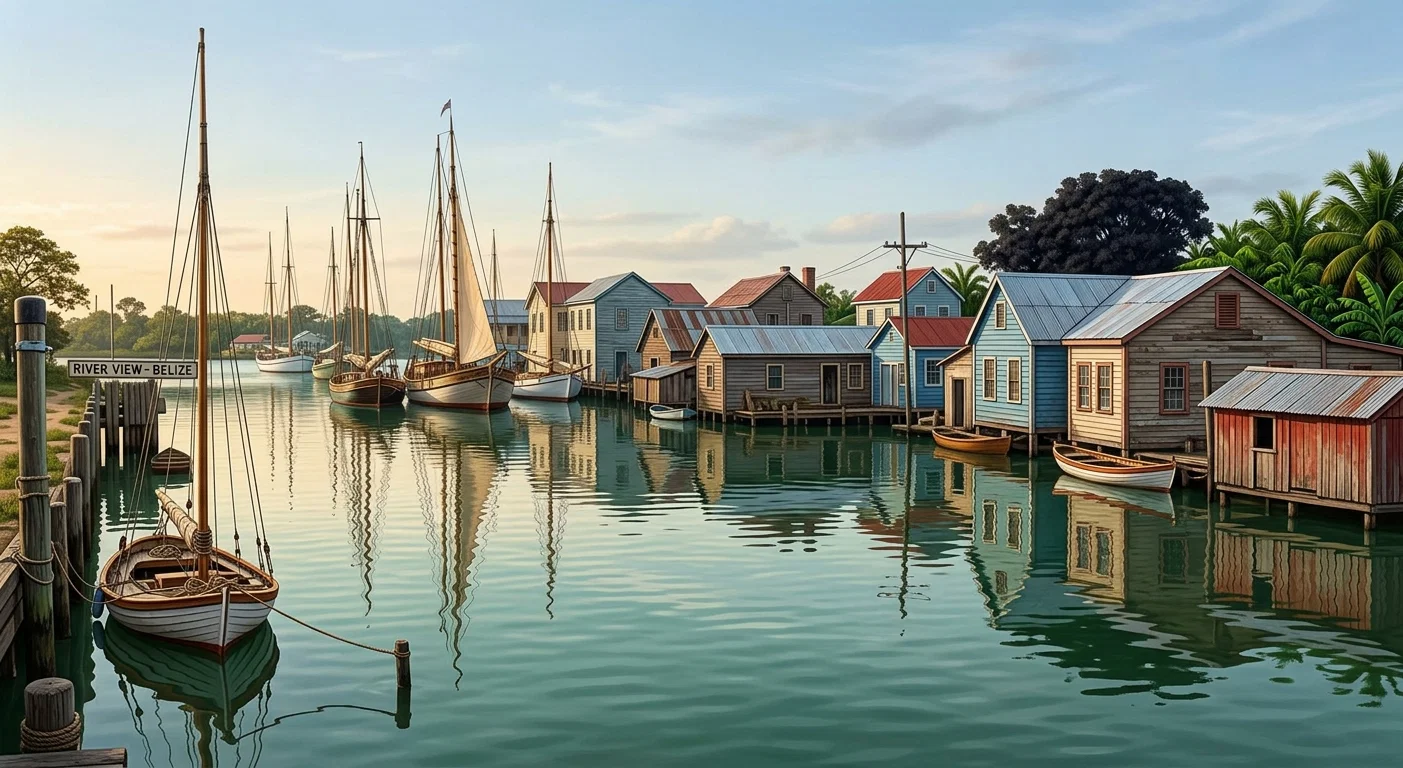
BRITISH HONDURAS is a crown colony of Great Britain, located on the eastern side of the peninsula of Yucatan. Belize, where the camp-meeting was held, is the capital, and contains a population of about ten thousand inhabitants.
RIVER VIEW — BELIZE, BRITISH HONDURAS
The annual session of the Central American Conference was held in connection with the camp-meeting. The attendance of our own people was not very large. The greater part of the membership is in the Bay Islands, and the getting together in a meeting in such widely scattered territory, with transportation facilities not the best, is a much greater task than in the United States. But a number came from the islands, and from various places on the mainland, so that all parts of the field were represented.
From the very first, a sense of the need of spiritual help was felt, and all earnestly sought the Lord for victory over sin. The Lord heard the prayers of his people, and brought new courage and hope into hearts.
The attendance, however, from the city was excellent. Many were unable to obtain seats at some of the evening services. From the first the stirring, testing truths of the message were presented, and many seemed deeply interested; some of these, we believe, will obey.
Many difficulties have to be met and overcome in this field. The influence of Catholicism has blighted things for many long years in the larger part of the territory. Yet in spite of the difficulties, the message is making its way. Some have embraced the truth during the year. A school has also been opened at Guatemala City. Brother and Sister W. E. Hancock have recently been called to connect with it as teachers, and are doing good work. It is hoped that through the influence of the school an opening will be made for the truth. There is also a school on the island of Bonacca, and Brother and Sister C. N. Harvey accompanied me from New Orleans to the camp-meeting on their way to teach this school.
Much has been accomplished during the past year through the distribution of our literature. The work in these fields must be largely carried forward by means of literature. Plans were laid at this meeting looking toward a wide and systematic distribution in the future of books, tracts, and papers in both the English and Spanish languages. The removal of the printing-office from Trinidad to Colon, Panama, together with a mail service which is improving, will greatly facilitate matters in this direction.
The business of the conference was given careful consideration, and was marked with unity. On account of the health of Sister E. L. Cardey being such that it was practically impossible for her to live in that field, it was thought best that Brother Cardey be relieved of the responsibilities of the conference, and the West Indian Union Conference was asked to send some one to the field to take charge of the work. While all felt sorry to have Brother and Sister Cardey leave the field, it seemed to be the only wise thing to do, under the circumstances. Brother C. E. Morgan was elected treasurer, and Sister Alma Osgood Sabbath-school secretary.
Elder U. Bender, president of the West Indian Union Conference, also attended the meeting, and his labors were much appreciated. April 16 we sailed from Belize on the "Harry L. Inge" for New Orleans. We had for companions in the cabin a Catholic bishop and a Jesuit priest. We had some interesting conversation during the voyage. They admitted the Catholic Church changed the Sabbath, and argued that the Bible in the hands of the common people was a dangerous book, for they could not understand it.
Personally, I enjoyed the meeting at Belize, and feel hopeful for the future of the work in that field.