The Heart of the Dark Continent

8%

Review and Herald Publishing Association · Takoma Park Station, Washington, D. C. · Aug 15, 1912

FromReview and Herald, Vol. 89, No. 33.

Read the full edition

The Heart of the Dark Continent

J. N. ANDERSON
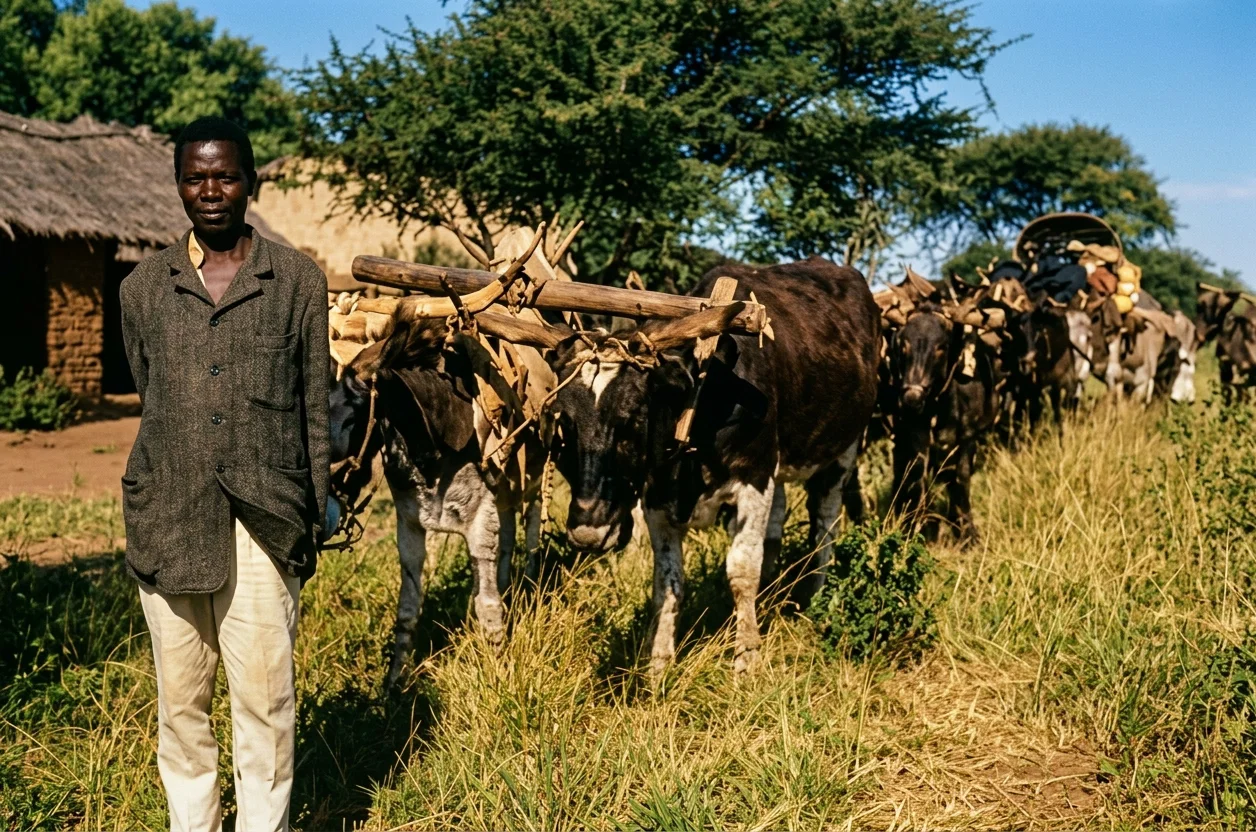
THE SOMABULA MISSION "EXPRESS"
AFRICA, the second largest continent in the world, the land where Moses lived and wrought, the scene of a mighty Christian church during the first centuries of the Christian era, the land of Tertullian and of Livingstone, is for very good reasons called the Dark Continent. Following the Mohammedan invasion of the seventh century, which swept away every trace of the Christian faith, except in a few places in the regions of the upper Nile, practically the entire continent of Africa remained unknown and untouched by the rest of the world until a few decades ago.
In the heart of that vast continent where his life was spent, lies buried the heart of its greatest missionary and explorer, David Livingstone, whose ambition it was to “penetrate through Africa;” and then by the power of the gospel bring healing to this “open sore.” The death of that great man in the depths of that mysterious dark land must have stirred the whole Christian world as it never had been stirred before for any heathen land. All the larger missionary societies of Europe and America promptly and enthusiastically sprang to the task of filling the great gapping door that Livingstone’s death had both opened and made known. Large sums of money were spent and the lives of many heroic missionaries were laid down as the price of laying a foundation upon which has been built an extensive and promising work, and which to-day is represented by 4,273 foreign missionaries under 158 different societies, aided by 69,704 native workers, located at 11,074 stations. The direct result of all this along with other previous missionary efforts, has been that considerable portions of the seaboard margin of Africa is entered and in places quite fully occupied. But the great interior, the very heart of the Dark Continent, remains unreached, and in a large measure unexplored. It is still waiting for some one to penetrate through the interior and carry the gospel of healing to Africa’s “open sore.”
Central Asia has 35,000,000 inhabitants beyond the present reach of all missionary ministration and planning; the vast interior of the Dark Continent has even more. The report of the World Missionary Conference puts the number of untouched souls at 50,000,000,—about one third of the entire continent. Witness the following tabulation from that report: “This area begins a few hundred miles south of the Mediterranean coast and includes, as we shall see, portions of Tripoli, the province Oran, the south half of Algeria, the Atlas-Rif country, the Mulaya Valley, the Sus Valley, and the Sahara district of Morocco; the uncounted thousands of nomads in the Sahara proper; Rio de Oro, with a population of 130,000; 8,000,000 in Senegambia and the Niger district; some 1,700,000 in French Guinea; 1,500,000 in Dahomey; some 500,000 in the Ivory Coast, and over 800,000 in Portuguese Guinea; about 1,500,000 pagans in Liberia; 500,000 in Togoland; some 4,700,000 in Northern Nigeria; 3,000,000 in Kamerun; some 8,000,000 in the French Kongo, besides 4,000,000 of the Baghirmi and Wadai districts; several million at least out of the 30,000,000 of the Belgian Kongo; a large population in Nyassaland; some 2,500,000 in Portuguese East Africa; about 2,000,000 in German East Africa; 3,000,000 in British East Africa; about 2,000,000 even yet in Uganda; and 750,000 in the Italian, British, and French Somaliland.”
Surely in the face of these figures it must be said that Africa’s evangelization is scarcely begun; and that feeling is only deepened when it is remembered that its population is a bewildering medley of races and tribes, whose languages are said to number 523, besides 320 dialects, and, with the rarest exception, all are without the slightest trace of a literature of any kind. “Polygamy is almost universal. Slave raiding, intertribal wars, and cruel superstitions have through long years preyed upon the lifeof Africa, and left its population reduced, divided, suspicious.” In certain parts cannibalism is still practised.
Religiously, Africa has about 4,000,000 nominal, spiritless Christians (the Ethiopian and the Abyssinian churches), whose ranks are steadily being thinned by the aggressive invasion of Mohammedanism (now fifty or sixty million strong), whose fierce propaganda is almost invariably favored by the local representatives of the European governments, while on the other hand, they restrict or prevent the extension of Christian missions. The remaining 90,000,000 or so are held in bondage by those tribal beliefs and practises summed up under the names of animism and fetishism. This latter class is reached most readily; “its very misery makes it [the gospel] welcome relief; its utter darkness makes it glad of light.” The door of access into Africa is the greatest in this direction, while Islam is the greatest obstacle; not a mere obstacle, indeed, but a bitter and fanatical rival whose ambition it is to dominate the whole continent.
This in brief tells the story of the Dark Continent as to the present status of missions and the unfinished task. From the merely human point of view it is both appalling and impossible. But that world of heathen and Mohammedan darkness is as much under the care of the Father as is America or Europe, and heaven is as near and as directly overhead the spoiled, benighted African as in our own cases. God’s eternal purpose includes every race, tribe, and tongue of Africa; his invincible light shines for all, and ours is the duty and the privilege to carry that light to every man, since he is— “Heir of the same inheritance, Child of the selfsame God. He hath but stumbled in the path We have in weakness trod.”
And we must not fail to see God’s hand of power working in Africa as in the other parts of the world. Practically the entire continent is under the political control of Europe, with the result that commercial slavery and intertribal wars have nearly ceased. Nearly all the navigable rivers and lakes of the vast interior now float large flotillas plying in the interest of foreign trade and commerce, and by that very means creating in the minds of the native people a knowledge of, and a desire for, the things of the outside world. Railways are fast being projected into nearly all the different parts of those dark regions, representing the steady and irresistible march of Western civilization upon the Dark Continent. The highway of the King is fully prepared, and all things seem to wait the coming of his messenger. The following lines written on seeing the statue of Gordon as it stands facing the great wastes of the Sudan, are to the point:—
“The strings of camels come in single file, Bearing their burdens o’er the desert sand; Swiftly the boats go plying on the Nile, The needs of men are met on every hand. But still I wait For the messenger of God who cometh late. “I see the cloud of dust rise in the plain, The measured tread of troops falls on the ear; The soldier comes the empire to maintain, Bringing the pomp of war, the reign of fear. But still I wait; The messenger of peace, he cometh late. “They set me looking o’er the desert drear, Where broodeth darkness as the deepest night. From many a mosque there comes the call to prayer; I hear no voice that calls on Christ for light. But still I wait For the messenger of Christ who cometh late.”
Foreign Mission Seminary.