En Route to Rio de Janeiro

7%

Review and Herald Publishing Association · Takoma Park Station, Washington, D. C. · Dec 31, 1908

FromReview and Herald, Vol. 85, No. 53.

Read the full edition

En Route to Rio de Janeiro

H. S. PRENER
A German liner left the New York City wharf on August 20, bound by direct route for Brazil. The first eighteen hundred miles of the trip brought us close to the Lesser Antilles. The most important to us was the island of Martinique.

Mt. Pelee

Martinique came within sight on our seventh day out. Our first view showed us the northern end, with a heavy thick growth of tropical trees, shrubs, and sward. The famous Mt. Pelee could be seen in the distance, piercing the clouds, and hiding its summit. Little huts, here and there, dotted the landscape. Immediately behind the green hills alongshore were mountains, which plainly showed volcanic disturbance. A survey of the ground revealed death reigning on all sides of the crater. Great flows of lava could be traced their full length to the sea. Although years have passed since the noted eruption, the grass and trees are sparse.
A large, dry river-bed was plainly seen, the course of the waters having been diverted by the upheaval and led into other channels. To the right of the immense lava flow and shore impressions in the layers of pumice made by the washing of the breakers, we passed the forsaken harbor and ruined city of St. Pierre. The marine glasses revealed dismantled houses and crumbling walls. The many buildings of the once crowded city still stand without roofs. All is silent; all teaches the utter insignificance of man. Above, a majestic mountain, below, a crushed city.
Prosperous towns and villages, amid luxuriant tropical foliage, may be seen within a few miles, and on the very edge of a vast area of wilderness.

Barbados, British West Indies

The break of day, one week from our departure, found us in an English harbor—Bridgetown, Barbados, British West Indies. The ferryman arrived early, soliciting passengers. Pickaninnies were anxious to dive for coins. We went ashore, glad for an opportunity to set our feet on land again. The houses are low, quaint, wooden structures, covered with cement. The predominant colors are pink, light-blue, gray, and orange. The small island is thickly populated by poor, but very intelligent negroes,—two hundred persons on an island lacking enterprise,—a multitude without work, with a wage scale as follows: carpenters, twenty-four to fifty cents a day; masons, forty-five to ninety cents. Some women work all day for six cents. The street railway is narrow-gauge. The cars are drawn by two little mules. Fares are charged according to distance. Instead of numbering the cars and dwellings, pretty names are displayed. Fire brigade and police department are manned by prim black men. Rich, gorgeous flora, ebony-trees, breadfruit-trees, bananas, tamarinds, cacti, etc., abound. Colored women are seen unloading a coal steamer, with little tubs perched on their heads. These are some of the many odd sights seen on this little island in the tropics.

Burial at Sea

One of the passengers, a Greek, after several days' illness, died on the second Sunday out. The officers, desiring to give him an immediate burial, called at midnight, and asked us to attend the service.
The body was wrapped in two small berth mattresses, and iron bars, weighing about three hundred pounds, were placed at the feet. It was then covered with heavy canvas, sewed at the ends, and the whole was tied up with rope, and, draped with a German flag, was placed upon a plank which extended beyond the side of the ship. All was done very quietly, with few words spoken. The light was dim, and the few chief officers in full dress added to the impressiveness of the scene. Mrs. Prener was the only woman present. The captain's shrill whistle broke the silence. All uncovered their heads, as the machinery gradually slowed down. The ship stopped. All present listened intently as we bowed in prayer. Then the plank was tipped, causing the heavy load to disappear in the black ocean.
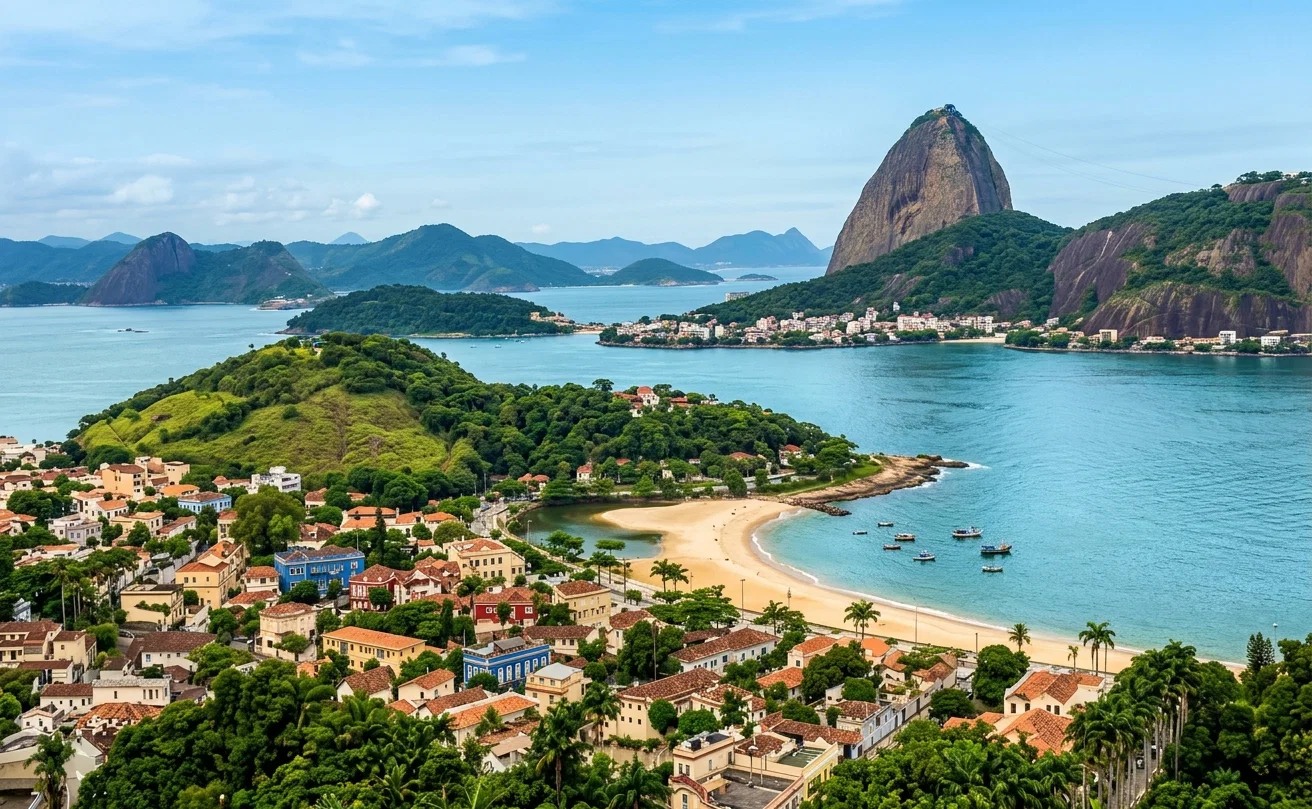
A PORTION OF THE RESIDENTIAL SECTION OF RIO DE JANEIRO

Brazilian Cities

Pernambuco, Bahia, and Rio de Janeiro were the three other places where our ship stopped. These cities are the New York, Philadelphia, and Washington of the Brazilian republic, respectively.Pernambuco lies in a strategic position for commercial intercourse with the European and American ports, situated as it is on the extreme eastern portion of the South American continent. Bahia, meaning “The Bay,” has a most beautiful horseshoe harbor, and is built the full length of a range of hills facing the water. Rio, the capital city, in the Federal District, with a population of nearly a million, is favored with one of the most beautiful harbors in the world. This, with its natural surroundings and recent improvements, makes it a surprisingly beautiful city for so undeveloped a country.