Visit to the American Mahratta Mission

9%

Review and Herald Publishing Association · Takoma Park Station, Washington, D. C. · Dec 31, 1908

FromReview and Herald, Vol. 85, No. 53.

Read the full edition

Visit to the American Mahratta Mission

GEO. F. ENOCH
On being graduated from one of our colleges some twelve years ago, the writer thought that, for him, the day of examinations and examination papers was past. It was accordingly with strange feelings that he found himself, after so long a time, seated at a school desk in the roomy high-school building of the American Board Mission in Ahmednagar, India, with pen in hand, and large sheets of foolscap before him, and a professor writing a list of examination questions on the blackboard. Were it not for strange-looking Mahrati characters, so unlike anything of the old school-days, one might almost imagine that time had actually slipped backward in its flight. But as one proceeds with the questions, having to write (or more properly speaking, to draw) the answers in the strange character, expressing one's self backward and in a roundabout way, as compared with the mother tongue, to decline nouns and pronouns in eight cases, to conjugate verbs in the fourteen tenses of the indicative mode, not to mention the tenses of the four other modes,—well, it would seem easier to have an examination as in the old days. The matter was made a little more difficult as the writer had had only seven months in which to prepare the year's work.
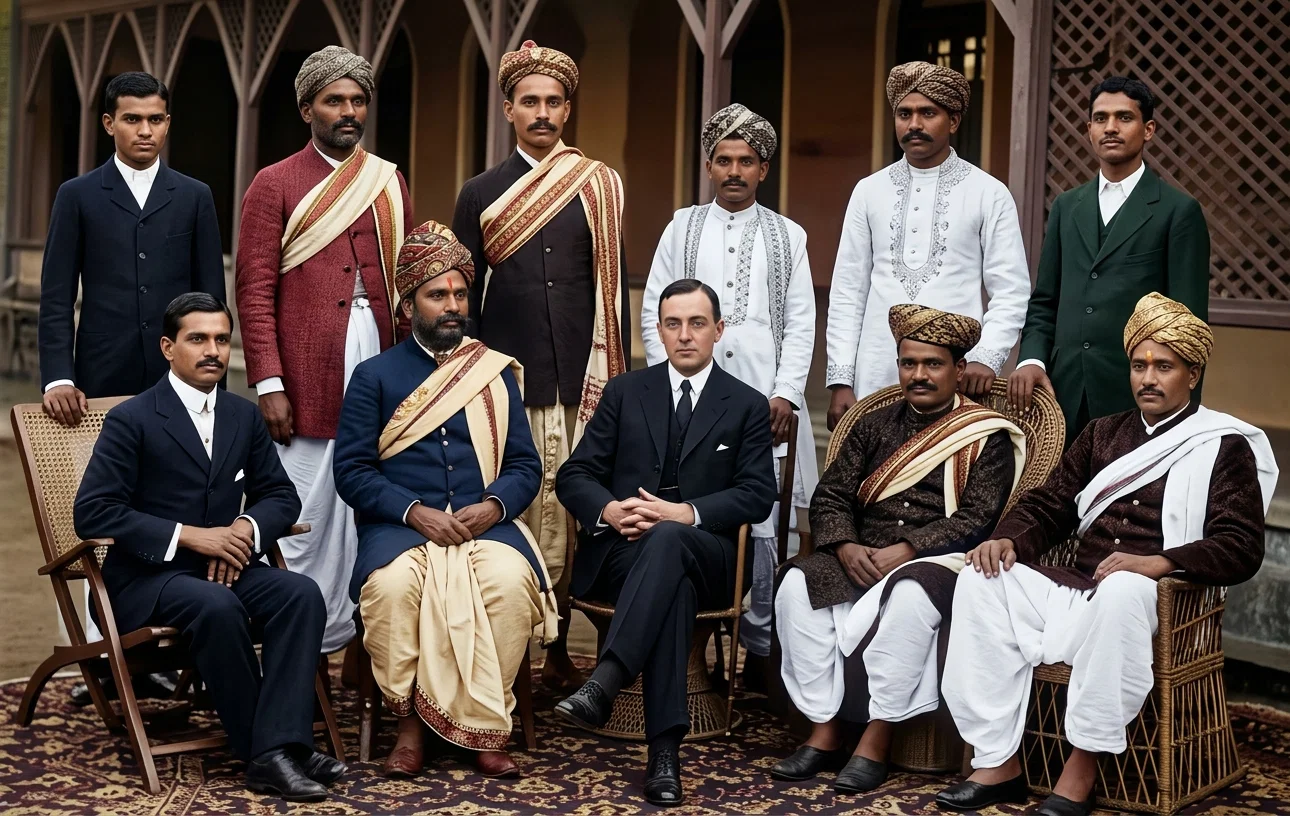
TEACHERS OF THE NORMAL SCHOOL AT AHMEDNAGAR
Some may wonder why such an examination is necessary. Our Indian committee, as well as almost all Indian mission committees, has found it best to outline a course of study for the first two years of missionary life in India. Those who have been years in the field know what will be required of the newcomer before he can do his work properly. That no time might be wasted, a syllabus is drawn up, and an examination is held at the end of each year. From the standpoint of the learner, this is a great help. He has a standard to work to. In the first days of discouraging struggle with the difficult language, it is helpful to have the work so outlined that one can see that he is making progress. Then a mission committee places a worker many miles away from the committee, where the only thing the worker can do is to study, and it is just that the committee shall require evidence that substantial progress is being made.
As we are the first of our workers to enter the Mahrati-speaking country, it was necessary to take the examination from some board operating in the field. Accordingly, the American Board kindly consented to allow the writer to sit with their missionaries who were taking their first year's examination. There were five of us, and all passed successfully. One of the examiners who has been on the board for years, said that it took much courage to try the examination after only seven months' study, as a full year's work was outlined. I felt that the work was accomplished in so short a time only by the special blessing of God, through the principles of healthful living, and in answer to our daily plea for the language of the people.
There are four tests in the examination as held by the American Board, with four hundred possible marks, two hundred of which are required for passing: Test (1) in ability to write; (2) in ability to pronounce and understand; (3) in ability to use matter studied; (4) in ability to converse, in which the one taking the examination must carry on a conversation, in the presence of the examiners, with a native who does not understand English.
I was glad for the opportunity of meeting the missionaries of the American Board. They were most friendly and cordial to me. Ahmednagar is their headquarters. Here they have a high school, with an enrolment of five hundred; a girls' school, with an enrolment of four hundred fifty; a normal school, with an enrolment of one hundred sixty; and a theological seminary, with a smaller enrolment. Connected with these educational institutions are industries, which were of great interest to the writer. In the heart of the native city they have a fine new church building, with over one thousand communicant members. In the entire Mahratta country they have nearly seven thousand communicant members. It was a great encouragement to see these fine-looking young men and women of India so enthusiastically engaged in training mind, and hand, and heart, and what has been accomplished here is an earnest of what can be done even in the darkest lands by faithful toil and sacrifice in the Master's name.
It was a pleasure to attend the graduating exercises of the theological seminary, at which the principal address was delivered by Prof. E. D. Burton, of Chicago University. The faculty, graduates, and alumni marched while singing a Mahrati tune in native meter, accompanied by the Indian little brass cymbals. It seemed a little odd to see the graduates deliver their addresses and receive their diplomas barefoot, and dressed in dhotars (the Indian substitute for trousers).
By conversation with the missionaries, I learned that the great political agitation that is now in progress in India, of which those in other lands may have heard something, is creating a state of mind that is rendering mission work more difficult year by year. The same ferment that is unsettling the minds of all the East, is working rapidly even in the recesses of these mountains. The powers of evil are intensely busy, preparing even the remote portions of earth for the last great struggle. O that God's people would so surrender to him that the power from above could make itself felt mightily just as far, and before it is too late!
Poona, India.