The Church

4%

Review and Herald Publishing Association · Takoma Park Station, Washington, D. C. · Jan 28, 1909

FromReview and Herald, Vol. 86, No. 4.

Read the full edition

The Church

Instruction Pertaining to the Duties and Responsibilities of Officers and Members

The Church a Missionary Department

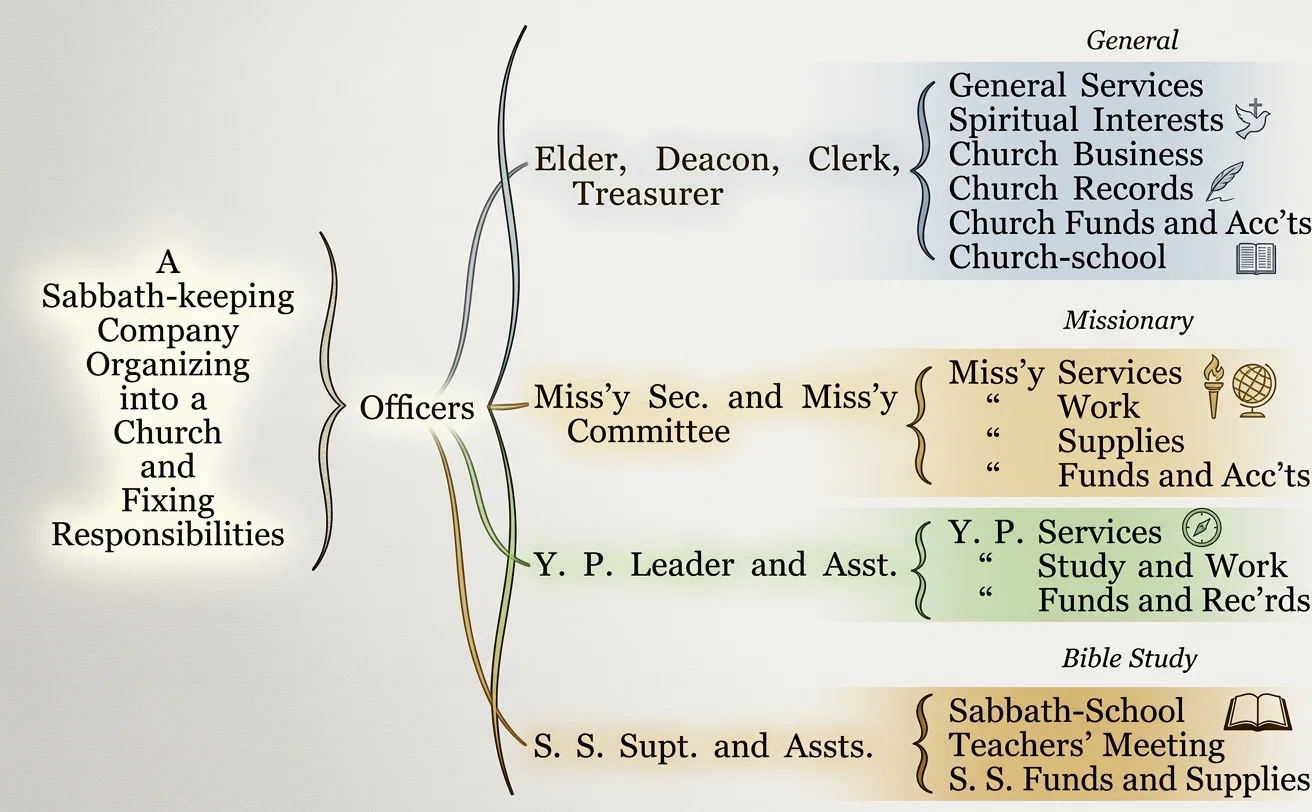
As shown by the following chart, there are three divisions of church work and official responsibility,—general, missionary, and Bible study. As this article has to do with the missionary department, we will take up the work of the head of that department—the church missionary secretary:—

The Church Missionary Society

Assisted perhaps by a missionary leader who may have charge of public meetings, or by a missionary committee in the larger churches, the local missionary secretary is in charge of missionary services, missionary work, missionary supplies, missionary funds and accounts.
The Young People’s Society and the Sabbath-school usually order their supplies through the missionary secretary [formerly known as librarian]. It is much more satisfactory than for each to order from the State office.
The work of the missionary secretary may be divided into two general divisions, and these subdivided, as follows:— 1. Relation to the State Tract Society. a. Communications to secretary. b. Communications from secretary. 2. Relation to the Church. a. To encourage individual effort. b. To promote interest in the missionary meetings. c. Suggestive lines of work. d. To keep the accounts.

1. Relation to the State Tract Society

a COMMUNICATION TO THE SECRETARY.—The church secretary acts as the medium of communication between the church and the missionary department of the conference. She orders all supplies from the tract society secretary, and should send brief reports of missionary activities of the church in connection with such orders. In addition to this a quarterly report should be rendered to the tract society secretary on blanks which will be furnished.
b COMMUNICATIONS FROM THE SECRETARY.—The church missionary secretary is also the medium through whom the missionary department of the conference communicates with the church. As the conference lays plans for missionary efforts and campaigns, and sends them out through its missionary department to the church secretaries, how important it is that they lose none of their force; but rather that they receive a new impetus because of the hearty interest taken in them by the local missionary secretary. It may seem that the plans thus received by the church secretary are too numerous and demand too much effort, but when we think of the very limited time in which we have to work, ought we not to expect one item of work to follow another in rapid succession?

2. Relation to the Church

a ENCOURAGE INDIVIDUAL EFFORT.—Besides giving careful study to the suggested plans of work submitted by the conference missionary department, the secretary should study the members of the church as well, with a view of giving to each one that line of work for which he is best adapted. Here is where the resources of the secretary are severely and continuously taxed. She should have for a motto, “Something for Each One to Do.” She must recognize the fact that God has given “to every man his work.”
b THE MISSIONARY MEETING.—In many churches it does not seem possible to hold a weekly missionary meeting, even in connection with the prayer-meeting. Where this is the case, and even where short weekly meetings are held, the regular Sabbath service may be devoted to missionary work once a month to good advantage. These meetings may partake very largely of a reporting nature, grouped as follows:— (1) What is being done in the mission fields, and how. (2) What is being done in the home land and local conference. (3) What is being done by the various members of the home church, and the methods used. (4) The presentation of some line of work which may be taken hold of by the church at once.
The information contained in the REVIEW AND HERALD will prove very helpful in preparing such a program. “The Missionary Idea,” by Sister Ellis, is also good. Reports of work in our home land and local conference may be obtained from the REVIEW, the union conference paper, and letters from the missionary department of the conference.
The report of the home church should be presented by the secretary, and others who have been active should be encouraged to relate their experiences. With these experiences and methods of work before the people, it is easy to interest them in some definite missionary proposition.
c SUGGESTIVE LINES OF WORK.—The following suggestions as to kinds of work that may be carried on in the churches is taken from “Church Missionary Work,” by Sister Anna L. Hindson, missionary secretary of the Australasian Union Conference, from whom many other suggestions for this article have been received:—
(1) Tract Work. (a) The package system. (b) The Signs of the Times leaflet packet. (c) By mailing. (d) Reading-racks. (e) Miscellaneous distribution. (f) Loaning or giving to tradesmen who call.
(2) Periodical Work. (a) Taking subscriptions. (b) Selling from door to door. (c) On streets and in stores. (d) Placing in racks in stations and in other prominent places. (e) Posting regularly to libraries and reading-rooms. (f) Mailing in connection with missionary correspondence, and to friends and relatives. (g) Taking them to hospitals, deaf and dumb asylums, and all benevolent institutions. (h) Selling or giving to tradesmen who call.
(3) Work With Our Books. (a) Selling. (b) Loaning.
(4) Missionary Correspondence. (a) To relatives and friends. (b) To persons whose names will be supplied by the State secretary.
(5) Christian Help Work. (a) Giving simple treatments. (b) Helping the poor, and teaching them how to help themselves. (c) Doreas work. (d) Visiting hospitals and sick neighbors, taking papers, texts, and flowers.
(6) Holding Bible Readings and Cottage Meetings. (a) In your own homes. (b) Among neighbors and friends who manifest an interest in the tracts and papers circulated.
(7) Earning Money for Missions. (a) By making missionary gardens. (b) By keeping missionary hens and bees. (c) By selling papers and small books and giving the profits. (d) By doing plain sewing, or making articles of fancy work for sale, etc.
For additional details for the carrying on of these various lines of work write to your conference missionary department.
H. H. HALL.