The East India Mission

7%

Review and Herald Publishing Association · Takoma Park Station, Washington, D. C. · Jan 28, 1909

FromReview and Herald, Vol. 86, No. 4.

Read the full edition

The East India Mission

THE Australasian Union Conference has held its biennial session, and the delegates from this field, with some new workers, have returned to their labors. It takes twenty-four days of continuous traveling to reach Sydney, our headquarters, where the conference meetings were held. In the same time we can journey from here to England or to Canada. The distance to Sydney is not so great, but the boats are slow, and they are also infrequent.
We are glad to have Brother G. F. Jones, the superintendent of the mission, and Sister Jones with us again, and both look so well after their five months' journeyings in the commonwealth. They brought with them a young man, K. Hungerford, to keep the books of the mission and the tract society, in the place of Brother Joseph Mills, who, with his wife, has been called to connect with the school in New Zealand. Two more workers are coming to the East in a few months.
Elder J. E. Fulton, who has been appointed to take charge of the East Indian Mission, and Sister Fulton also arrived from Java, where they have been spending a month planning for the extension of the work in that field. The mission there has been strengthened by the addition of Brother and Sister Thorpe, trained nurses from the Sydney Sanitarium; they are now connected with the Java Mountain Home, a property recently acquired for the benefit of our workers in that trying and unhealthful climate. It is situated about forty miles from the city of Sourabaya, on the mountainside, at an elevation of two thousand four hundred feet above sea-level.
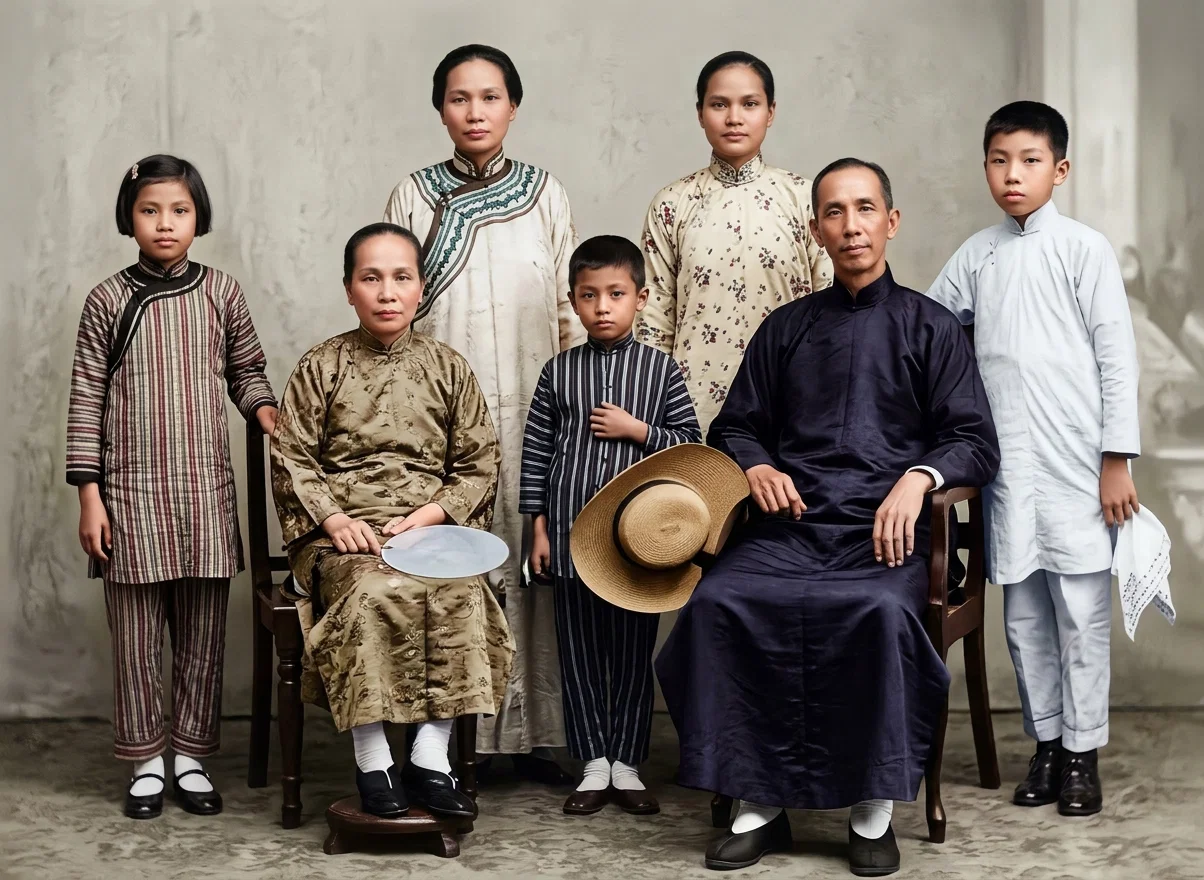
BROTHER CHAN AND FAMILY
Brother Chan is our Chinese laborer at Singapore. His two eldest daughters, Teck Soon and Teck Sung, standing in the rear, are Bible workers
BROTHER CHAN AND FAMILY Brother Chan is our Chinese laborer at Singapore. His two eldest daughters, Teck Soon and Teck Sung, standing in the rear, are Bible workers
The workers there have decided to take Miss Jansz's mission for the Javanese, which she offered to us about two years ago. Sister Tunheim and a co-laborer are already there, learning the language and becoming acquainted with the workings of the colony and the ways of the people. Miss Jansz has been keeping the Sabbath for many years, and has also taught her converts the necessity of doing the same. About thirty-five are baptized and keep the Sabbath. They are still far from being Adventists, but they make a favorable showing when compared with those from whom they have come.
Heretofore it has been thought that it would be advantageous to have a large central educational institution in Singapore, to which might be brought the most promising natives from the different islands in the archipelago to give them a training for the work. This plan has been tried for about a year and a half, but it has not proved a success. The diversity of languages presents an insurmountable difficulty to such a plan. Every mission will have to conduct its own school and train its own workers. When the boys are moved from their own islands to more civilized places, they lose their original simplicity, and begin to pattern after the Europeans, whose habits are expensive, and not always beneficial to the natives. Upon returning home they consider themselves superior to the other natives, and conduct themselves in a patronizing manner toward them. The Singapore School and the mission have now been united in one institution, and will be conducted as one enterprise hereafter.
The proclamation of the message in this city has been much hindered through the lack of a building in which to hold meetings. Missionaries of other denominations have had sufficient influence to prevent us from renting a hall or other place of meeting. The government, after being approached several times, finally consented to let the mission have a small piece of land in a central position, at seventy-five cents (Singapore) a square foot, on which to build a church. Compared with the cost of other land in that locality, the price is said to be very low—about one half of its real value. The government insists on a good building being erected on the ground, so land and all will amount to about £1,250. This large sum could not have been obtained except through the liberality of our people in the United States and in Australia.
The major part of the inhabitants of Singapore being Chinese, it is necessary that workers understanding that language be connected with the mission. Brother Fletcher is earnestly endeavoring to master the Hokien dialect, so that he may be able to devote his talents to those people. Nearly all the Chinese who are born here can speak Malay. Brother and Sister Jones are able to teach and preach in that language. There are also several Chinese workers. Brother Chan Thiam Hee distributes tracts, and does general colporteur work. His daughters, Chan Teck Sung and Chan Teck Soon, are engaged in the Bible work. Besides knowing several dialects of Chinese, and Malay, they are also able to speak easily in English. Chan is the surname, and the given names follow. Teck is a name which is equivalent to the first half of compound names now so fashionable in civilized countries.
They are an exemplary Christian family, and loyal Adventists. The father receives twenty-five Singapore dollars a month, and the daughters twelve and a half each. The whole amounts to twenty-eight American dollars.
The boys from Batakland who are attending the school in Singapore were much disappointed because no one was found at the late union conference who could go with them to their country. Their call is certainly one of the most urgent in the East Indies. Two of them returned home this week, after being here eleven months. They came for six. Probably the others will go soon. They do not like to stay away from their country long at a time, and they are anxious to return and tell their relatives and friends the things which they have seen and heard. It is a great pity that we have no one to send to that country immediately. A young man and his wife, or, better, two such, could do a good work among that people. The missionaries do not need to be very scholarly; an acquaintance with outdoor life, adaptability, a supply of ordinary common sense, a love for the truth and for the souls of these poor people, will insurea good harvest in Batakland, if we can judge by present appearances.
A young man from Holland, Jacob van de Groep, has come to connect with the work in the Dutch possessions in the East. At present he is in Deli, a thriving town on the east coast of Sumatra, canvassing for our Dutch publications. He is accompanied by a young Chinese, the adopted son of Chan Thiam Hee, named Lee Chong Miou, who is canvassing for “Christ Our Saviour” in Malay. This is the first regular canvassing done in the Dutch Insulande, and we are waiting with interest to see what the results will be.
There is a great work to be done in this world of islands, with its millions of inhabitants, diverse in language, religion, habits, and social conditions. In some respects the problems presented here are more complex than in any other country. Comparatively few of the people can read, and to reach those who can will require literature in many languages, and in as many as nine different characters. It is estimated by some that the languages and dialects spoken in the archipelago number nearly fifty; more conservative estimates place it at about forty.
It is not for us to worry, however, about the difficulties. The Lord has them in hand, and we can well afford to let him dispose of them in his own way. When this denomination rises as one man, and gives itself without reserve to the great work to which it is dedicated, we shall not be left long to languish in these sweltering climates, but we shall see marvelous things accomplished in a short time. Not that the denomination can do them; but when we are doing all we can, then the Lord will manifest his power to fulfil his promises and take his people home. It cheers our hearts to hear of the interest in the home lands in the spread of the message in these corners of the earth.
GEORGE TEASDALE.