The Industrial Feature in Mission Schools
7%

Review and Herald Publishing Association · Takoma Park Station, Washington, D. C. · Jan 16, 1913

FromReview and Herald, Vol. 90, No. 3.

Read the full edition

The Industrial Feature in Mission Schools

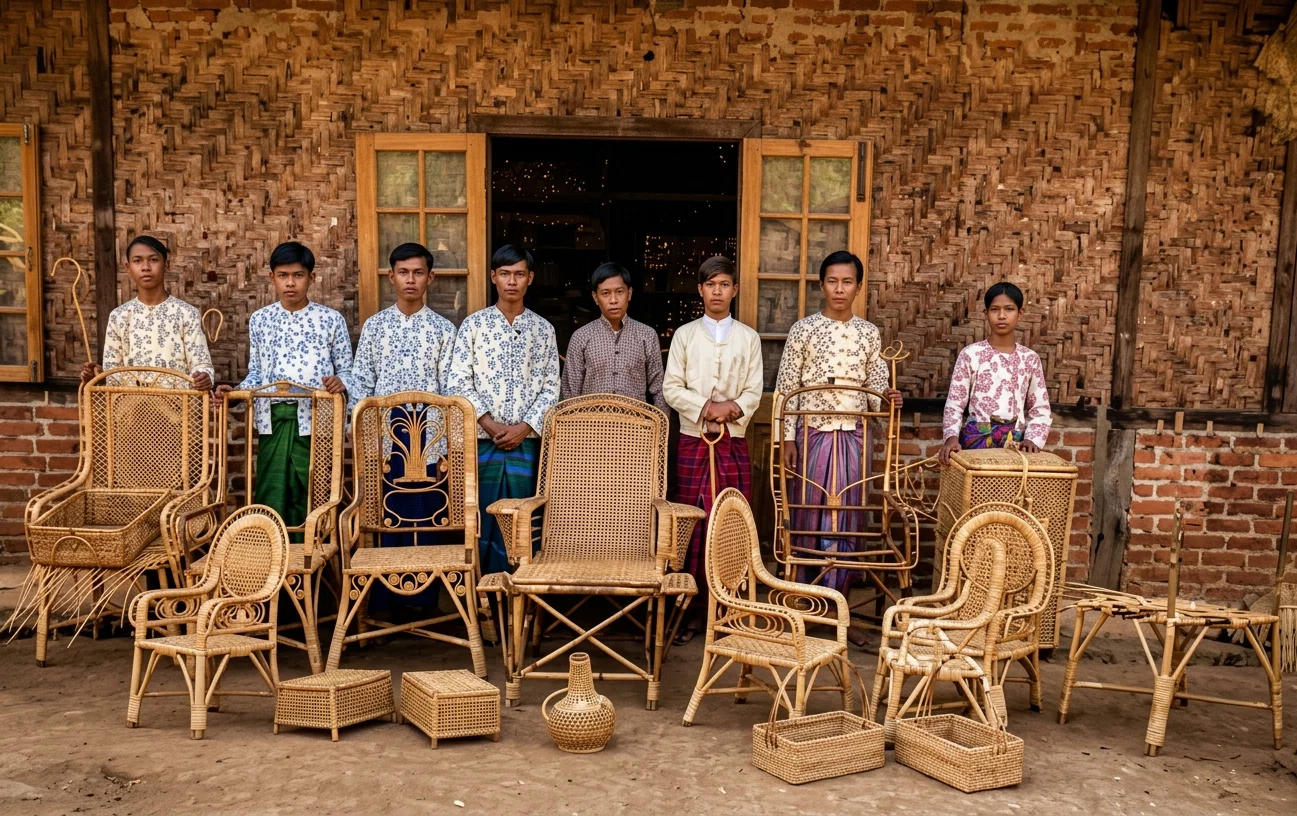
[This article was read at the biennial meeting of the India Union Mission. The accompanying illustration is one of the industrial classes at the school in Burma.—H. R. S.]
Here in the East industry suggests work, and work suggests a coolie, and a coolie suggests disgrace. Our great problem is how to show the people that industry and work are not synonymous with toil and drudgery, to show that the hand connected with the brain will do greater wonders than either working alone, and that labor is a great uplift toward a better life.
Two boys are removing some earth. One of them, after being compelled to throw aside his basket, which he fills with his hands and carries pressed against his chest, takes pick, shovel, and wheelbarrow. He allows mud to accumulate at the end of his shovel, and pushes and strains with both hands at the end of the handle. He gives a blow with the pick from the height of a foot above the ground. He puts his load near the handles of the barrow, and trundles it away to the tune of a whining wheel. That is toil. He is a coolie—a servant to his work. The other boy keeps his tools sharp, so that he will not have to “put to more strength.” His wheel is oiled, and he makes it carry the load. He swings the pick from over his head with the aid of his body, and gets a knee-push on the shovel handle. It need not be added that he moves twice as much material as his companion, with the same effort. That is work. He is a master workman—master of his work. We teach it is no disgrace to start as a coolie, but that it is so to remain one.
Vocational training in connection with schools for the development of the mind is now conceded by all leading educators to be a great good. The industrial phase of education has passed the experimental stage, at least in the West. Also the training of the hand has been added to the curriculum of many mission schools, and has been taught for a number of years with varying degrees of success. Coming closer to our own interests, Seventh-day Adventist missions, especially in Africa, have achieved remarkable results in this mode of education. Their industries have been largely confined to farming and dairying. In Burma we have started a school unique in many ways, chief among which is the fact that it depends very largely on a non-Adventist constituency for its support, and is engaging in wood, cane, and leather-working trades.
There is no school like it in this field, in that there is no Adventist school like it; for our work demands a different school than any other work. It is an experiment yet and a new thing, and therefore is in danger of being a wrong thing. Danger, I say, but so far our experience has proved no likelihood of its being wrong.
We need to make progress prayerfully. To an industrial school success means industrial and financial benefits; to a mission industrial school success means that and social and moral uplift added; to a Seventh-day Adventist mission industrial school success means all this, and in addition, saving souls for eternal life.
We have the boys now, but n-u-m-b-e-r-s does not spell success with us. We have received more donations from outsiders than is usual here in the East, but m-o-n-e-y does not come any nearer spelling success. Our achievements must be in soul-saving; and the trades are really successful only to the degree that they are conducive to that end. Our greatest danger lies in letting business get the upper hand. The school shows some lessons learned, but chiefly problems to be solved. While material additions to our facilities for work are greatly needed, we realize after all that our problems will be solved best by adding hard work, patience, and love together; by subtracting worry from business; by multiplying prayer by faith; and dividing responsibility by individual effort.
I shall state a few of our lessons which have not yet attained the growth of successes. Of nearly every Burmese boy who came to us, we found that he and work had had trouble and parted. So we hold out a place in the trades as a prize to be gained, and are not quick to accept a boy till he proves his worth. We do not urge lazy boys to work. We talk of the joys of work, and have work done before them. We have found that our boys want to learn all the trades we teach. We say they may, but one at a time. They do not reach a second. The boys will not stick to a trade long enough to learn, so we require a deposit at the beginning, which is not returned unless they stay by. The boys are not anxious to learn trades unless they get money for the work, so we pay them two pice an hour at first when they earn nothing, and later one anna an hour when they earn two annas. They understand the scheme, but prefer it to working for a time with nothing but skill for pay. We find the boys work better if they get the cash in hand and pay it back for their expenses, instead of having it applied on their account and never seeing it. So we do as they prefer.
MEIKTILA INDUSTRIAL SCHOOL
We have found it difficult to procure suitable manual teachers; and not being able to get even Christian mechanics, we have been only fairly successful in getting good morals, skilled workmanship, and teaching ability. We find also that our men are not very willing to teach their trades to Burmans, by whose ignorance they now profit. We must battle against indifference in both teacher and pupil.
As yet the trades do not pay as business propositions. Each department just about pays for cost of materials and wages of the teacher and boys. However, we have every reason to believe that with more room, facilities, and help, we can make the trades fully support themselves and add a little to the running expenses of the school. It is obvious that with our expenses and standard of work we can not successfully compete with the cheap labor which is done all around us. Our only chance to rival others in business is to pay boys less wage than men doing the same work, and to make something different. So we are specializing on mission furniture, shoes made on American lasts, and cane furniture after the Chinese patterns.
But what has industrial work to do with the salvation of souls?—Much in many ways. It enables us to get boys under our influence who would not otherwise come to a mission school. It occupies the time and interest of the boy who is inclined to go wrong. It gives boys better health, so that their minds are clear to comprehend truth and their hearts open to accept it. It uses strength that would otherwise be lost as a result of bad habits. It disciplines the boy, and saves the teacher that unpleasant task. It teaches habits of order, and “order is heaven’s first law.”
But experience speaks most emphatically, and ours has been that. Other conditions being equal, the boy who works with his hands and head at the same time is the most orderly, obedient, clear-headed, healthy, and susceptible to religious influences. The One who said, “In the sweat of thy face shalt thou eat bread,” and whose own Son was apprenticed to a carpenter, has not at this late day subtracted aught from the abundant blessings of the manual arts.
R. B. THURBER.