In the Land of Egypt

7%

Review and Herald Publishing Association · Takoma Park Station, Washington, D. C. · Jan 16, 1913

FromReview and Herald, Vol. 90, No. 3.

Read the full edition

In the Land of Egypt

L. R. CONRADI
LEAVING Brindisi on the Austrian Lloyd steamship “Goritia,” October 22, Brother Guy Dail and I reached Alexandria Friday afternoon. The early part of the trip, along the coast of Greece and Crete, was somewhat rough, but the nearer we came to Africa the more quiet was the sea and the warmer the weather.
The great topic of conversation among the passengers seemed to be the war in the Balkans, and it is very evident that the Greek Catholic element is pushing the “holy” conquest against the Turk, and will not rest till he is crowded out of Europe.
Early Sabbath morning, October 26, we had reached Assiut, Upper Egypt, where we found assembled all the workers of the Syrian and Egyptian fields. Assiut is a city of about fifty thousand inhabitants. It is the headquarters of the Presbyterian mission, which has a large college and hospital here. We have rented a roomy house for holding meetings, which accommodated our meetings during our conference. Right in front of our mission building the Holiness people have their place of meeting, and we found several of their American workers there. Not far from us, right across from the Presbyterian church, the Copts are erecting one of the finest churches in Egypt.
The six days spent at our council were taken up very fully with instruction and in seeking the Lord together. Sunday night we had a public service in English, which was translated into the Arabic. From fifty to one hundred attended the evening lectures. One Greek sister, who had recently embraced the truth at Jerusalem, but who had to leave there because of the opposition of her relatives was baptized by Elder W. C. Ising. Three natives from a neighboring town, who, with a fourth, had become interested in our work and were already keeping the Sabbath, were with us most of the time. Elder George Keough expects soon to baptize them. Not only are our foreign workers acquiring the Arabic language, but we are also securing more native laborers, so that the way is open for the advancement of the cause among the native element. As yet we have not realized the great importance of the Arabic language and field, which stretches from the borders of India on the east to the Atlantic on the west, and from the Mediterranean to the very heart of Africa. Thus far we have only three missions in this great field—the North African, where we have three workers and twenty-five members in Algeria; the Egyptian, with two ordained ministers, one Bible worker, four canvassers, two nurses, and eighteen members; and, lastly, the Syro-Arabic field, with one ordained minister, one Bible worker, one Bible worker and canvasser, and three nurses, with a membership of twenty-four. That makes for the whole Arabic-speaking field eighteen laborers among fifty millions of people.
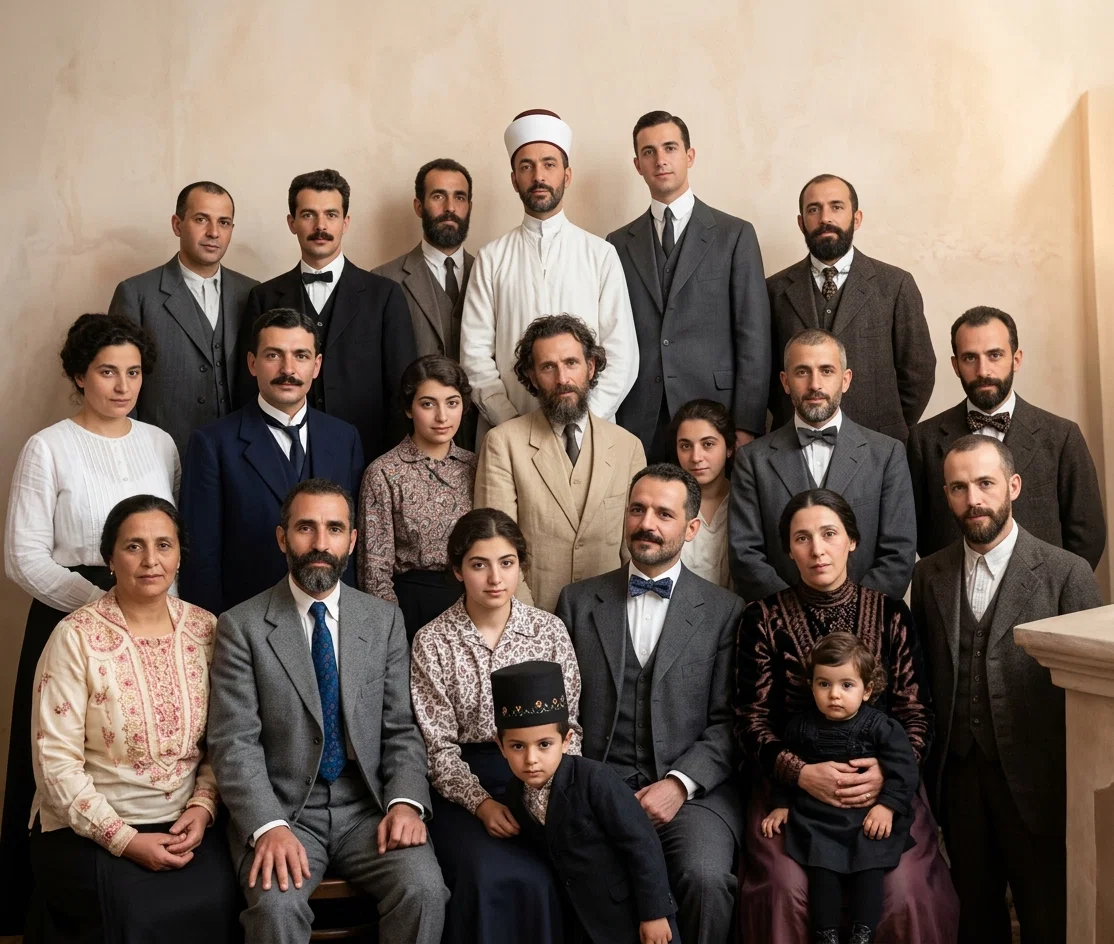
WORKERS IN THE SYRIAN AND EGYPTIAN MISSIONS
The workers seemed to appreciate the instruction given them, and realized to a far greater extent the importance of doing all they can to develop their latent talents. Two of our Sabbath-keepers formerly were Mohammedans. One of these is engaged in the work, and the other, very much interested in the truth, became a member of the Coptic Church, but is now nearly ready for baptism. The languages represented are the Greek, Arabic, Armenian, Persian, and Turkish, besides the European languages—French, German, and English—which are spoken by our workers and members in these three fields.
At present our literature consists of eight Arabic tracts; but “His Glorious Appearing” will soon be issued from the press in this tongue. Several canvassers have begun to labor, and we hope that as soon as we have this new book the canvassing work may take a good step in advance. It is planned to publish a health book in the Arabic for the canvassers, and perhaps it will also appear in other tongues. It will contain about two hundred fifty pages.
In view of the urgent need of soon opening up Mesopotamia, it was the mind of the brethren at the meeting that we should make a call for another ordained minister for these fields by next spring, and then we shall open up that great country where we already have two Sabbath-keepers,—one at Mosul and another at Bagdad,—both of whom are earnestly calling for help. Skodsborg Sanatorium has recently supplied a nurse for Jerusalem.
Brother George Keough is to labor in one of the villages near Assiut; Brother A. A. Elshaheed will open an effort at Arment; and Brother H. Piotrowsky will continue in the work at Assiut, assisted by a native helper. Brother Ising will carry on operations in and about Beirut, assisted by a native helper. Brother Fr. Gregorius will labor north of Jerusalem; our nurses of Palestine will continue with the work of our health institution there, while the native canvasser and Bible worker will also labor in and about Jerusalem for the winter. The canvassers in Egypt will work in and around Cairo mostly.
Before we took leave of Assiut, twenty of us celebrated the ordinances of the Lord’s house. November 1 we were in Cairo.
The following incident illustrates the spirit prevalent in these lands. One of the old tombs in Cairo where a Mohammedan saint is buried, fell into decay and was about to tumble down. The Greek Catholics are putting up a new church in the neighborhood. The Mohammedans were much troubled as they saw that their building about one of their tombs must be torn down, and some fanatic suddenly saw the spirit of the entombed Mohammedan saint in the confinesof the Greek Catholic church. The news spread among the lower elements of the Mohammedan portion of the population, and a mob of about twenty thousand gathered to take possession of the Greek church, in behalf of their saint. The chief of police was informed, and quite a squad of policemen and officers of the fire department came; so the worst was avoided by a well-directed stream of cold water among the excited people. It is very evident that there is intense feeling between the Greek Catholics and the Moslems, and a very small incident would now be sufficient to set the whole country on fire. Of course the Balkan war has a strong influence in producing this state of affairs just at present.
What this great field needs is more consecrated workers, who will study the language, stick to the country, and not give up until the work advances. Let us all hope and pray that workers may be found to answer these great needs.