The New South Australian Headquarters

5%

Review and Herald Publishing Association · Takoma Park Station, Washington, D. C. · Aug 19, 1915

FromReview and Herald, Vol. 92, No. 41.

Read the full edition

The New South Australian Headquarters

W. W. FLETCHER
The rapid growth of our cities is making it increasingly difficult to rent centrally situated offices for carrying forward our conference and tract society work. For years the South Australian Conference rented a cottage on Franklin Street, Adelaide, not far from the general post office. With the growth of the city the rent increased; and as the cottage was not particularly suitable in either style or location, a move was made, during the time Brother Cole was president of the conference, to Grote Street, the next street south from the general post office. There a very suitable two-story building was secured on a two years’ lease, at a weekly rental of thirty shillings. Besides providing office room, this building contained a large upstairs room, which was used for Sabbath and Sunday night meetings.
Soon a great theater was erected almost opposite, at a cost of about thirty-two thousand pounds. Other large buildings were built near by. As soon as the lease expired, the rent was raised to £2 a week, and soon after to £2 10s. Even at that rental no lease would be granted, evidently because a further increase of rent was intended.
Just at this time a block of land on Grote Street was brought to our notice, which seemed reasonable in price and suitable for erecting the buildings we needed. A general meeting of the Adelaide believers was called on the evening of Oct. 5, 1912, to consider the advisability of endeavoring to secure the land, and building a place for conference headquarters. The plan was unanimously approved by the believers present. When the proposition was submitted to the union conference committee, it was feared by the committee that too great an investment would be involved, and it was advised that a suburban property be purchased for the office work, and that the city church and mission meetings be held in rented halls. The South Australian brethren then gave up the idea of building on Grote Street.
Shortly afterwards the union conference treasurer, Brother P. H. Pretyman, visited Adelaide, to help us erect a building on suburban property. It was found that it would be difficult to secure a suitable property, and that the price would be eight or nine hundred pounds. After looking at the Grote Street block, Brother Pretyman advised us to take a suburban cottage temporarily, see what could be raised in gifts toward building in the city, and submit the plan again to the union conference.
When the South Australian believers were asked to subscribe funds for establishing our headquarters in the city, they responded most nobly. More than £600 was pledged. This was excellent for a conference of about four hundred members. At the union conference council in September, 1913, the plan was approved. The land was purchased, and the building was completed by October, 1914.
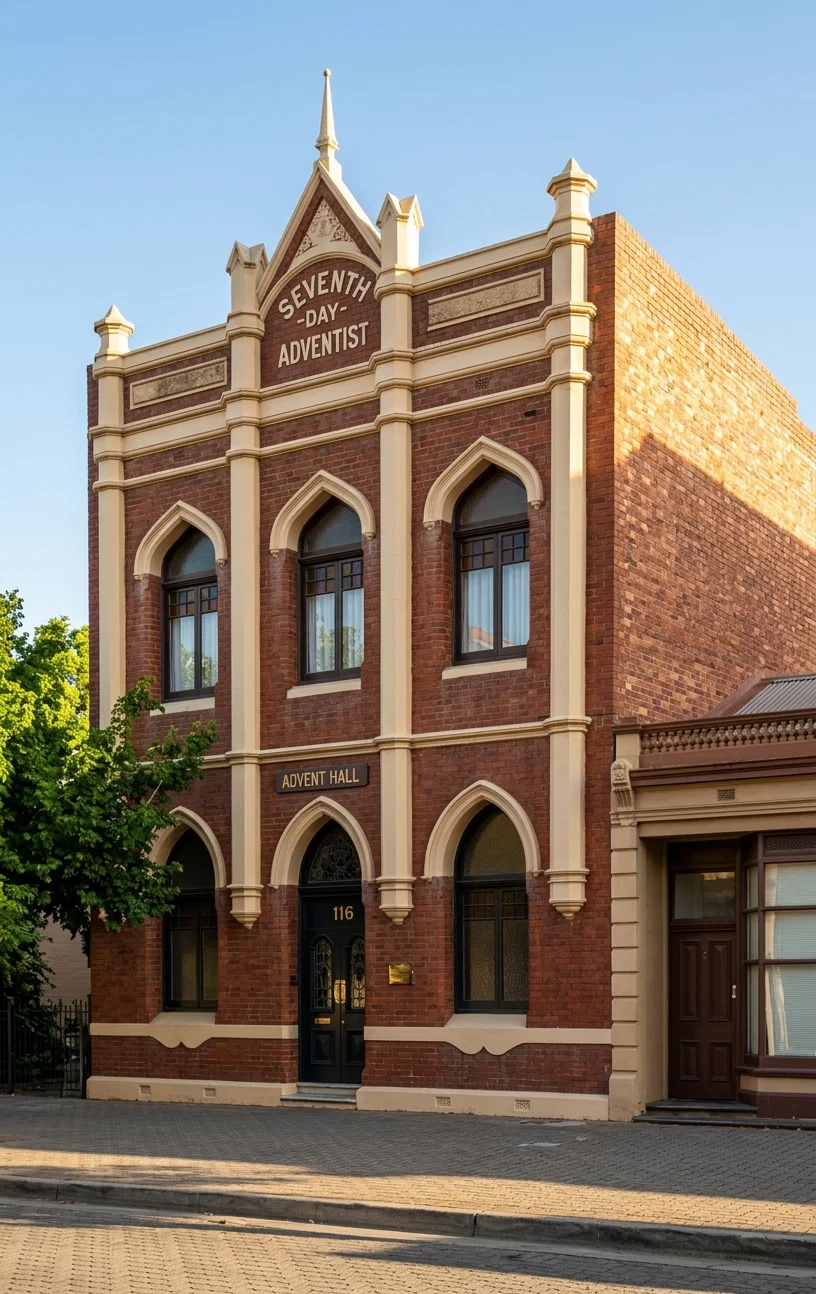
OUR NEW ADVENT HALL, IN ADELAIDE, AUSTRALIA

The Building

The land purchased has two frontages, each thirty feet—one on Grote Street on the south, and the other on the north. Almost all the land is covered by the building, which is of brick throughout, as required by the City Building Act. The front portion of the building is two stories high, covers the full width of the block (thirty feet), and is about twenty feet deep. Here are the office rooms. On the ground floor the treasurer’s room is on the east side (right side of accompanying picture). The tract society room is on the west (left of the picture). The front door opens into a passage six feet wide, which leads through to the meeting hall, on the ground floor behind the office building.
On the second floor is the committee room (two windows on the right), and two rooms for departmental secretaries. The committee room is sixteen feet by thirteen feet and six inches. The conference and tract society are thus provided with five light, airy office rooms, four of which face the south, a desirable aspect in the hot Adelaide summers.
The meeting hall is on the ground floor immediately behind the offices, and is fifty-six feet long and twenty-four feet wide. There is a sloping floor, falling about fifteen inches from the entrance toward the rostrum. A good cement baptistery has been built under the rostrum. The hall is well lighted from one side. While this is satisfactory as far as the light is concerned, it does not provide a draft of air through the hall such as there would be if there were windows on both sides. To overcome this difficulty two large electric fans have been installed, which are operated at very little cost.
The whole building is lighted with electricity. The offices are fitted with electric radiators, an economical substitute for fireplaces. The office rooms also have telephone intercommunication, which proves a great saving of the workers’ time.
The hall is plainly and neatly furnished, and will comfortably seat one hundred and seventy-five persons. The ceiling is high enough to allow for a balcony to be built if needed.
Behind the meeting hall there is a classroom or vestry (eleven by nine feet), and a stock and packing room for the tract society, of the same dimensions. This room is reached from the offices without entering the meeting hall, and also opens on the back street for the handling of bulk shipments. Altogether, the premises are proving a great boon to our conference, tract society, city mission, and church work. The building, having been designed to meet the needs of the cause, provides us with conveniences that we could never hope to secure by renting a place, even at a high rental.

The Location

The city of Adelaide is a mile square, and is surrounded by a broad belt of park lands, beyond which lie the suburbs. King William Street runs through the center of the city, due north and south. Wakefield Street from the east and Grote Street from the west, meet King William Street in the center of the city.
The Queen Victoria Statue stands at the center of Victoria Square. From that statue to our headquarters building is a walk of three or four minutes. The three streets mentioned are the broadest in the city, and were intended to become the leading business thoroughfares. By building on Grote Street we have the advantage of a central location without having to pay the prohibitive prices ruling for land in leading business streets.
Among all the believers there was the heartiest cooperation in this building enterprise, both in gifts and in active interest. We trust the outcome will be to the glory of God and the advancement of his cause.