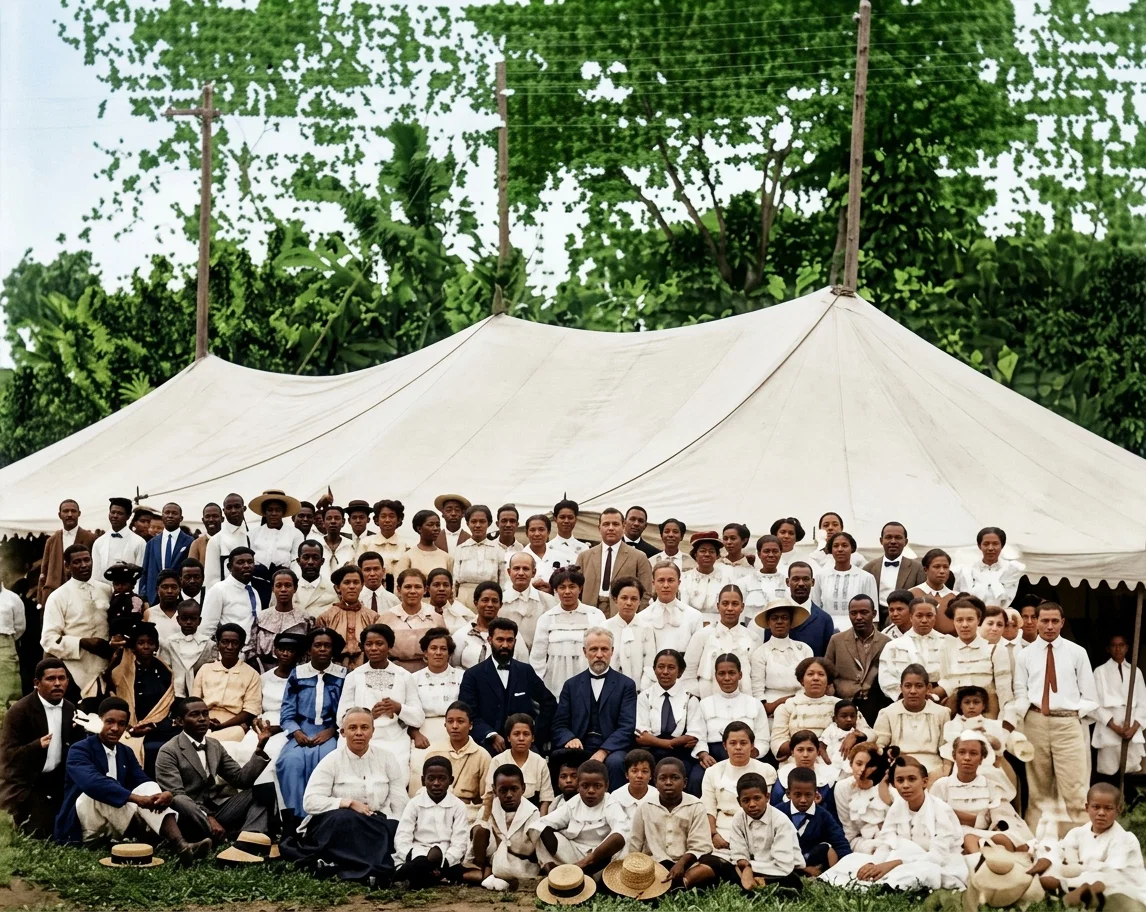
The Central American Camp Meeting

5%

Review and Herald Publishing Association · Takoma Park Station, Washington, D. C. · Aug 19, 1915

FromReview and Herald, Vol. 92, No. 41.

Read the full edition

The Central American Camp Meeting

In the year 1892 Elder Frank Hutchins and wife, now Mrs. E. R. Palmer, were sent to pioneer the work in the Bay Islands and along the Central American coast. “In the years that followed they scattered thousands of pages of literature all along the coast from British Honduras to Colon.” Elder Hutchins found fifteen believers in Ruatan, one of the Bay Islands. Soon others accepted the present truth in Utila and Bonacca, other islands of the same group. “The progress of the message was so rapid that a church building, begun as a union church, was finished as a Seventh-day Adventist church, almost all those connected with it having accepted the present truth during its erection.”
The Lord continued to bless the work, and in 1908 this field was organized into a conference. The eighth annual session of this conference was held this year in La Ceiba, Spanish Honduras, May 21-30. About one hundred brethren and sisters were present at this meeting, most of whom were English speaking; but as there is a small company of Spanish-speaking believers in La Ceiba, where the meeting was held, all the conference business was conducted in the two languages. In the evening, preaching services were held at seven o'clock in English and at eight o'clock in Spanish. There was a good attendance from the town, some nights the tent being full.
As the message first gained a foothold among the English-speaking people of the Bay Islands and in Belize, and as the workers who have labored in this field have for the most part spoken only the English language, practically nothing has been done for the Spanish-speaking population of Honduras. But as ninety-six per cent of the whole population in this field is Spanish speaking, the brethren felt that definite plans should be laid at this annual meeting to reach those of this tongue with the present truth. To this end the following recommendations were enthusiastically and very unanimously passed:— “Whereas, Spanish is the language spoken in the greater portion of our field, and,—
“Whereas, This makes it very necessary that the man in charge should be able to speak this language, we therefore—
“Recommend, That the director of our field so arrange the work of the mission that he can devote at least one half of his time to the study of the Spanish language during the next twelve months.
“Whereas, The circulation of our literature is one of the most successful methods of bringing people into the truth, and,—
“Whereas, Very little has yet been done in the colporteur work among the Spanish-speaking population of our field, we therefore—
“Recommend, That at the earliest possible date a good, experienced man who speaks the Spanish be secured to take charge of this branch of the work in our field.”
The present organization of the field has been found unsuitable, on account of the lack of communication, and the following recommendations were adopted in order to remedy the situation:—
“Whereas, The lack of communication and travel between the north and south portions of the Republic of Honduras makes it practically impossible successfully to work the south section from the north, we—
“Recommend, That all that portion of Honduras south of the five northern provinces be separated from the Central American Conference, to form a mission field by itself.
“Whereas, We believe that it would be for the best interests of the work in our field if it were operated as a mission field instead of as a conference, we—
“Recommend, That the Central American Conference be disbanded, and that we ask the General Conference to organize it as a mission field on the same basis as Mexico, Cuba, and Porto Rico.”
These plans appealed to the delegates, and were received with lively interest.
The home missionary and the Missionary Volunteer work were more thoroughly organized. The Sabbath school work received attention, and in all things belonging to this message the members showed their desire to keep pace with the world-wide movement.
The excellent results obtained in offerings to foreign missions are worthy of mention. The amount per capita for the year was $6.32. The average per capita given by the members in the United States during 1913 was $6.95. So the Central American people came behind the general average only sixty-three cents, which, considering the conditions of their field, is a very creditable record.
VIEW TAKEN AT THE CENTRAL AMERICAN CAMP MEETING
The following-named persons were suggested as officers for the Northern Honduran Mission for the coming year: Director, Isaac Baker; advisory committee, Isaac Baker, Dr. A. J. Hetherington, Christopher Jones, S. J. Bennett, H. Moncado; Sabbath school and Missionary Volunteer secretary, Mrs. Alma O. Jones. The General Conference Committee is asked to supply a secretary and treasurer for the mission.
At the close of the meeting three young persons were baptized. The brethren and sisters who attended the meeting received rich blessings, and returned home determined to do more than ever before to help give the message and finish the work.
N. Z. TOWN.