W. A. BARLOW

7%

Review and Herald Publishing Association · Takoma Park Station, Washington, D. C. · Jan 16, 1908

FromReview and Herald, Vol. 85, No. 3.

Read the full edition

W. A. BARLOW

Santalia and the Santals— No. 7

W. A. BARLOW
Dr. Campbell, superintendent of the Santal Mission Press, has contributed the following note on the Kols and Mahles:—
“Besides the Santals there are several other Dravidian tribes in Santalia, some of whom still retain their ancient language and customs, but many have become more or less Hinduized, and have adopted the language spoken by the Hindus in the district.
“Two of those tribes which have been least affected by Hinduism are the Kols and Mahles. Many of the Kols and a considerable number of the Mahles are Christians. Of the Kols, who are variously known as Kol, Kolhe, or Karmali, no statistics as to numbers are available, the reason being that up till very recently they have been regarded as belonging to the Munda section of Kols who inhabit chiefly the Ranchi district, and have been included with them in census reports. The Karmali Kols disclaim any clanship with the Munda Kols, and say they are a separate tribe, and do not intermarry with them. Their language is more allied to Santali than to Mundari—the language of the Mundas—and has been classed by Mr. Grierson, in the “Linguistic Survey of India,” as a dialect of Santali. So far as the information available at present goes, the Karmali Kols appear to be mainly located in Hazaribagh, Manbhum, and the south of the Santal Parganas, and number considerably less than one thousand souls.
“In physique the Karmali Kols differ somewhat from the Santals. They are more lightly built, and the women are very often comparatively tall, and when young have remarkably fine figures. The predominant hue is very dark, but many are as fair as the fairest high-caste Hindu in the districts in which they live.
“They are divided into the same septs as the Santals, and in every instance each sept has the same totem. Like the Santals they are exogamous, but unlike them, they, to some extent, practise infant marriage. In the matter of religion they have adopted many Hindu ideas, and observe certain Hindu festivals.
“By profession, the Karmali Kols are iron smelters and blacksmiths. The districts in which they are located are rich in iron ore, which is smelted in rude furnaces erected under the shade of some large tree to shelter the workers from the glare of the sun. All their work is done in the open, and in the hot weather the furnaces are worked at night. The disappearance of the forest from many parts has interfered with the iron smelting industry, as it is becoming difficult to get a sufficient supply of charcoal, and the landholders are now almost everywhere levying a cess on each furnace provided with charcoal from their forests. Not being in a position to follow their own hereditary craft, many of them have taken to coal mining, and as they make good miners, their services are much in demand. They are more industrious than the Santals, and as they seldom possess land they are under less temptation to spend time in visiting relatives, and in hunting and fishing, which possess such great attractions for the Santal.
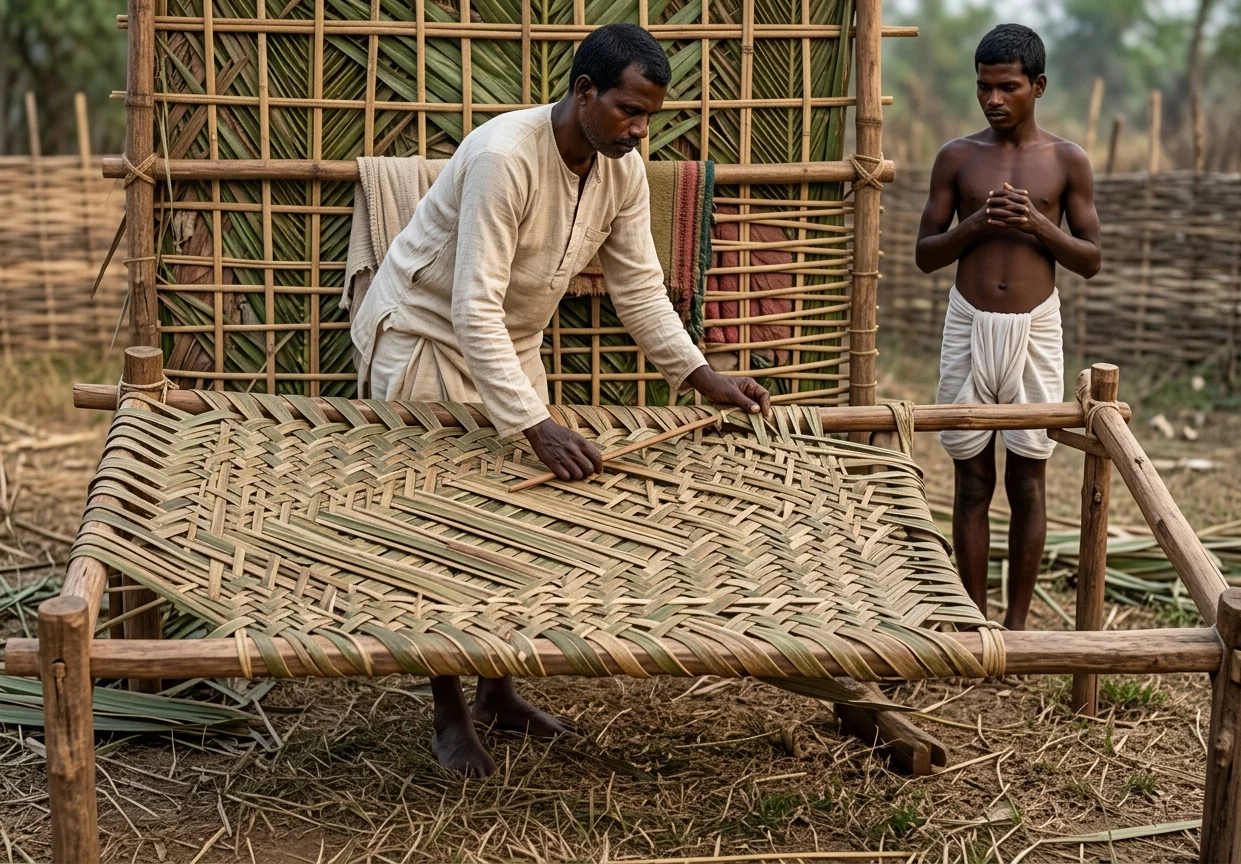
A NATIVE OF INDIA AT WORK
The Mahles are more numerous than the Karmali Kols, and are most largely represented in the districts of Manbhum, Lohardaga, Hazaribagh, Singbhum, and the Santal Pargannas. Their language differs very little from Santali, and their septs and totems are in many instances similar. Their religion is described by Mr. Risley in his ‘Tribes and Castes of Bengal,’ as a mixture of half-forgotten animism and Hinduism imperfectly understood. They practise both infant and adult marriage, and divorce is easy. A divorcee of either sex may remarry.
“By profession they are workers in bamboo, and make all the household bamboo ware used in the district. Their only implement is a curved knife, and measurements are made with the fingers. As a rule they are entirely dependent upon their trade for a living, very few of them possessing any land for cultivation. Mahle settlements are generally in close proximity to the hills on which bamboo,—the raw material from which they manufacture their wares,—is found.”
“Speed away! speed away, on your mission of light, To the lands that are lying in darkness and night; ’Tis the Master’s command; go ye forth in his name, The wonderful gospel of Jesus proclaim; Speed away! Speed away! Speed away!”
Simultala, India.