West Africa

6%

Review and Herald Publishing Association · Takoma Park Station, Washington, D. C. · Jan 23, 1908

FromReview and Herald, Vol. 85, No. 4.

Read the full edition

West Africa

L. W. BROWNE
About seven weeks ago a native worker and I came to Waterloo, a village having a population of three thousand, twenty-one miles southeast of Freetown. As its inhabitants are the most intelligent among the people of the villages in this vicinity, we immediately began to canvass for our literature. Sales were slow, but a lively interest was manifested by all, many requesting that the truths found in the books be explained to the public.
Before the first week closed, we visited the district commissioner, who purchased “Great Controversy.” In course of conversation, he suggested that we should ask the Church Missionary Society for permission to use an old church building which they have vacated, in which we could give our lectures, and then promised to be responsible for the obtaining of the same. He was so sure that we could have it, that he advised us to write our placards to that effect. Knowing the antipathy that other denominations have for our work, I hinted that his plan did not seem feasible; but he reassured us that it was a settled matter, because his word was authority.
On returning to Waterloo the following week with our placards, we learned that the Society had positively refused to grant our request. In order that we should not be disappointed, he consented for us to use the public market, a building twenty-five by sixty feet, which was erected about five years ago, but was used only a few months, and then vacated. It was thought that it would be useless to invite the people to come here, inasmuch as they had sworn never to return to it for vending purposes, and had even declined to attend a social entertainment held in it some time ago, at which music and dancing were prominent. But the Lord’s ways are not the ways of man, and he overrules all prejudices when his truth has to be proclaimed.
At our first meeting, about two hundred were present. Since then we have had an average attendance of two hundred fifty. The commissioner came to the opening meeting, and at its close highly commended the people for the interest they had exhibited, also exhorted them to attend regularly, so that no opportunity might be lost by which they might be benefited.
There lived in this village, two years ago, a man who preached on the prophecies to some extent. As he was not well informed, he told the people that he could not tell them much, but the time was not far distant when God’s true messengers would come to clearly expound these things to them. Many believe that we are the ones to whom he referred.
Among the obstacles Satan has placed in the way of the truth of God we might mention necromancy in all its forms—transmigration of souls, ancestral worship, spiritism in a crude form, and witchcraft—the outgrowth of their superstitious fears. For example, when a child is born, it is conspicuously marked on its face, the marks remaining through life, and even after death, in the spirit world, they believe. And when that child reappears in the flesh, as they claim it invariably does, if it should visit the neighborhood through birth, it can be readily recognized; but generally it is born some distance away. Witnesses are abundant on every hand to prove the truthfulness of these statements, claiming to have seen and handled such transmigrated children.
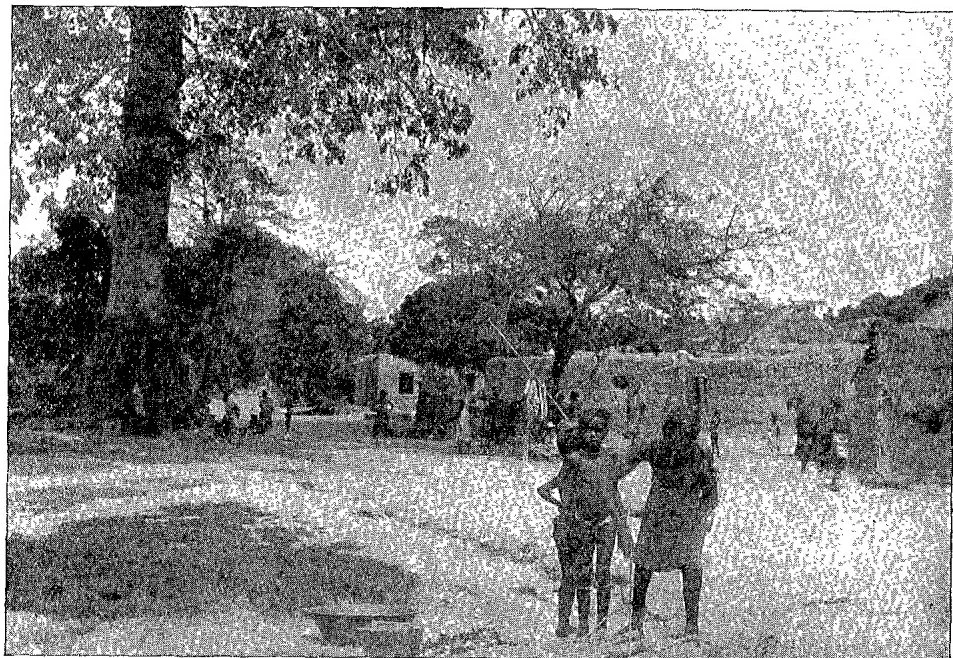
A WEST AFRICAN VILLAGE
Ministers and lay members of Christian denominations frequent the homes of Mohammedans, in order to solicit their aid in times of distress and financial failure, and the heathen so cunningly bewitch them that large sums of money are continually spent in this manner. Note the result: When the Mohammedans are invited to become Christians, they refuse, on the ground that their religion is superior to the Christian faith; for were it not so, Christians would not seek their help in time of trouble.
As might be expected, our views concerning the immortality of the soul met with great opposition, the ministers being in the vanguard. We visited the pastors of the Anglican and Methodist denominations, and presented the truth to both. The Methodist pastor quite stubbornly resisted our position on the nature of man, stating that he could not agree with us, because it was one of the essential doctrines of Methodism. Having discussed with him “hades,” “Abraham’s bosom,” etc., we left him, promising to lend him “Here and Hereafter,” which he consented to read. This minister has been attending regularly, but so far has not accepted the light.
Last Friday evening we extended a cordial invitation to all to come to our home for Sabbath services. Six responded. On Sunday as we visited among the people, we discovered that others were on the point of decision, so the next Sabbath we expect a larger number.
The experience of a Methodist class-leader is very remarkable, as related by himself yesterday. He states that after listening to the presentation of the Sabbath question for the first time, he went home, and retired, but not to sleep; for he could not. “The seventh day is the Sabbath,” kept ringing in his ears, and before morning dawned he had decided to obey. His pastor has threatened to take his class from him, but he is fixed in his purpose. Pray that the Lord may help him and the others who are now venturing out.
Day after day the merits of our literature are being discussed. This morning a justice of the peace came to purchase “Thoughts on Daniel and the Revelation;” but as we have no more at present, we could not sell it to him. To scatter our publications as the leaves of autumn, is an injunction that it will pay us in a twofold sense to carry out: first, with respect to the people; for they become acquainted with the solemn truths for this time; and, secondly, with regard to the workers, as we are thus brought into close contact with the people for whom we labor, and they become friendly, and learn to place confidence in us and the truth we represent, when they see our straightforward, business principles in obtaining sales. Canvassing is really an entering wedge, andshould be neglected by no one who aspires to be a successful worker.
The “great awakening” is being felt in Africa; and as a child awakening from sleep cries for food, so is there a general demand here for spiritual bread. Who will voluntarily join the ranks, and assist in feeding these starving, benighted souls, with the pure, unadulterated word of truth?
The fever still troubles me, there seldom being a week when I am not affected. But my motto is, “Faint, yet pursuing.”
Waterloo, Sierra Leone.