Another European Conference

3%

Review and Herald Publishing Association · Takoma Park Station, Washington, D. C. · Jan 30, 1908

FromReview and Herald, Vol. 85, No. 5.

Read the full edition

Another European Conference

GUY DAIL
That which but a few years ago seemed a visionary dream, an illusion of the enthusiast, an utter impossibility, is now an accomplished fact—our largest field in the world has been organized into the Seventh-day Adventist Russian Union Conference, and seeks recognition among the sisterhood of union conferences that encircles the globe.
It gives us great pleasure to thank God for the manner in which his Holy Spirit has visited the sessions of that small body of delegates from all parts of Russia, assembled in Riga, October 26–29, where the most important meeting we ever had in the czar’s dominions has just been closed.
Riga is under martial law. Soldiers pace to and fro, or stand with planted bayonets upon the street corners. Every day we see well-guarded squads of arrested revolutionaries slowly and sorrowfully wending their way to prison—and to death. There are numerous reports of theft, of burglary, and of murder. The postal authorities employ armed men to protect the mails from organized bands of highway robbers. The people themselves, in their dealings one with another, often show the bitterest race and class feelings, which sometimes result in acts of open violence.
In the midst of such surroundings the Lord has mercifully protected us all from harm. He has made it possible for the thirty-three delegates representing the Caucasian, South Russian, and Baltic Conferences, and the East, Middle, and West Russian Missions quietly to come together each day, formulate and adopt their constitution, choose their officers, and lay plans for the prosecution of the work of God. Brethren L. R. Conradi, J. T. Boettcher, Fred Anderson, and H. Hartkop rendered valuable aid and counsel.
We wish the readers could have been with us, and enjoyed making the acquaintance of Russia’s sons and daughters who have tasted the sufferings that come to the leaders of a reform movement in a land such as theirs. Here are those to whom Seventh-day Adventist literature, which had often been carried across the border at great personal peril, was forbidden. Here you could shake the hands of men and women who have been pierced to the heart by the sudden and unheralded entrance of the pettiest village police official into the overcrowded room whither they had stealthily assembled for prayer and to listen to the Word of God. At that time this might be the forerunner of arrest and imprisonment and exile.
But those days are no more. God has granted us religious toleration. Our publications may be freely circulated. Our ministers may preach the word openly. Our brethren can come together in peace, and pray, and sing, and study the Scriptures. How thankful the people are can be known only by those who have once been denied the blessings of liberty, and have afterward enjoyed them again.
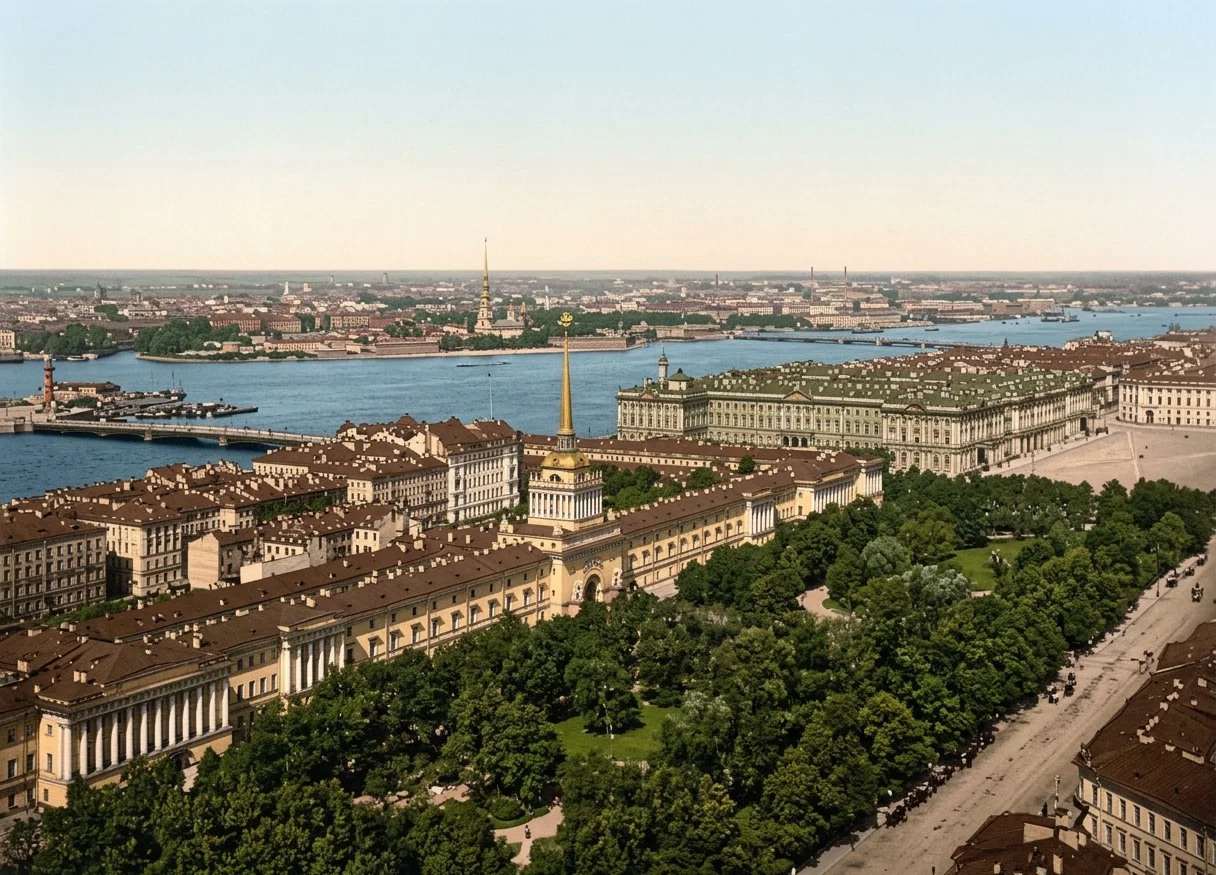
GENERAL VIEW OF ST. PETERSBURG, RUSSIA
As we have been granted the same rights as the Baptists, we have drawn up a constitution, giving the principles which we wish to govern the Russian Union Conference; however, before this is fully operative, it must first receive the sanction of the government. Elder Boettcher will avail himself of the earliest opportunity to present a statement of our desires to the authorities in St. Petersburg; but until the necessary legal acknowledgment is obtained, it will be impossible to transfer the Russian headquarters from Hamburg to Riga. This is a very important matter, and it ought to be continually remembered in the prayers of our people. The initial steps to securing the rights for a branch publishing house here have also been taken.
The question of finance received a great deal of attention. Russia—a land of wonderful resources—is poor, because its natural wealth is so imperfectly developed. Most of the people are indigent peasants. The majority of our brethren belong to this class, although there are a few well-to-do business men and farmers to be found among the ranks of Seventh-day Adventists here.
In 1906 the 2,281 members of Russia paid a tithe of $8,157—not four dollars per capita; and this is $2,572 more than was received in 1905 from a membership of 2,003. Heretofore, the German Union has made up whatever the Russian missions lacked in meeting their expenses; for 1905, when there were nineteen workers, it required an appropriation of $1,450 to cover the Russian deficits; in 1906 the sum rose to $2,500; we do not know what it will be for 1907, as the accounts will not be audited until the German Union Committee meeting in February; but there are now thirty-two ministers, licentiates, and Bible workers in the Russian Union,
and it is estimated that the General Conference will be asked to appropriate $3,000 toward their expenses for 1908. However, these are not large amounts, if we remember that this union embraces more than two and one-fourth times as much territory as there is in the United States with all its colonial possessions, and that its inhabitants number 146,000,000—a mixed multitude of over one hundred languages. What wonder is it that such a field as this should need more laborers and more means, if we consider that the entire Russian Union can muster only 2,558 Seventh-day Adventists! If the United States of America, including the Philippines, Alaska, Guam, Porto Rico, the Hawaiian, and all her other islands, were to have in proportion to her area only as many members as there are in this field, then we would have but 1,135 Sabbath-keepers scattered throughout all her territory—one representative of the message to every 3,283 square miles (seventeen square miles less than the combined areas of the States of Rhode Island and Delaware).
It is therefore easy to understand why one of the main issues brought before the Russian delegates should have been the consideration of ways and means to provide facilities for the education of native workers. The German Union has promised $2,500 toward their institutional enterprise as soon as the brethren in Russia have raised twice that amount for this purpose. The $1,900 they have secured in cash and pledges toward their material fund for “Ministry of Healing,” makes a nice beginning, and they expect to realize great benefit from the sale of the relief books in the immediate future.
The canvassing work and general circulation of our literature must also be energetically developed in this field. As about eighty per cent of the inhabitants of Russia are the ignorant, poverty-stricken peasants, few of whom can read, the colporteur has many difficulties to surmount. We now have twenty canvassers who are devoting their powers to the solution of this problem. They need encouragement. One way in which our people in other lands may encourage the workers in Russia, cheer their own hearts, and be a blessing to others, is to scatter our publications among their Russian, Lettonian, Esthonian, or Polish neighbors; for literature adapted to all these nationalities can now be secured from the New York Branch of the Review and Herald Publishing Association, 32 Union Square, E., New York City.
The following free rendering of a few of the resolutions and recommendations which were unanimously adopted after a careful and candid discussion of the meaning and breadth of each, will be of interest to the readers of the REVIEW:—
“Whereas, Notwithstanding tribulation, imprisonment, and persecution, God in his mercy and by his strength has made it possible for present truth to be scattered into all parts of the Russian empire, and has given us, in the six leading languages of the country, a number of workers, and many churches, with a membership of 2,558; and,—
“Whereas, It is now possible for us to take so important a step as that of organizing the Russian Union Conference; therefore,—
“Resolved, That we hereby express our deepest gratitude to the Lord for his compassionate help and kind providence during the past twenty-one years, and that we to-day reconsecrate ourselves to his service, and erect here our Ebenezer, that we may be empowered to continue successfully to its completion the work that is begun, to the honor of God and the salvation of many souls.
“Whereas, The General Conference and the German Union have in the past assisted us with means and workers: therefore,—
“Resolved, That we express our thanks for the help thus received, and ask God to give us a clearer understanding of the wonderful privilege he has conferred upon us as the bearers of hismessage for this time to the people of the great Russian empire, that we may be worthy of the aid of our brethren in the future.
“Resolved, That the newly established Baltic, South Russian, and Russian Union Conferences, as well as the West Russian Mission, date from Jan. 1, 1908.
“Resolved, That we express our full confidence in the mission God has committed to this denomination, and assure the General Conference of our hearty co-operation in accomplishing his work.
“Whereas, More men and means are necessary for the effective spread of the message among the many millions of our great field; therefore,—
“Resolved, That we earnestly request all our brethren to heed the Holy Scriptures by being faithful in tithes and offerings, as only thus will it be possible for us properly to forward the work and keep step with our sister union conferences in the future.
“Resolved, That we empower the Russian Union Committee to place before the proper officials for their approval, the constitution that has been here unanimously adopted.
“We recommend, That, in harmony with the vote of the General Conference, only such be chosen for church officers and field laborers as are faithful in the payment of their tithe.
“Whereas, The government has granted us legal rights as a denomination; therefore,—
“We recommend, That all our churches, after conferring with the president of their field, apply to their respective governors with reference to the making over of the proper books of record.
“Whereas, The canvassing work is very important to the most successful dissemination of the precious seeds of truth; therefore,—
“We recommend, That all our fields select properly qualified persons who will devote their lives to the circulation of our literature, and that we pledge encouragement to such as thus engage in this branch of the message.
“Resolved, That we extend to our American brethren our most hearty thanks for their timely assistance during the recent famine, and assure the donors that the Russian Union will carry out their wishes in the disposition of the remainder of the fund.”
In closing this report, we can only wish that God will very richly bless in their future labors all the Russian workers, especially Elder J. T. Boettcher, the newly chosen president of the union, and the union committee (Brethren H. J. and H. K. Loebsack, D. Isaac, O. Wildgrube, D. P. Gaede, and J. Sprohge), together with Sisters S. Bojanus (secretary) and Emma Creeper-Fenner (treasurer) and Sabbath-school and missionary secretary). We believe that our brethren in more favored lands, including our Russian-American Sabbath-keepers, will pray for this new union and God’s children there, and esteem it a privilege to help hold up their hands in any way they can.
Riga, Russia.