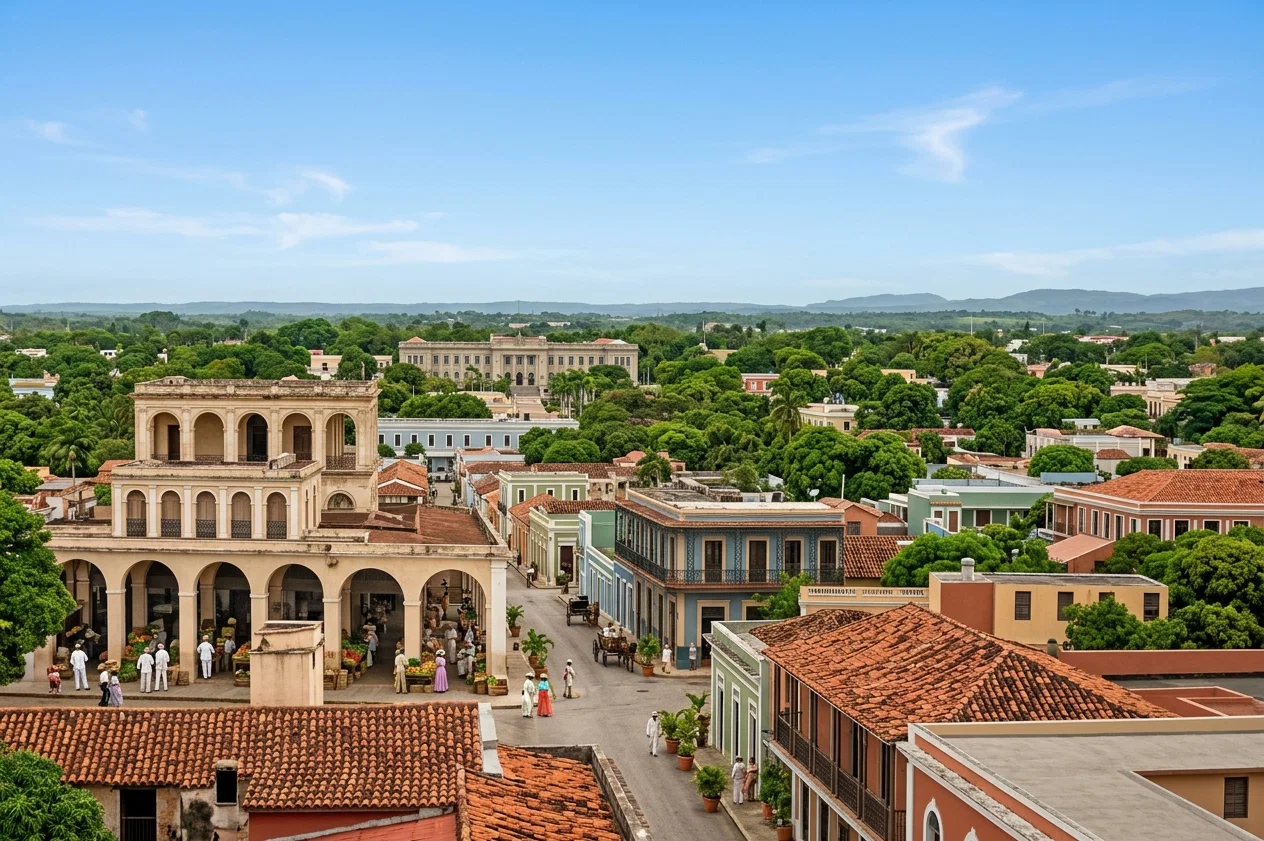
Porto Rico

8%

Review and Herald Publishing Association · Takoma Park Station, Washington, D. C. · Jan 30, 1908

FromReview and Herald, Vol. 85, No. 5.

Read the full edition

Porto Rico

U. BENDER
LEAVING Cuba, October 14, we sailed along the south coast of Hayti, stopping at two ports in the republic of Santo Domingo. We arrived in Ponce, Porto Rico, the morning of the seventeenth. Porto Rico has a five days' quarantine against Cuba on account of yellow fever. Allowing our time on board, there were yet three days which we must spend in the quarantine station. Only eighteen could be accommodated at Ponce, so they took the rest of us around to San Juan.
SAN JOSE, PORTO RICO
I did not reach the home of Elder B. E. Connerly in Mayaguez until Sunday morning. Elder Connerly met me at the station, and we were soon talking over the work of the Porto Rican Mission.
Elder Connerly and his wife have been in Porto Rico five years. Three years ago Brother C. N. Moulton and wife came from Jamaica to assist in the work, and about a year ago Brother and Sister J. C. Brower came from the States. These faithful soldiers and their wives comprise the force of laborers carrying this message to Porto Rico, an island with an area of thirty-six hundred square miles and a population of about one million. The past year they have extended the work into Santo Domingo, a division of Hayti, with an area of twenty thousand square miles and a population of six hundred thousand. For a few days these workers were together, planning how the work might be carried on in the most profitable manner, with so small a force of workers and the limited amount of means that can be spared for the work there.
They find that it is very hard to get these people to stand firmly for the truth. Rome has taught them to consent to a teaching, but the necessity of living out what they believe is a new experience for them. They think they are Adventists when they “believe,” whether they “do” or not. A faith without works is good enough for them.
There is one thing that is favorable; they like to read, and the work done by the paper El Centinela has extended over all the island. It goes to every class, and reaches hundreds with its messages of truth, where only tens could have been reached by regular ministerial labor, and they, only of the very common people. Other denominations are spending thousands of dollars in building churches and conducting schools and medical missions. With all these efforts they reach only the lowest classes. If you provide everything, and the people are not asked to bear any burden, they will fill your chapel till some one else provides a better one and does a little more for them; then they are gone.
I am thoroughly convinced that the best way to educate these people and make them see that they must stand for the truth and bear its burdens, is to place among them our papers and books. All classes are reached in this way, and the truth, taken month after month, does good like a medicine. I am sure a laborer in Mexico had the right plan in mind when he wrote the following: “If I had one hundred thousand dollars with which to give the message to Mexico, I would spend ninety thousand of it in scattering literature, and ten thousand dollars in reaping the harvest.”
By issuing a monthly paper in Span-ish, and pushing the circulation of our tracts and books, a work has been done in Porto Rico that never could have been done had the plans and methods which succeed so well in other fields been followed. Elder Connerly is now printing over five thousand copies of El Centinela each month. The people are eager for it.
There is no cause for discouragement in Porto Rico. The work has not made a showing as it has in some places, but the seed has been sown, and the fruit is beginning to appear. There is a power in this message that never fails to work if you can get the truth before the people. It is evident that the best way to get it before the Spanish-speaking people is by our literature.
One Sabbath afternoon, while at Mayaguez, I accompanied Elder and Mrs. Connerly to the cemetery, where we visited the grave of Brother Fisher. Here lay our brave, strong comrade, slain in the heat of battle. He fell when there was no one ready to fill his place, and his wife and child were left to struggle on alone in a strange country. We talked of God's dealings with men. We do not understand why these things come as they do, but we know his ways are best. Just as the Sabbath was passing away, we read a psalm, and then, kneeling by the grave we poured out our hearts in prayer that God would make us sufficient for his work, and that he who has the power over death might come quickly.
November 4 I sailed from San Juan for Cape Haytien, where Elder W. Jay Tanner and family have been stationed for the past two years.