Santalia and the Santals

6%

Review and Herald Publishing Association · Takoma Park Station, Washington, D. C. · Feb 6, 1908

FromReview and Herald, Vol. 85, No. 6.

Read the full edition

Santalia and the Santals

— No. 8

Mission Work among the Santals
W. A. BARLOW
Not the least of the consequences of the Santal rebellion referred to before was the inauguration of mission work among them. The Sepoy mutiny, which followed, quickened the conscience of the British people to a marked degree, and gave a great impetus to missionary enterprise. The Santal rebellion led not to the increase, but to the initiation of Christian work among the Santals. The government’s necessity was the missionary’s opportunity.
The earliest English missionaries, when they arrived in India, had to seek the protection of the Danish flag, but the government has learned wisdom since then. While rightly pledged to religious neutrality,—which it is to be feared neither Hindus nor Mohammedansunderstand, but interpret as religious indifference,—it has given Christian missionaries all they ask, a free field and no favor, that liberty to preach and propagate their religion which all other sects in India enjoy. There are times, however, when the feeling shown by the government toward missions may be expressed by a warmer term than toleration.
The remark has been attributed to Charles Darwin that if those who scoffed at missions were about to be wrecked on an unknown shore, they might well pray that the missionaries had been there before them. The government of Bengal, at any rate, knew very well that there would be fewer murders in Santalia in the future if missionaries settled there; if any missionary society was prepared to open up work among the Santals, it would get sites for its stations on exceptionally favorable terms.
The organization that took advantage of this favorable opening was the Church Missionary Society, and to this day its missionaries in Santalia are reaping the benefits of their predecessors’ wisdom in specially liberal help for their educational work. Work was begun in 1862, in the Santal Parganas, where it is still being vigorously and successfully prosecuted, with four central stations. The first missionaries were the Rev. E. Puxley and the Rev. W. T. Storrs. Mr. Puxley was distinguished not only for religious zeal, but also for linguistic proficiency, and he undertook the very difficult task of reducing the Santali language to writing. He published a small Santali dictionary, which has long been out of print, and a translation of Matthew’s Gospel. The number of Christians in this mission at the end of 1903 was 3,496.
In 1867 another interesting work was started by the Rev. H. P. Boerresen and L. O. Skrefsrud, the one a Dane, the other a Norwegian. Their mission is now known as the Indian Home Mission to the Santals, because it was at one time the intention of the founders to raise all the necessary funds for its support in India. Mr. Skrefsrud is also a scholar of remarkable linguistic accomplishments, and has published a Santali grammar, which is still the standard work on the subject. This mission also works in the Santal Parganas, and the Christians connected with it early in 1904 were over twelve thousand in number. The American Baptists laboring in the north of Orissa have also a large number of Santals within their bounds, among whom much fruit has been gathered.
One of their earlier missionaries, the Rev. Dr. Phillips, wrote a small Santali grammar, using the Bengali instead of the Roman characters which the other missionaries have adopted. The Wesleyan Mission, whose headquarters are at Bankura, also works among the Santals in that region, and further toward the south in the country which the Bengal-Nagpur Railway has rendered more accessible.
The American Methodist Episcopal Mission has a station at Pakur, the headquarters of a subdivision of the Santal Parganas; the Dublin University Mission is at Hazaribagh; the Plymouth Brethren have several missions at stations on the East Indian Railway,—Jamtara, Mihijam, Karmatar,—and in the Banka subdivision of Bhagalpur; the Christian Disciples have a station at Deoghur, in the Santal Parganas; and the Seventh-day Adventists have one at Simultala, in the Monghyr district. Pastor Haegart, an independent missionary, is also at work in the Santal Parganas. Thus it can not be said that the Santals are being neglected. It should be remembered, however, that these missions are scattered over an area at least as large as Scotland, and that as the Santals are entirely a village people, and as their villages are small, and found chiefly in hilly country far apart from one another, a much greater effort is necessary to reach them than if they lived in towns or as a dense population in one easily defined district. There is abundance of work for all the missions at present engaged, and with a few exceptions, the best spirit has hitherto prevailed among the various missions at work among the Santals.
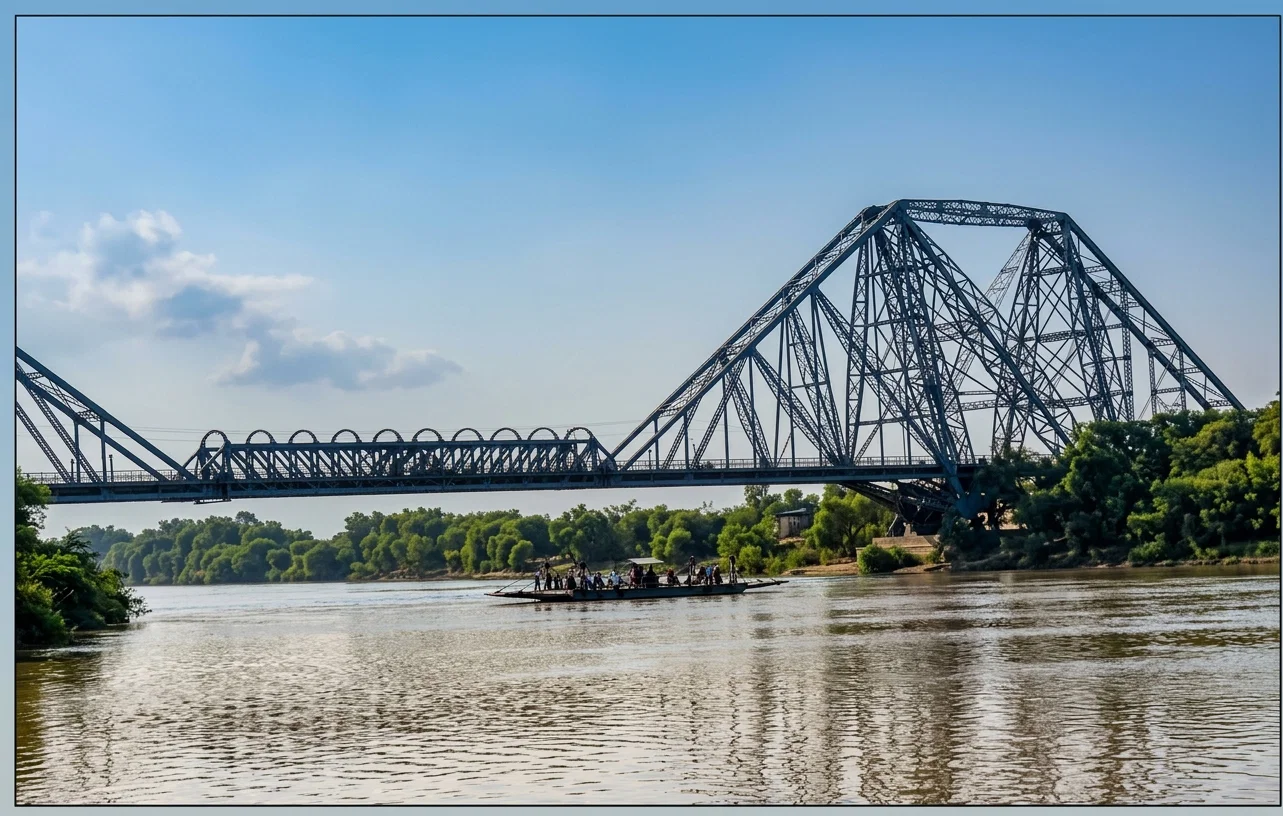
CANTILEVER BRIDGE OVER INDUS RIVER
As far as we can ascertain, it was Dr. Alexander Duff who first suggested the foundation of a mission to the Santals in connection with the Free Church of Scotland. The modern reader of that great pioneer missionary’s biography is as much impressed with his physical as with his mental energy; his eager activity seems to have been as boundless as his enthusiasm. Instead of seeking rest at the hills from the fatigue and monotony of his educational work, he seems to have spent his vacations in making long and toilsome expeditions, often in the height of the hot season, in the search of fuller and direct information about new openings for missionary effort. Among other distant parts of India which he visited, at a time when travel was much more tedious and toilsome than it is now, were Tinnevelli, where the results of the Church Missionary Society’s work among the Shanars deeply impressed him, and Burma, where he was equally interested in the success which had attended the labors of the American Baptists among the Karens.
Early in the sixties the following reference by Dr. Duff, to the region we are now concerned with, appeared in the Missionary Record:—
“Most of the cold season of 1861-62 I spent among the Koles in Chota Nagpur, accompanying the Chief Commissioner, Colonel Dalton, in his rounds through the district. Part of the cold season of 1862-63 was among the Santals in the hill region between Chota Nagpur and Rajmahal, on the Ganges, making inquiries with a specific view toward the ultimate establishment of a mission among them. Several members of the Free Church in Calcutta were willing liberally to support such a mission.”
Simultala, E. I. R., India.