In the Mountains of Java

6%

Review and Herald Publishing Association · Tacoma Park Station, Washington, D. C. · Feb 20, 1908

FromReview and Herald, Vol. 85, No. 8.

Read the full edition

In the Mountains of Java

G. E. TEASDALE
The last issue of the REVIEW contained an account of the unsanitary conditions of the cities of Java, and the prevalence of fever during the five or six months of the year when there is no rain. We had hoped, by careful living and faithful observance of the laws of hygiene, to escape the disease and maintain the good health we had hitherto enjoyed. However, in this we were destined to be sadly disappointed; in one day three of our family were prostrated with fever, and one, our older boy, now lies in the Sourabaya cemetery awaiting the resurrection call. He was the healthiest and brightest of our family, the flower of our garden; the thought of death had never come to him. We expected he would live until the Lord came, and of us all, he enjoyed living the most. We laid him away, knowing that for him the time of waiting was over. Our comfort is in Him who has power over death and the grave; for he says, “And this is the Father’s will which hath sent me, that of all which he hath given me I should lose nothing, but should raise it up again at the last day.” There is a void in our hearts and a vacancy in our home which render the pleasures of life insipid, but which make us look with a greater longing for that grand day when the Lord will come; the dead will be raised, and with the living righteous receive the gift of immortality.

Native Modes of Travel

Following the death of our child the remaining members of our family contracted the fever, and narrowly escaped the grave; but by the grace of God our lives were spared, and a kind friend, hearing of our distress, offered to us the use of his mountain home, where we could go for a few weeks to regain our health and energies. Monday morning early saw us on the express-train bound for Probolinggo, a town some fifty miles distant, and reached in two and one-half hours’ time. The service is better than one would expect in a country where the great mass of the inhabitants are non-travelers and but small producers. The politeness of the officials and the general kindness manifest on every hand tend to moderate considerably the hardships of travel. The train steamed into a neat railway station a few minutes before ten, and we transferred ourselves and baggage for the next stage of the journey toward the mountains, into two small vehicles called dokars, each drawn by two diminutive ponies. The first few miles’ drive took us through a level and exceedingly fertile country, then the road began gradually to rise, and we traveled upward until it became so steep
that the ponies could take us no farther. On one part of this journey we experienced an illusion which is difficult to explain. For about half a mile it seemed as if the incline of the road had changed, and we were going down instead of up. The ponies moved easily along, and at what seemed to be the bottom of the road there was a bridge, on the other side of which the road began to rise. But to our great surprise, on one side of the road there was a stream running swiftly in the opposite direction, which demonstrated to us, in opposition to our senses, that we were indeed all the time going up a steep hill instead of down. Some of our company, and others who have remarked about the illusion, still maintain that the stream flows up. Our six senses are not always to be relied upon to interpret rightly the phenomena of nature.
A twelve-mile ride in the dokars brought us to the end of the second stage of the journey. Awaiting us here was another carriage, to which were attached two bulls and two cows. In this we journeyed six miles more up very steep hills until we arrived at Sockapoera, which is to be our home for the next six weeks. The house is a typical old East Indian home. The main room is T-shaped, the top stroke being the whole front of the house, measuring about sixty feet by ten, and the stem flanked by three bedrooms on each side, is twenty feet by thirty-six. The front of the house is all glass windows, which open out to a beautiful tropical flower garden that loses itself in the distance among the trees. At the foot of the mountain are miles of flat country which stretch away to the sea just discernible in the distant haze. The whole panorama looks like an immense park partially gone back to a state of nature. The roads are well made and shaded by magnificent tropical trees, and on either side are hedges studded liberally with large red flowers. The fragrance of the trees and blossoms recalls one’s youthful dreams of enchanted lands, and makes one think of a still better country which shall blossom as the rose. Among the trees are the native homes and plantations. The houses are neatly made of split bamboo, and some of them are quite comfortably furnished.

A Densely Populated Country

Native life in the mountains is a decided improvement to that on the plains and in the cities. The natives are everywhere; the country abounds with them; on the most lonely mountain path, and in the hidden recesses of the valleys one meets them every few minutes. How they manage to obtain a livelihood is a wonder to one unacquainted with their ways. They are most respectful to a
white man, crouching on the roadside or dismounting from the ponies while he passes by. If they are called upon to approach him in his home or office, they do it in a stooping position, and kneel at his feet, often with hands together as in the position of prayer, especially if the white man be an official. One often wonders what is passing in their minds as their lordly master—fled to the mountain for his health—laboriously toils up a hill in the cool of the early morning with the vain hope of reducing the cumbersome proportions which afflict him, proportions which have come as the result of indulgence in the victuals won from the soil by the sweat of his brother’s brow. They may remember the benefits which Western civilization and good government have brought to them; but most probably they have forgotten them long ago, and dark, indistinct thoughts come as to why one
man, whose skin is white, can take to himself a portion which is equal to that upon which three hundred of the owners of the soil have to exist. After gazing abstractly for a moment or two at the liberal girth of the slowly retreating form, he fastens his sarong a little tighter around his own meager waist, applies his shoulder to the creaking bamboo, so upon the end of which hangs the weekly product of his garden, and trots along with it, maybe many miles, to the nearest market, where it is disposed of at a price which would scarcely keep the cigar case of the white man supplied for a single day. To many Europeans no doubt this obsequious deference is quite satisfying; but to me it is humiliating, and begets within me a feeling of smallness. I suppose I am not one of those “in whose breast beats the heart of a king.”

The Occupation of the People

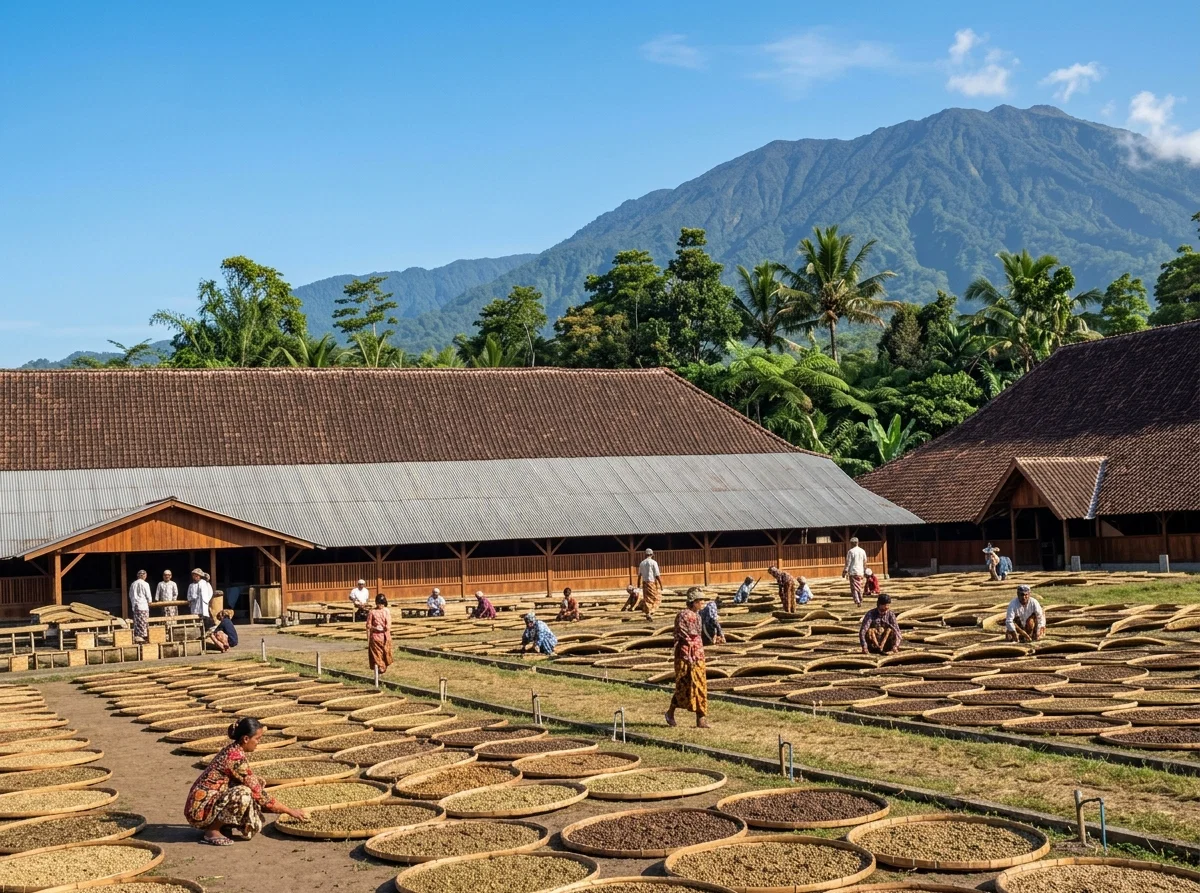
Many of the natives living on these mountains possess fine, rosy complexions, and all are stalwart and well proportioned. Vegetable growing is one of the chief means of obtaining a living, and there are also some coffee plantations owned by the different villages. Beautiful roses bloom here, and also at certain seasons of the year strawberries and other temperate-zone fruits are obtainable. Water for the gardens and for household use is obtained from some spring on the mountainside, and conveyed to the villages and gardens in bamboo chutes. What the cocoanut palm is to the South Sea islander, the bamboo is to the East Indian. Its uses are legion, and it enters into almost every department of life. If the husbandman requires a new yoke for his oxen, water-pipe for irrigation purposes, fence for his garden, his eye looks for a suitable bamboo; or if the housewife wants a new water pail, chair, utensil in which to cook the rice, and many other household necessities, she also has recourse to the bamboo.
COFFEE DRYING IN JAVA
The mountain on which we are living is about eight thousand feet high, and Sockapoera is nearly half-way up. During the day the sun is quite warm, but the nights are delightfully cool, making one or two blankets on the bed a necessity. The mountain is addicted to the almost universal habit of smoking, but so long as it is content with that, we do not mind. Even though it broke forth in fury occasionally, and killed its thousands, it would be comparatively harmless when measured with the fumes of the deadly nicotin, the smoke of which arises forever and ever from the mouths of its hapless victims. A few miles to the back of us are several active volcanoes [One of these was given upon the first-page cover of the REVIEW last week.—ED.], and Bromo, one of the most noted in Java, is said to present a magnificent spectacle at certain periods. It is our intention to visit this mountain in the near future if circumstances are favorable, and I shall be pleased to write an account of our trip.
Sockapoera, Java.